



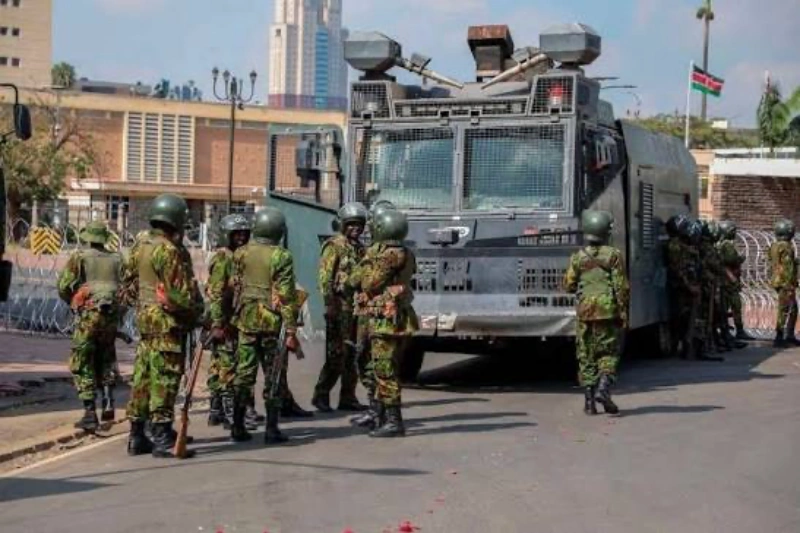

Dar es Salaam is under heavy guard this week. Soldiers and police have taken up positions across Tanzania’s commercial capital ahead of the planned Tanzania Saba Saba protests scheduled for 7 July.
The build up follows an indefinite ban on political rallies. Internal Affairs Minister Patrobas Katambi announced the restriction, citing security concerns, according to Omanghana. Officials have not said how long the ban will remain in force.
The Tanzania Saba Saba protests take their name from the 7 July holiday, which usually marks the founding of the party that led the country to independence in 1964, as Citizen Digital reports. This year, youth activists have repurposed the date to demand democratic reform.
Checkpoints have gone up in Kimara, Ubungo, Magomeni, Kinondoni and Tandale, the Dar es Salaam districts hit hardest by last October’s election violence, with similar deployments extending to Arusha, Mwanza and Mbeya, according to reporting compiled around the Tanzania Saba Saba protests. Riot police carrying weapons have been visible across the city, and one officer told AFP, as carried by Citizen Digital, that the exercise was routine.
Not everyone is convinced. A Dar es Salaam resident named Nasibu, quoted by Citizen Digital, said the scale of the deployment suggested the demonstrations would not be allowed to go ahead at all.
The Tanzania People’s Defence Force issued a warning of its own on 4 July. In a statement from the Director of Information and Public Relations, Lieutenant Colonel Sylvester Mangure, the army said it would act against anyone involved in “acts of violence and disruption of peace,” as reported by The Chanzo.
The army also urged citizens to report suspected unrest to local leaders. The warning comes as preparations for the Tanzania Saba Saba protests continue across Dar es Salaam and other major cities.
Dar es Salaam’s regional commissioner, Albert Chalamila, struck a similarly firm tone last week, warning that any past use of force to keep the peace was merely a preview of what could follow, Citizen Digital reported.
The tension traces back to October 2025, when Tanzania held a presidential election that has remained deeply contested. President Samia Suluhu Hassan was declared winner with close to 98 per cent of the vote, after leading opposition figures were barred from standing or withdrew from the race, Africanews reported.
A government-appointed commission later found that at least 518 people died in the unrest that followed the vote. Opposition parties and human rights groups dispute that figure, arguing the true toll runs into the thousands, according to Africanews.
Chadema leader Tundu Lissu remains in custody on treason charges linked to his calls for electoral reform, a case that continues to draw criticism from rights organisations, Africanews noted.
The Tanzania Saba Saba protests are also set to overlap with the Dar es Salaam International Trade Fair, one of the country’s largest annual commercial events. Omanghana reported that businesses and exhibitors are concerned the overlap could disrupt trade during a period already marked by uncertainty.
Prime Minister Mwigulu Nchemba has used recent public rallies to allege that young people were being paid to mobilise protesters, telling a gathering in Serengeti on 1 July that one suspect admitted receiving payments to recruit others, The Chanzo reported. It remains unclear whether anyone named in these claims has been formally charged.
For now, Dar es Salaam remains tense but calm. Whether the Tanzania Saba Saba protests proceed on 7 July, or whether fear and the scale of the security presence keep people off the streets, will not only shape how the country’s political crisis develops but also the civic space in the days ahead.


