



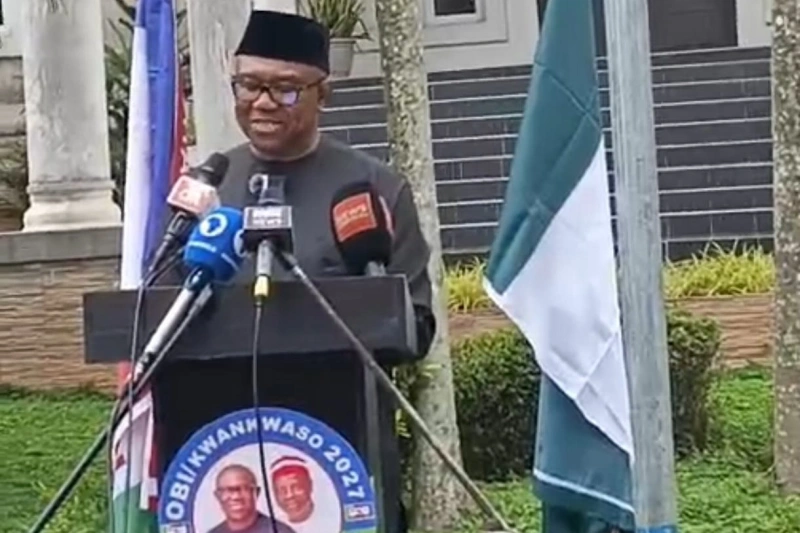

Obi flagged off his 2027 presidential campaign on Thursday with a direct warning that Nigeria “can work” only if leadership shifts from consumption to production. He laid out an economic and security agenda built on discipline and regional productivity.
The Nigeria Democratic Congress candidate addressed journalists to mark the official commencement of campaigning for the January 2027 presidential and National Assembly elections. The campaign period began on Wednesday and runs for 150 days, under Section 98 of the 2026 Electoral Act.
Obi opened with a stark assessment of the country he hopes to lead. He cited International Monetary Fund figures showing that 63 per cent of Nigerians, more than 140 million people, live at or below the national poverty line. Humanitarian agencies expect 35 million people to require food assistance during the 2026 lean season, while roughly 3.6 million remain internally displaced by conflict and insecurity.
He argued that Nigeria’s problems are not a shortage of resources but a failure to convert existing strengths, including its people, market and enterprise, into productivity and shared prosperity.
The former Anambra State governor pointed to his own record in office, citing investment in education, healthcare, infrastructure and fiscal discipline during his tenure. He was careful to frame it as an experience for voters to weigh rather than a flawless template.
His running mate, Senator Rabiu Kwankwaso, brings a separate governing record from Kano State, where his administration concentrated on education, technical training and scholarships. Obi described the pairing as two different paths reaching the same conclusion, that Nigeria must invest in its people and manage public funds with discipline.
On the economy, Obi promised to raise agricultural productivity through securing farming communities, expanding irrigation and improving rural roads, while linking farmers to finance and markets. He said manufacturing and agro processing would be strengthened so Nigeria exports more finished goods rather than raw materials.
He was blunt about the yardstick he wants voters to apply. Are Nigerians better off than four years ago? Can they afford food, education and healthcare? Can businesses hire and expand?
Security featured as what Obi called the foundation for any economic plan. He proposed better intelligence coordination among security agencies, stronger policing and border management, and decentralised security management paired with coordination across government levels. He linked insecurity directly to lost productivity, noting that farmers cannot reach fields, children cannot attend school and businesses cannot move goods when safety is absent.
Obi rejected the framing of Nigeria’s young population as a burden, calling it an asset that requires preparation through stronger basic education, universities and technical and vocational training.
On health, he cited Nigeria’s primary healthcare system as among the weakest globally, with infant and maternal mortality rates he described as deeply concerning. He pledged expanded access to essential medicines and stronger support for healthcare workers.
The address included a region by region breakdown of priorities. These ranged from agriculture and manufacturing in the north west to maritime services and environmental protection in the south south. The Federal Capital Territory was singled out as a test case for urban planning and public services.
Citing the World Bank’s April 2026 Nigeria Development Update, Obi said reform on its own is not the goal. He argued that stabilisation must translate into stronger human capital and inclusive growth. He committed to cutting wasteful spending while protecting investment in education, security and infrastructure.
Obi issued a pointed challenge to rival candidates, insisting that no one seeking the presidency should hide behind aides and surrogates instead of facing voters directly. He said he and Kwankwaso would travel the country themselves rather than delegate that duty, and argued that any candidate unwilling to do so lacks the capacity to govern.
He closed by urging Nigerians to debate ideas without hatred, compete without violence and reject campaigns built on ethnicity, religion or propaganda. He described competence, compassion, capacity, character and commitment as the standard he wants applied to every contender.


