



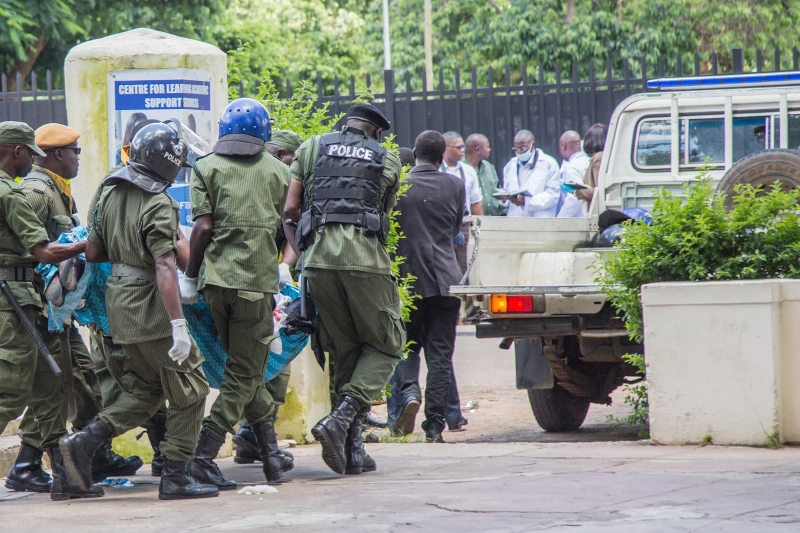

Zambia’s post-election crackdown has widened this week after police confirmed the death of a former cabinet minister and the United Nations raised concern over the arrest of opposition figures, deepening a crisis that has followed last week’s disputed vote.
Former Transport Minister and opposition MP Mutotwe Kafwaya, 49, was fatally wounded when a joint security team stormed a property in Lusaka’s Kabulonga area. The property is linked to opposition leader Brian Mundubile. The raid took place on the night of 14 August, hours after Zambians went to the polls, and marked the opening chapter of Zambia’s post-election crackdown.
Police said officers were met with gunfire when they arrived at the house and returned fire, wounding an unidentified man who later died in hospital. Eleven people were arrested, and authorities accused Mundubile’s party of storing high-grade weapons and posing a threat to national security.
Kafwaya’s family did not learn of his death for several days. His wife had asked the Lusaka High Court to order officials to explain his whereabouts before police eventually confirmed his identity this week.
Mundubile has rejected the government’s version of events as fabricated. He says his colleague was shot in front of him and that those at the house were unarmed. The opposition leader, who says he is now under protection, has called for an independent and transparent investigation into the killing.
Zambia’s post-election crackdown drew a rare rebuke from the United Nations on Wednesday. High Commissioner for Human Rights Volker Türk urged authorities to stop arresting people arbitrarily and to bring anyone held to court promptly. All arrests, he said in a statement, must be fully consistent with international human rights standards as well as Zambian domestic law.
The Electoral Commission of Zambia declared President Hakainde Hichilema the winner of a second term on Tuesday. He took about sixty per cent of the vote, against roughly thirty eight per cent for Mundubile. Vote counting had been suspended for hours after the poll amid reports of violence against officials and ballot theft at some stations, an early sign of the turmoil that has come to define Zambia’s post-election crackdown.
Mundubile now intends to challenge that outcome. He says his campaign has gathered evidence of serious irregularities in how votes were conducted, tallied and transmitted. He plans to petition Zambia’s Constitutional Court within the seven day window allowed under the country’s laws.
A challenge, if filed, would delay Hichilema’s swearing in and could force a fresh election should the result be overturned. An election observer mission from the European Union has already flagged transparency concerns, noting that some polling staff failed to record results on tally sheets as required.
Zambia’s post-election crackdown comes as an unwelcome test for a country long regarded as one of southern Africa’s steadier democracies since it returned to multiparty rule in 1991. Kafwaya had served as MP for Lunte since 2016. He held two cabinet posts under former President Edgar Lungu before losing his government seat when Hichilema first won power in 2021.
The government has not disclosed where the eleven detained officials are being held or what charges they face. Family members of at least one detainee, an Anglican bishop, say they had gone two days without contact before Türk’s statement was issued.
For now, Zambia’s post-election crackdown leaves the country in an unusual standoff. Hichilema has been certified the winner by a wide margin. Yet the man he defeated is refusing to concede. He is preparing to fight the result through the courts while sheltering from what he describes as ongoing threats, according to Reuters reporting on the unfolding dispute.


