



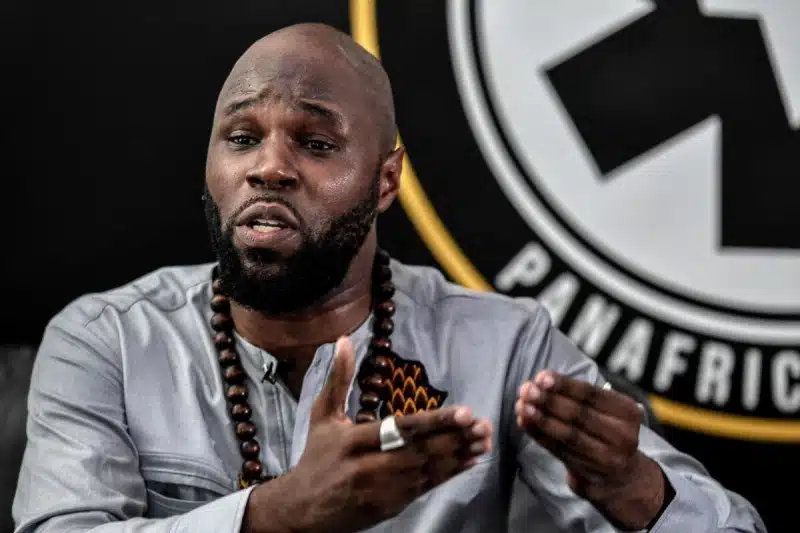

A pan-African activist wanted by his home country over an alleged coup attempt has been caught in a sting operation in South Africa’s capital, setting off a legal and diplomatic battle that reaches from Pretoria to Niamey.
Now, with Kemi Seba arrested in South Africa, the case has escalated into a high-stakes legal confrontation involving asylum claims, extradition pressure, and geopolitical tensions across West and Southern Africa.
Caught at a Shopping Mall
South African police arrested Kemi Seba in a sting operation at a shopping centre in Pretoria alongside his 18-year-old son. A third man was also taken into custody.
The South African national who was arrested alongside the pair had allegedly been paid about 250,000 rand, equivalent to roughly $15,000 or £11,000, to help them cross the Limpopo River into Zimbabwe, from where the group reportedly intended to travel on to Europe.
Seba, whose real name is Stellio Gilles Robert Capo Chichi, heads the NGO Pan-Africanist Emergency and is known for his attacks on France and African governments aligned with Paris.
The arrest, on 14 April 2026, came after months during which the 45-year-old had largely stayed off social media and out of public view.
What Benin Wants Him For
Benin issued an international warrant for Seba’s arrest on 12 December after he supported a foiled coup, as reported by France 24. Mutinous soldiers claimed on television to have overthrown President Patrice Talon. Seba posted a video declaring it was “the day of liberation” for his country. The warrant was issued for “justifying crimes against state security and inciting rebellion.”
In the video, he described the soldiers involved in the attempted overthrow as “patriotic.”
The coup attempt was suppressed within hours, with assistance from Nigeria and France.
The Charges in South Africa
With Kemi Seba arrested in South Africa, police moved swiftly. Seba and his son were charged with conspiracy to commit a crime and immigration violations for allegedly planning illegal migration to Europe via Zimbabwe. The trio appeared at the Brooklyn magistrates’ court, where the case was rescheduled until 20 April.
Preliminary investigations showed that Seba was “alleged to be a wanted fugitive in France and Benin for criminal activities relating to crimes against the state,” South African police said.
Seba, who has mostly been underground and much less on social media since the failed coup, could not be reached for comment.
A Diplomatic Passport From Niger
The circumstances surrounding Kemi Seba’s arrest in South Africa carry wider geopolitical weight.
Seba was stripped of his French citizenship in 2024 and was granted a Niger diplomatic passport designating him a special adviser to junta leader Abdourahamane Tchiani.
Tchiani leads Niger’s military government after the Sahel state expelled French and other Western forces and deepened security ties with Russia.
That combination, a formal advisory role with a coup-installed government and travel on a diplomatic passport that France no longer recognises as legitimate, has made Seba one of the more watched figures in the ongoing realignment of West Africa’s political allegiances.
Kemi Seba Arrested in South Africa Matters Arising
The fact that Kemi Seba arrested in South Africa places Pretoria at the centre of a sensitive continental dilemma.
South Africa has a long tradition as a place of refuge for political exiles, dating to the anti-apartheid era. At the same time, it must respond to formal extradition requests from fellow African states.
Benin has already begun moves to secure his return, sending signals that this case will test not just legal frameworks but diplomatic relationships.
Supporters Call It Political Persecution
Not everyone accepts the official framing of the case.
Sayia Moudongo, from a diaspora association in Paris, told the BBC that the arrest was “an attempt to scare a prominent pan-African voice,” adding: “We will fight this until Mr Seba would be released.”
Seba has built a following of 1.5 million on social media Africanews through years of campaigning against French economic influence in Africa, particularly the CFA franc system that ties several West African currencies to France.
Benin Moves to Secure His Return
An official in the Benin presidency told AFP the country was organising for a delegation to travel to South Africa “to handle the formalities” for his return.
Sources suggest Seba would prefer to be sent to Niger rather than Benin. Africanews That preference is unlikely to carry legal weight, however, as South African courts will follow the extradition process triggered by Benin’s international arrest warrant rather than any preference expressed by Seba or his legal team.
South Africa Now Holds the Key
The fact of Kemi Seba arrested in South Africa now places Pretoria at the centre of a question that goes well beyond one man’s legal troubles.
Seba had been briefly arrested in 2019 and again in 2023 during visits to Benin. He was detained by French police in 2024 on suspicion of “links” with the Russian paramilitary group Wagner, but was later released. France 24
How South African courts and government handle this case will be closely watched across the continent, particularly in countries where anti-Western movements draw inspiration from the same networks Seba has publicly championed.
What Comes Next
The bail hearing is scheduled for 29 April 2026. Until then, Seba remains in custody in South Africa, caught between a country that wants him extradited, a junta in Niger that issued him a passport, and a growing base of supporters who see his imprisonment as proof of the very political persecution he has spent two decades writing and speaking about.
The outcome of the Kemi Seba arrested in South Africa case will determine not only his personal fate, but also set a precedent for how African states balance political dissent, security concerns, and extradition in an increasingly polarised geopolitical landscape.


