



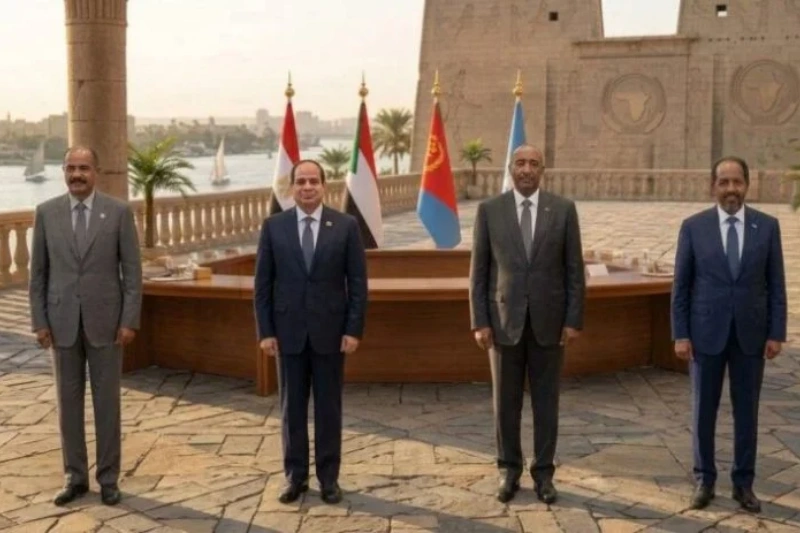

The Alamein summit brought four regional leaders together on Egypt’s Mediterranean coast on Sunday and produced a declaration that never names Ethiopia.
Yet it reads like a reply to Addis Ababa, point by point.
The talks brought Egypt’s Abdel Fattah El-Sisi together with Eritrea’s Isaias Afwerki, Somalia’s Hassan Sheikh Mohamud and Sudan’s army chief, General Abdel Fattah al-Burhan. They met in New Alamein on 4 October 2026, on the sidelines of the African Union’s mid-year coordination meeting.
Cairo called it a consultative gathering. Former Egyptian assistant foreign minister Hussein Haridy told Arab News that “this is not a summit directed against any third party”. The Alamein summit, he added, had no formal agenda.
Read the text, though, and the targets are easy to spot.
On the Red Sea, the leaders said governance should stay with the countries that border it. They also pledged to protect freedom of navigation in the Gulf of Aden and the Bab-el-Mandeb strait. Ethiopia is landlocked and has spent years pressing for sovereign sea access.
On the Nile, they rejected any unilateral step that harms the existing water use of Egypt and Sudan, the two downstream states. They called for prior notification, consultation and consensus. Ethiopia’s Grand Ethiopian Renaissance Dam is the obvious backdrop. Addis Ababa says the dam is vital for its development and electricity, and that it does not intend to harm anyone downstream.
On Somalia, the four refused any recognition of Somaliland. For Mogadishu, the Alamein summit was a chance to hear that again from three allies. Somalia has opposed Ethiopia’s sea-access deal with the breakaway region since it was signed on 1 January 2024.
The leaders also urged partners to give the African Union mission in Somalia, AUSSOM, adequate and predictable funding so security duties can pass to Somali forces.
On Sudan, they rejected parallel entities and any support for mercenaries. Sudan’s army has accused Ethiopia of aiding the Rapid Support Forces, according to The National.
Sudan’s former foreign minister, Ambassador Ali Youssef, has described the gathering as extremely important because all four states have disputes or tensions with Ethiopia.
The timing of the Alamein summit tells its own story. Heavy fighting has gripped Tigray since late September. On 1 October, Ethiopia closed its embassy in Asmara and expelled 10 Eritrean diplomats. Eritrea cut diplomatic ties in response. Egypt and Ethiopia then traded expulsions of one diplomat each.
Ethiopia accuses Egypt, Eritrea and Sudan of backing the Tigray-led armed alliance. All three deny it. Egyptian diplomat Rakha Ahmed Hassan, called the claim baseless and unsupported by evidence.
On the same day as the Alamein summit, federal forces retook Mekelle after the TPLF said it had temporarily moved out of the Tigray capital. Eritrea’s information minister, Yemane Gebremeskel, said Addis Ababa was building a pretext to attack his country.
So what did the Alamein summit actually create? Not an army. A framework for regular coordination.
They agreed on a follow-up mechanism and said the Alamein summit would be held periodically and whenever circumstances require. That is the real news. In October 2024, only Egypt, Eritrea and Somalia met in Asmara, and they set up a foreign ministers’ committee. Now Sudan is in the room and the meeting has a standing structure.
Egyptian presidency spokesman Mohamed El-Shenawy said El-Sisi used the Alamein summit to warn against foreign interventions that prolong conflicts. Attempts to undermine state unity, the president argued, break international law, the UN Charter and the African Union’s Constitutive Act.
Sources had told The National to expect wider military cooperation from the Alamein summit. The published text speaks of coordinating regional security, not deploying troops. But the footprint is already there. According to estimates cited by The National, Egypt has about 15,000 military personnel in Somalia and holds naval and army sites in Eritrea.
The contrast is hard to miss. In his opening speech, El-Sisi called for “co-operation, not competition; dialogue not confrontation”. Meanwhile Egyptian forces are already stationed on the soil of two of his guests.
There is a door left ajar. Mohamud said on Saturday that Somalia does not object to Ethiopia using Somali ports for commerce, provided the terms are agreed with Mogadishu.
At the time of writing, we had found no formal response from Addis Ababa to the Alamein summit. When it comes, it will matter. Addis Ababa has accused three of the four of backing an alliance whose fighters have just left Mekelle.
The declaration avoided the name. The map does not: four countries, one unbroken Red Sea coast, and a landlocked neighbour looking in.


