



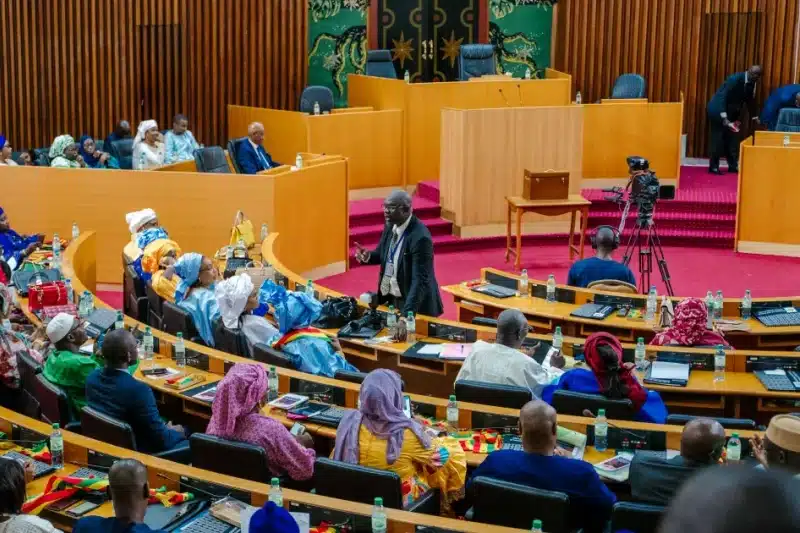

Senegal special funds are at the centre of a widening rift between the government and parliament. Lawmakers are pushing through a bill to bring the country’s secretive state spending under legal control for the first time.
The National Assembly in Dakar opened an extraordinary session on 10 August 2026. Deputies must examine five legislative texts within a fortnight. Two of them deal directly with Senegal special funds, also known locally as crédits spéciaux or “caisses noires”. Both were tabled by MPs from the ruling Pastef party under emergency procedure.
The lead bill, proposition de loi n°34/2026, was sponsored by deputies Guy Marius Sagna, Mame Diarra Bèye and Alphonse Mané Sambou. It seeks to give Senegal special funds a defined legal regime. Their use would be restricted to national defence, internal and external security, and intelligence operations. A parliamentary committee adopted the text by majority vote. It now goes to a plenary sitting on 19 August.
Under the proposal, the prime minister and relevant ministers would manage Senegal special funds. The president would no longer hold that role directly. The bill also creates a form of delayed parliamentary oversight. A committee bound by secrecy rules would review spending under the scheme without exposing sensitive operations.
The reform has exposed a split between the Pastef-led parliamentary majority and the executive it nominally supports. On 14 August, Justice Minister Moussa Sarr filed a government amendment. It sought to narrow the bill’s scope to funds allocated to the presidency, the National Assembly and the office of the prime minister. The amendment also proposed shifting implementation rules to executive regulation rather than statute. Committee members rejected it, keeping the broader parliamentary version intact ahead of the plenary vote.
President Bassirou Diomaye Faye campaigned in 2024 on a promise to scrap unaccountable political funds. He pledged to replace them with a properly regulated system for Senegal special funds. He has said he found the presidency’s political coffers empty when he took office that April.
Yet the presidency’s own 2026 budget stands at roughly 204.5 billion CFA francs. Former prime minister Ousmane Sonko has separately disclosed that he had access to 1.77 billion CFA francs in political funds during his time at the Primature.
Sonko now chairs the National Assembly after leaving the premiership. He has become an unlikely champion of the reform he once managed without oversight. Addressing MPs, he argued that no public money should escape scrutiny. That stance has put him at odds with the presidency he helped install.
Faye, for his part, has defended keeping Senegal special funds in place. He points to their role in intelligence work and emergency solidarity payments. Scrapping them entirely, he has warned, would leave the state unable to respond to sensitive, unforeseen demands.
The debate sits within a wider transparency push moving through Senegal’s institutions this year. The Assembly’s bureau also approved a separate bill amending Article 37 of the constitution. That measure would tighten rules on the president’s asset declaration.
Lawmakers have set up several parliamentary inquiry committees. One is examining alleged irregularities in the rollout of the “Un étudiant, un ordinateur” laptop scheme run by the higher education ministry.
Senegal’s anti-corruption body, the Office National de Lutte contre la Fraude et la Corruption, began publishing compliance lists on 10 August. The lists name officials who have and have not filed asset declarations. It marks a shift from a largely confidential system towards public compliance tracking. The contents of individual declarations remain undisclosed.
The push for transparency follows a difficult period for Senegal’s public finances. A Court of Auditors report that was published in February 2025 found that budget deficits and public debt had been significantly underreported between 2019 and 2023.
The International Monetary Fund later confirmed the finding after its own review. That episode left successive governments under pressure to show that public money is properly accounted for, including Senegal special funds, which have historically been shielded from scrutiny.
Not everyone in Dakar agrees that full disclosure is the right approach. Some commentators argue the arrangement serves a legitimate purpose precisely because it sits outside normal reporting lines. Occasional abuse of the system, they say, should not be used to dismantle it altogether. That argument is likely to resurface when deputies return to the chamber on 19 August. The government’s narrower version of the bill faces defeat unless it can rally enough support before the session closes.
For now, the outcome will determine how much of Senegal’s discretionary state spending stays behind closed doors. It will also show how far Faye’s administration is willing to open its Senegal special funds to parliamentary eyes, and whether the reform survives the standoff with the government largely intact.


