



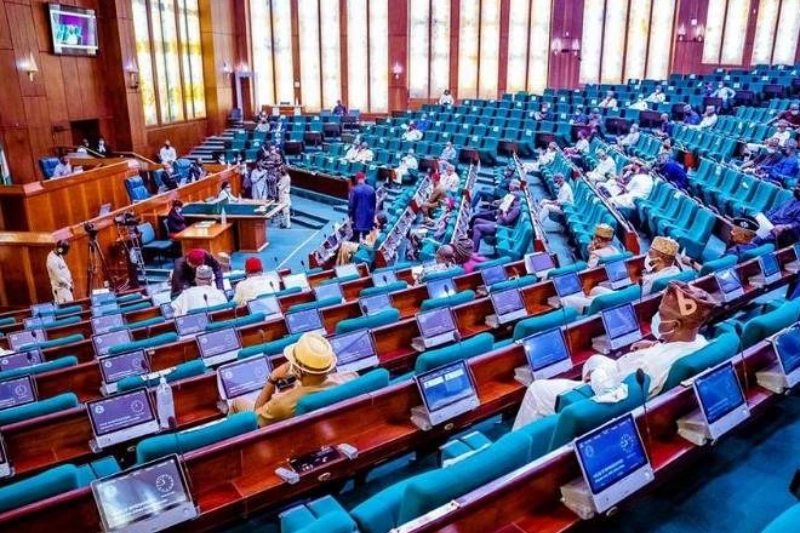

The House of Representatives was thrown into disorder on Wednesday after lawmakers clashed over a fresh push to summon President Tinubu to explain persistent delays in implementing the 2025 Appropriation Act, Daily Trust reports.
The disagreement began during plenary when Benedict Etanabene, who represents a Federal Constituency in Delta State, raised a point of privilege over a circular issued by the Accountant-General of the Federation, Shamseldeen Ogunjimi.
Etanabene drew the House’s attention to a directive dated 29 June that instructs all federal ministries, departments and agencies to stop processing payments for constituency and zonal intervention projects unless those projects have first been vetted by the Federal Ministry of Special Duties and Intergovernmental Affairs, as detailed in the circular obtained separately by SaharaReporters.
The lawmaker argued that the added layer of clearance was never contemplated in the Appropriation Act and could slow down projects already captured in the 2025 budget. He said the executive owed both Nigerians and the National Assembly a proper account of the delay, and he moved that the House summon President Tinubu to appear personally and explain the rationale behind the circular.
That proposal split the chamber immediately. Some lawmakers backed the call to summon President Tinubu, insisting the executive could no longer sidestep questions over budget implementation. Others pushed back hard, arguing that inviting a sitting president to appear before the House on an administrative circular set a troubling precedent. Members shouted across the floor as the presiding officer struggled to restore order, and proceedings were briefly disrupted before calm returned.
The circular at the centre of the dispute reiterates an earlier directive from the Office of the Secretary to the Government of the Federation, issued in September 2023, governing how zonal intervention and constituency projects are implemented, according to a copy reviewed by Punch. Ogunjimi’s office says the fresh reminder became necessary because compliance with the 2023 guidelines has been inconsistent, undermining accountability and transparency in how the projects are executed.
Under the revised guidelines, the Federal Ministry of Special Duties and Intergovernmental Affairs remains the agency responsible for verifying and certifying constituency projects before implementation. Payment-processing officers across MDAs have been directed to reject any request that lacks the ministry’s Certificate of Verification and Compliance, the circular states.
Constituency projects, formally known as zonal intervention projects, are nominated by federal lawmakers to meet development needs in their districts but are executed by MDAs using appropriated funds. The scheme has long drawn scrutiny from the Auditor-General’s office and civil society groups over abandoned projects, duplication and weak monitoring, which government officials say is precisely why tighter verification was reintroduced.
For lawmakers like Etanabene, though, the frustration runs deeper than one circular. He has previously complained publicly about unpaid constituency project funds stretching back to work completed in December 2024, and Wednesday’s push to summon President Tinubu reflects a wider pattern of tension between the legislature and the executive over budget releases that has simmered for months.
The Presidency has not issued a public response to the renewed call to summon President Tinubu, and it remains unclear whether the House will formally adopt the motion when plenary resumes.
Nigeria’s constitution grants the National Assembly oversight powers under sections 88 and 89, but the question of whether those powers extend to summon President Tinubu or any sitting president to appear in person has never been fully tested in court, with related suit on that very question still pending before the Federal High Court in Abuja.
For now, the Accountant-General’s circular stands, and constituency project payments across the country remain suspended pending verification, leaving lawmakers and contractors alike waiting for clarity from the executive.


