



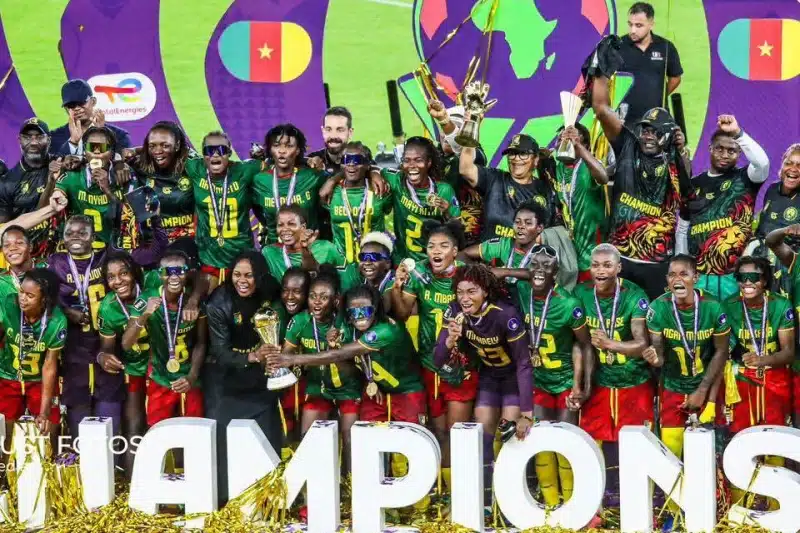

Cameroon have won the Women’s Africa Cup of Nations title for the first time in the tournament’s history. The Indomitable Lionesses beat debutants Malawi 3-0 in Sunday’s final at the Prince Moulay El Hassan Stadium in Rabat, Morocco.
It was a night that had been two decades in the making. Cameroon had reached three previous finals, in 2004, 2014 and 2016, and lost all of them to Nigeria. This time, there was no repeat heartbreak, and Cameroon finally got their hands on the Women’s Africa Cup of Nations title.
The match was effectively settled before half-time. Marie Ngah Manga headed Cameroon into the lead in the 21st minute, converting from close range after Naomi Ndjoah Eto forced a save from Malawi goalkeeper Mercy Sikelo. Eto doubled the advantage soon after, turning smartly to slot the ball home despite having her back to goal. Ngah Manga then completed her brace on the stroke of half-time, sending Cameroon into the break with a commanding 3-0 lead.
Malawi, appearing in their first ever final of the competition, pushed forward throughout the second half but could not find a way back into the contest. Cameroon’s defence, marshalled by Monique Ngock and Achta Toko, held firm and kept the Chawinga sisters, Tabitha and Temwa, largely quiet, as the Associated Press noted the pair had combined for nine goals to power Malawi to the final.
Cameroon’s path to the Women’s Africa Cup of Nations title was far from straightforward, and few would have predicted it after such a shaky start to the campaign. The team initially failed to qualify for the tournament and only earned a place after the Confederation of African Football expanded the competition from twelve to sixteen teams. Once there, Cameroon leaned heavily on Benfica goalkeeper Michaely Bihina, who kept the Indomitable Lionesses in the competition during a group stage in which they managed just four goals in five matches. In the final itself, Bihina barely needed to make a save.
The victory makes Cameroon only the fourth nation to claim the Women’s Africa Cup of Nations title, joining Nigeria, Equatorial Guinea and South Africa in that select group. Nigeria remain the dominant force in the competition with ten titles, but Sunday’s result shows the gap at the top of African women’s football is narrowing. Ngah Manga’s brace also took her tally to five goals for the tournament, level at the top of the scoring chart with Zambia’s Barbra Banda and Malawi’s Temwa Chawinga.
Speaking after the final whistle, Ngah Manga said winning the Women’s Africa Cup of Nations title felt like a dream given how hard Cameroon had worked for the moment, adding that becoming champions of Africa meant a great deal to the squad. Ngock, meanwhile, was named player of the tournament following a series of commanding defensive displays through the knockout rounds.
The final drew a notable crowd of dignitaries. FIFA president Gianni Infantino attended alongside CAF president Patrice Motsepe and Cameroon Football Federation president Samuel Eto’o, who watched the Indomitable Lionesses finally get their hands on continental silverware.
For Malawi, missing out on the Women’s Africa Cup of Nations title was softened by history of their own. According to Equalizer Soccer, the Scorchers became the lowest ranked side, at 153rd in the FIFA standings, ever to reach a Women’s Africa Cup of Nations final, and their run in Morocco secured qualification for the 2027 FIFA Women’s World Cup for the first time.
Cameroon’s triumph brings the curtain down on a Women’s Africa Cup of Nations tournament that ran from late July to mid August across Rabat and Casablanca. For a country that has waited since 2004 to win the Women’s Africa Cup of Nations title, the wait is finally over, and the Indomitable Lionesses now carry the weight of continental champions into the next cycle of African women’s football.
Cameroon’s route to the Women’s Africa Cup of Nations title also carries weight beyond the pitch. The success gives the Cameroon Football Federation a fresh platform to grow the women’s game at home, from grassroots participation to investment in domestic leagues that feed the national team.


