



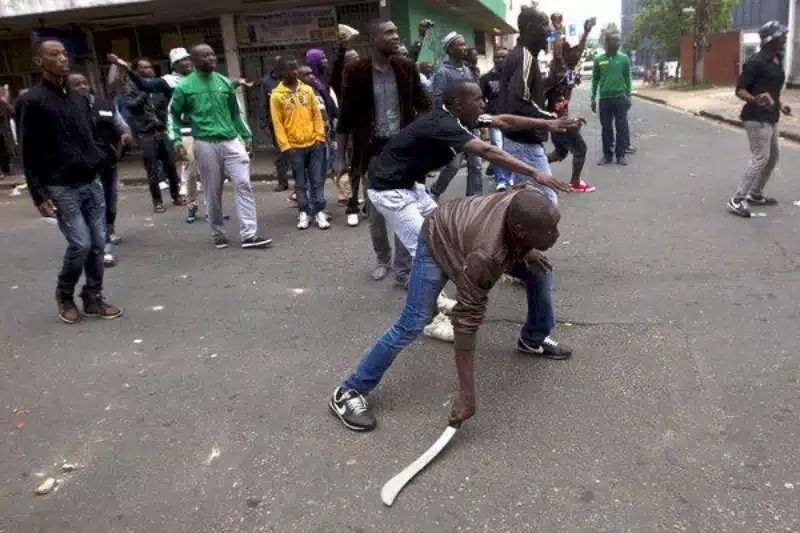

Human rights organisations say what was once sporadic mob anger has hardened into a structured, nationwide campaign of exclusion.
It is this shift, where vigilante violence against migrants in South Africa is no longer episodic but entrenched, that is now testing the limits of the country’s constitutional democracy.
A Movement With a Mission
It calls itself a civic movement. Critics call it something else entirely.
Operation Dudula, whose name translates from Zulu as “force out”, has become the most visible face of vigilante violence against migrants in South Africa. What began as street protests in Johannesburg townships has expanded into what human rights observers now describe as a parallel enforcement structure operating entirely outside the law.
The African Commission on Human and Peoples’ Rights has issued urgent warnings, saying the pattern of vigilante violence against migrants in South Africa has crossed a threshold from isolated incident to organised campaign.
From Protests to Raids
The tactics have moved well beyond marching.
Vigilante groups are now conducting unauthorised home searches, carrying out street-level identity checks, and performing what they describe as “citizen arrests,” actions that often lead to violence. The International Commission of Jurists, which has been monitoring the situation, warns that these actions directly breach Article 3 of the African Charter on Human and Peoples’ Rights, which guarantees equality before the law.
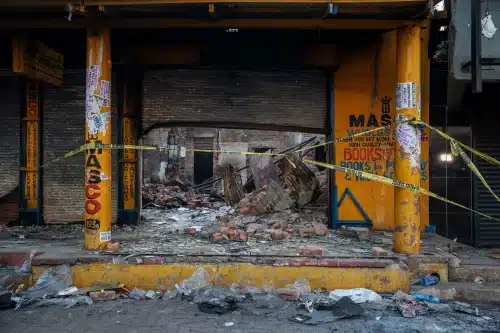
This is no longer mob violence. Rights observers say it is systematic policing by non-state actors.
Hospitals and Schools Under Siege
By late 2025 and into 2026, the reach of vigilante enforcement had extended into spaces that are legally protected.
Migrants, including pregnant women and young children, have been blocked from accessing public hospitals. Informal enforcement has shut migrants out of clinics in townships including Alexandra, on the northern edge of Johannesburg.
The consequences have been deadly. Rights organisations have documented the case of a one-year-old Malawian child who died after being denied medical treatment in Alexandra.
In April 2026, fresh alarm was raised over organised campaigns to prevent foreign-born children from enrolling in public schools and to intimidate school administrators into turning families away. South Africa’s Constitutional Court has previously affirmed, in what is known as the Phakamisa judgment, that every child holds an unqualified right to education regardless of documentation status. Section 29 of the Constitution makes the same guarantee explicit.
The school blockade campaigns are therefore not just morally troubling. They are unlawful.
Why Vigilante Violence Against Migrants in South Africa Is Escalating?
Vigilante violence against migrants in South Africa does not exist in isolation. Rights analysts point to a convergence of pressures that have made it politically and socially useful.
Unemployment remains persistently high. Public services are overstretched. Competition in informal economies is intense. In that environment, the International Commission of Jurists argues, migrant communities become convenient scapegoats for what it describes as systemic governance failures, including austerity measures, corruption, and institutional inefficiency.
Political calculations have sharpened the problem. As electoral pressures mount, some leaders have softened their condemnation of vigilante actions while others have actively echoed community frustrations to consolidate support. Anti-migrant rhetoric has found a useful home in a difficult election season.
Social media platforms have accelerated coordination. Raids are organised online. Misinformation linking migrants to crime spreads rapidly through community groups before any correction is possible.
Impunity Has a Long Memory
Human Rights Watch has pointed to a long-standing failure by South African authorities to prosecute perpetrators of xenophobic violence. Major outbreaks in 2008 and again in 2015 produced few convictions. The message absorbed by vigilante actors, rights groups argue, is that this kind of enforcement carries little consequence.
That culture of impunity is now feeding the current wave of vigilante violence against migrants in South Africa in ways that are measurably more organised than anything seen before.
The Ubuntu Contradiction
South Africa carries a particular moral weight in this story.
The country that gave the world the philosophy of Ubuntu, roughly translated as “I am because you are”, served for decades as a refuge for those fleeing colonial rule and apartheid-era persecution across the continent. That history makes the present moment deeply contradictory.
The African Commission on Human and Peoples’ Rights has flagged what it sees as a growing gap between South Africa’s constitutional values and the lived reality of African migrants on its soil. Diplomatic tensions have mounted with Nigeria, Zimbabwe, and Somalia. Anti-South African sentiment is rising in parts of the continent. The country’s standing as a symbol of African solidarity is under sustained pressure.
What Rights Bodies Are Demanding
The African Commission on Human and Peoples’ Rights and the International Commission of Jurists are calling for action on three fronts.
First, the state must reassert its authority. Vigilante enforcement structures should be criminalised and dismantled. The monopoly on policing must return to the state.
Second, accountability must follow. Perpetrators, as well as individuals who promote or encourage vigilante activity, including through coordinated messaging on social media, must be held accountable under the law.
Third, the structural drivers cannot be ignored. Without serious investment in addressing unemployment, inequality, and service delivery collapse, the conditions that make vigilante violence against migrants in South Africa politically useful will remain in place.
The Larger Warning
Rights organisations are clear that what is at stake goes beyond the migrant communities most immediately at risk.
Normalised vigilantism, they argue, corrodes the rule of law for everyone. When non-state actors conduct house raids, enforce border controls, and block children from classrooms with broad social tolerance and limited legal consequence, the foundations of constitutional democracy weaken.
South Africa built its post-apartheid identity on the principle that rights are universal and not conditional. The spate of rising vigilante violence against migrants in South Africa across its townships in 2026 is, at its core, a test of whether that principle still holds.
This report draws on statements and findings from the African Commission on Human and Peoples’ Rights, the International Commission of Jurists, and Human Rights Watch.
This report draws on statements and findings from the African Commission on Human and Peoples’ Rights, the International Commission of Jurists, and Human Rights Watch.


