



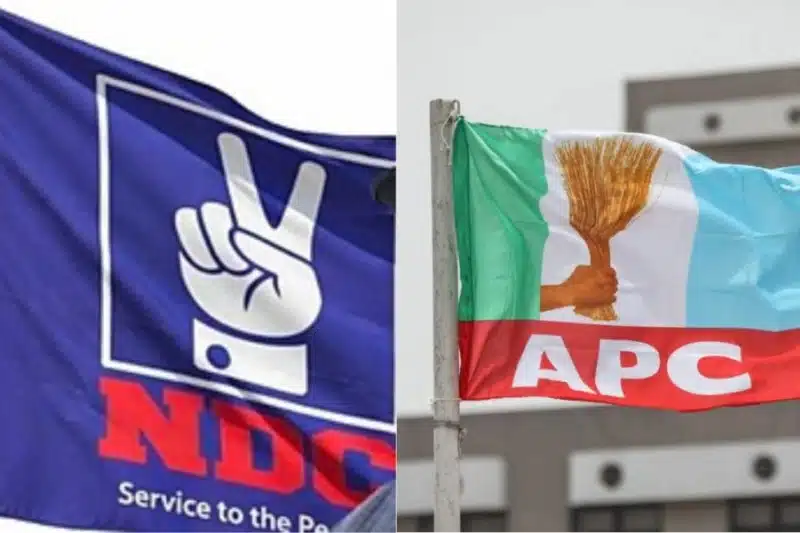

Fifty-nine days before Nigerians choose a president, the row over campaign violence has turned into a blame game.
On Wednesday, the Nigeria Democratic Congress answered Dele Alake, spokesperson for the APC Presidential Campaign Council. A day earlier, Alake had said the NDC and the ADC recruit young men, arm them with cudgels and send them to APC rallies.
NDC deputy spokesperson Dr Sam Omale called that ‘a textbook case of the perpetrator crying victim.’ His party says the APC is exporting President Bola Tinubu’s Lagos pattern of political violence to the whole country.
Both sides now hold a list of campaign violence cases. Neither has shown who paid for what.
Alake built his case on an Abuja mosque. Police say stones and other objects hit the presidential motorcade after Friday prayers, damaging vehicles and injuring some security operatives. The incident happened on 13 November. Alake called it an ‘abhorrent and anti-democratic stunt’ and blamed opposition thugs.
Police arrested 78 people, and Tinubu later ordered them freed. The ADC asks why, if the APC knows who sponsored the stone-throwers. It also notes that the Presidency first denied the motorcade was pelted at all.
The NDC’s own list of campaign violence is longer, and some entries stand up better than others. Take Enugu. Gunmen hit NDC supporters at the airport and then at the party’s state secretariat on 10 October. Premium Times reported that supporter Ifeanyi Nwolie died days later from a gunshot wound. The state government had said no one died.
Oregun, in Lagos, sits awkwardly with the NDC’s case. Police confirmed the attack on the party’s town hall on 12 November. Yet Alake’s own council condemned it and demanded arrests, and the Lagos APC denied any role.
Kano shows how far apart the camps are on the basic facts of campaign violence. Police say eight people were arrested after a clash in Bichi on 15 November that left five injured and 13 vehicles damaged. The state government called the reported attack on NDC running mate Rabiu Kwankwaso’s convoy fictitious, saying there were ‘no pictures, no videos.’
In Benue, Peter Obi says thugs led by an aide to Governor Hyacinth Alia stopped his convoy on 8 September. He was heading to Yelwata, where more than 270 people were killed in 2025. The state government rejects that. Police later paraded suspects.
Two other cases concern words, not weapons. Edo governor Monday Okpebholo told Obi in July 2025 that ‘a new Sheriff is in town’ and that his security could not be guaranteed. He later called it protocol, not a threat.
Senator Francis Fadahunsi was filmed telling APC supporters in Ilesa to ‘kill’ Accord Party members before August’s Osun election. He says he meant defeat them with votes. Police questioned him for more than two hours and a magistrate ordered a probe. No charge has been reported.
The wider numbers on campaign violence cut across party lines. CentreSGD, citing the CLEEN Foundation’s threat assessment, counted 70 physical attacks in 19 states and the capital between January and 27 October. Twenty-seven people died in 20 of them.
The victims were not in one camp. They included NDC supporters in Enugu, APC convoys in Katsina, AAC candidate Omoyele Sowore in Ekiti and the ADC’s Atiku Abubakar in Kebbi. CentreSGD said it was not ruling on blame.
That is the real story. Campaign violence is not one party’s weapon, and it is not one party’s wound. Every camp is hurt, and every camp points elsewhere.
The dispute also extends beyond physical attacks to the conditions under which opposition parties can campaign. The NDC says it is being prevented from putting up posters and billboards or using public facilities for rallies.
The cost of securing outdoor advertising space has also become a contentious issue, with reported billboard charges running into hundreds of millions of naira in several states. Without comparable figures across states, however, the scale and consistency of these restrictions remain difficult to establish. Alake maintains that the APC wants peaceful, free and fair elections.
Obi, the NDC’s presidential candidate, said after Kano that such attacks ‘must not be allowed to become part of our political culture.’ On paper, both parties agree that campaign violence must stop.
The public record, though, shows arrests and denials. It names no sponsor. Yiaga Africa’s September survey found 61 per cent of Nigerians fear violence could stop them voting, and the presidential vote is on 16 January. Campaign violence now has a deadline.
CentreSGD’s warning on campaign violence was blunt: ‘Democracy cannot thrive in an environment governed by fear.’
Press releases fade by the weekend. The grave of Ifeanyi Nwolie in Afa will not.


