



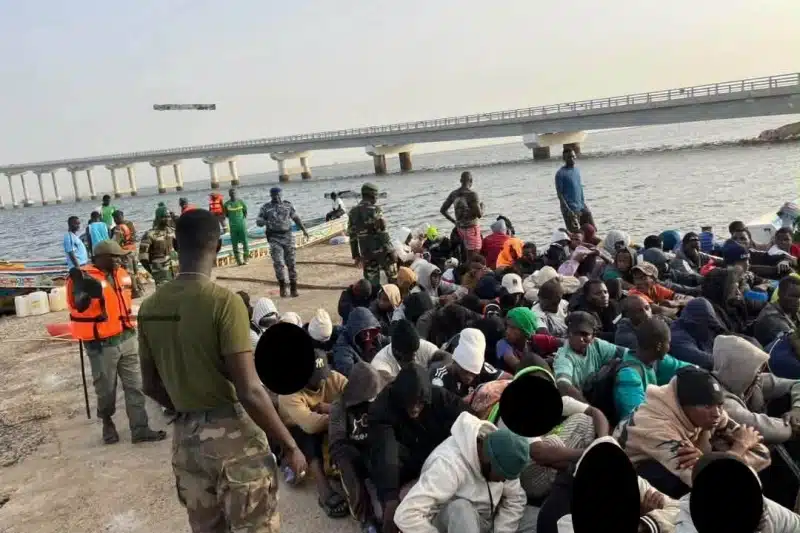

Three days after the Youth Olympic Games closed in Dakar, gendarmes detained 50 people in two coastal towns. Four of them, the gendarmerie says, were smugglers. The other 46 were would-be migrants. The arrests offer another indication of how rapidly irregular migration in Senegal is gathering pace.
A gendarmerie statement said the Foire brigade stopped 16 people at Yoff Ndenatte on 16 November. One was an alleged smuggler. The other 15 were would-be migrants, three of them women, all Senegalese. Officers seized a boat engine, a GPS unit, about a dozen badges and 175,000 CFA francs.
The next day, the Yenne brigade detained 34 people at Toubab Dialaw. The statement counted 31 would-be migrants and three alleged smugglers. Gendarmes took a 40-horsepower engine, a GPS, a compass and food. Investigations continue to establish responsibility and identify the networks involved. The statement did not say whether the 46 would-be migrants face charges.
The timing is the real story. Spain’s government delegate in the Canary Islands, Anselmo Pestana, said on 9 November that Senegal was the big difference in the latest surge. Hardly any boats had come from there in 2025 or for most of 2026. Then the shift in irregular migration in Senegal showed up in Spain’s figures.
The Associated Press reported that more than 11,000 migrants reached the Canary Islands in the first half of November, most from Senegal, Mali, Gambia and Guinea. In all of 2025, the International Organization for Migration (IOM) counted 17,788 arrivals.
Spain’s Maritime Rescue Service rescued 1,488 people aboard 14 boats on 14 November alone, a record for the route since 2020. Most of those rescued were from Senegal, Gambia and Guinea.
Activists say the Games gave irregular migration in Senegal an opening. El País reported that around 10,000 police officers and gendarmes were assigned to the three host cities. Boubacar Seye, who heads the NGO Horizons sans Frontiers, told the paper that young people and organisers spotted the opportunity.
Saliou Diouf, of the Boza Fii association, said smugglers knew when enforcement was being pulled away. The Canary Islands president, Fernando Clavijo, has suggested a similar link and puts the deployment at 15,000 officers. None of that proves the Games caused the surge. It is a claim from activists and a Spanish regional leader, not a finding.
Senegal’s Navy says its operations continued throughout the period. It reported stopping more than 1,500 people at sea in recent days, including 817 rescued by two vessels on 10 November alone.
The national numbers on irregular migration in Senegal are just as large. On 17 November, the anti-trafficking division DNLT presented its 2026 record. Its head, Commissioner Cheikh Sadibou Senghor, said officers detained 6,889 people between January and November, blocked 107 departures and dismantled 88 networks.
Nearly 350 suspected organisers went before prosecutors. Those figures are separate from this week’s operations. He also said intercepted migrants are treated as victims of trafficking networks, not as criminals. That line will be tested by what happens to the 46 detained near Dakar.
The scale of that enforcement has coincided with more than 11,000 arrivals in Spain in just a fortnight. The human cost of irregular migration in Senegal is already clear. IOM said at least 34 people died when a boat capsized near Loumpoul, between Dakar and Saint-Louis, in the first days of November, and called the toll provisional.
The agency has recorded at least 454 deaths and disappearances on the West African Atlantic route this year as of 26 October, and treats that as a minimum. Its director general, Amy Pope, said smugglers had sent people to sea in unfit boats, adding that “these networks profit from desperation.
Behind irregular migration in Senegal sits a gloomy jobs picture. Seye told El País that “the economy has stalled”. The paper reported youth unemployment of 23.5 per cent, citing Senegal’s statistics agency, and about 160,000 young people entering the job market each year. It put public debt at about €42 billion, or 132 per cent of GDP. A young man from Saint-Louis, Mohamed Camara, told the paper that some crossing boats belong to fishing families who can no longer live off the sea.
Spain is increasingly concerned about irregular migration in Senegal. Its interior minister, Fernando Grande-Marlaska, travelled to Senegal earlier this month and announced €500,000 for the Senegalese Navy. Spain votes on 29 November, and AP says the arrivals have become political fodder.
Gendarmes can seize an engine, a GPS and a compass. The reasons behind irregular migration in Senegal are harder to confiscate.


