




Ghana exported far more raw cashew nuts last year than its farmers produced. The difference came largely from nuts brought across its borders.
President John Dramani Mahama now wants the lorries to wait.
At the commissioning of a factory in Techiman on Monday, 16 November, he announced plans for a cashew export ban covering the first three months of every harvest season, with a levy on later exports to follow, Citi Newsroom reported.
He said “we intend to put a levy on any cashew that is exported,” adding that Côte d’Ivoire is doing the same.
The cashew export ban would not be absolute. Nobody would export, he said, “until our local processors have bought enough.”
No start date, levy rate or legal instrument had been published at the time of writing.
Ghana grows about 262,000 tonnes of raw cashew a year. It processed roughly 15,000 tonnes of that in 2025, under 6 per cent, according to a study by the consultancy Nitidae, supported by the Association of Cashew Processors of Ghana, GIZ and the European Union Delegation.
The same study put raw exports in 2025 at about 444,000 tonnes, mostly to Vietnam and India. That is more than Ghana grows.
The gap, it said, comes from an estimated 165,000 tonnes of nuts informally imported from Côte d’Ivoire, Mali and Burkina Faso and shipped out through Tema.
Reports of the speech do not explain whether the proposed cashew export ban would also cover nuts imported informally from neighbouring countries and routed through Tema.
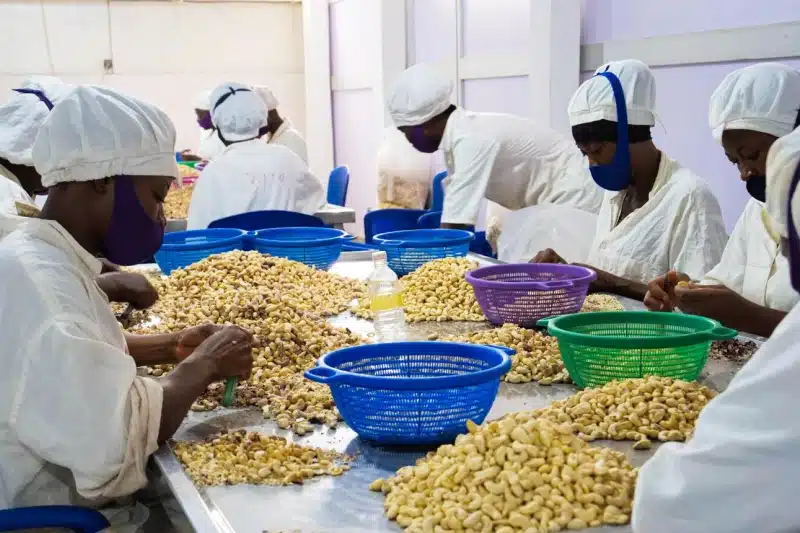
The new factory, NADKANSCO, can process 30,000 to 31,000 tonnes a year, Mahama said. It already employs nearly 1,000 people directly, according to the Ghana Export-Import Bank (GEXIM), which committed about US$12 million to the project.
Now the catch. Mahama said the plant’s working capital would last only 60 to 80 days. Figures given at the commissioning suggest that existing GEXIM support will finance the purchase of only about 5,000 tonnes, against the roughly 30,000 tonnes the factory needs annually.
Government will give GEXIM more money to on-lend to the company, Mahama said. Reports of the speech did not give an amount.
A cashew export ban gives the local factory first access to the nuts. It does not pay for them.
In March 2016, the Trade Ministry barred raw cashew exports between 31 March and 31 May, with nuts reaching ports or borders in that window liable to confiscation, Graphic Online reported. Only three of 13 processors were still running at the end of 2015, the ministry said.
The 2016 cashew export ban was short-lived, with producers and MPs quickly pushing back against the restriction.
Ekow Spio-Garbrah, then trade minister, later said credit facilities and prompt payment for farmers were not in place when it was announced. “We should have held durbars with farmers,” he said.
Pressure has built since. In February, Mahama told foreign cashew traders to build factories in Ghana or leave the market. In August, the Nitidae study urged a levy with a fixed tax and a floating part tied to world prices, plus a cashew development fund.
Monday’s plan shares the levy and a dedicated fund with that blueprint. It adds a cashew export ban, which the study had cautioned against in its blanket form.
Farmers are the quiet party in all this. Farm-gate prices fell from about GH¢20 per kilogramme in February 2025 to around GH¢7 by May, the study said.
Its authors warned that a blanket ban could cut farm-gate prices further, push trade into informal cross-border channels and discourage farmers from expanding.
Mahama’s version is time-limited, but the main harvest has traditionally run from January to June. Three months is half of it.
Would farmers in Bono and Bono East see lower prices while exporters wait? That question is still open. The proposed cashew export ban could change who buys their produce, but it cannot guarantee that local processors will offer better prices or pay promptly. Mahama said the government would support both farmers and processors.
Processors have pushed for action. Antonio Manuel Caramelo Raposo, president of their association, has argued that each raw tonne exported is “a factory job, a tax cedi and a unit of foreign exchange” that Ghana chooses to send to Vietnam and India.
In 2016, a cashew export ban lasted days. This time there is a working factory, a state bank behind it and a president saying it in public.
What farmers are told about price and payment will decide how long this one holds.


