



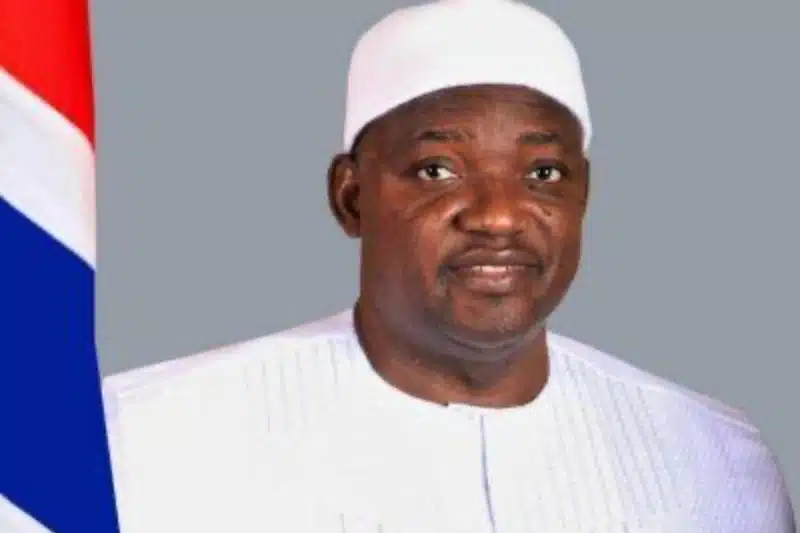

In 2016, Adama Barrow promised to serve three years and step aside. On 5 December, Gambians vote on Barrow’s third term bid, which, if successful, could keep him in power until 2032, roughly 15 years after he first took office.
It became official at the weekend. The Independent Electoral Commission accepted his nomination papers and those of eight other candidates, Reuters reported on Monday, as the campaign formally opened. The Point, a Banjul daily, reported that seven other nominations were rejected.
The field includes Talib Ahmed Bensouda, the popular former mayor of Kanifing. Isatou Touray is the only woman in the race against Barrow’s third term bid. Campaigning runs until 3 December.
The main challenge comes from Ousainou Darboe, 78, Barrow’s former vice-president. He now leads the opposition charge against Barrow’s third term bid, and the history between the two men is part of the story.
It is a long way from where Barrow started. In 2016 he was a property businessman and a political unknown. Darboe, the opposition’s natural leader, spent much of that year in prison, and Human Rights Watch recorded his release in December.
Barrow beat Yahya Jammeh, who had ruled for 22 years. Jammeh first conceded, then refused to go. Barrow took his oath at the Gambian embassy in Dakar while regional troops gathered at the border. Human Rights Watch recorded that Jammeh finally left for Equatorial Guinea on 21 January 2017.
The coalition behind Barrow had a simple deal. He would lead a three-year transition, then hold fresh elections without standing himself. The US Congressional Research Service noted that pledge in 2018, when it expected him to step down in late 2019.
He did not go. A street movement called Three Year Jotna, a Wolof phrase meaning the three years were up, demanded he keep his word. Barrow split from Darboe’s United Democratic Party and won re-election in December 2021 under his own National People’s Party. Official results gave him 53.2 per cent against Darboe’s 27.7.
Barrow’s third term bid is legal. That is the awkward part. The 1997 constitution sets no limit on presidential terms, and Barrow is the leader who promised to change it.
Two attempts have failed. In September 2020, lawmakers allied to him sank a draft that would have counted his first term towards a two-term cap.
The 2024 draft retained a two-term limit but removed the clause that would have counted Barrow’s first term. Had it passed, the arrangement could have allowed him two further terms under the new constitution.
ConstitutionNet, a constitutional research site, recorded the result. The bill fell on 7 July 2025 by 35 votes to 21. That was short of the three-quarters majority the 1997 text demands.
Barrow blames the UDP. He told a Gambian television channel, in an interview The Point reported on 30 October, that his side could not find the votes. The UDP argues the 2024 draft had been reshaped to suit him.
Voters have long been clear on limits. Afrobarometer found in 2018 that 87 per cent of Gambians backed a two-term cap. The civic group Never Again Network opposes Barrow’s third term bid because, it says, he is breaking a promise to entrench those limits.
On nomination day, The Point quoted Barrow telling reporters, “I believe in term limits.” Asked whether Barrow’s third term bid would be his last, he said limits were not the only test of a good democracy. He noted that Britain and Germany manage without them. Both are parliamentary systems, a different arrangement from an elected president. He stopped short of promising it would be his last.
He did promise a new constitution with limits if his party wins the majority needed in the assembly. Reuters noted that Barrow’s third term bid follows a similar vow after the 2021 win, yet the same constitution remains in force. Legislative elections are due next year.
Then the lights went out. Blackouts lasting up to 48 hours hit Gambia through the hot season. In early September, a Reuters witness saw police fire tear gas as protesters burned tyres and shouted “Barrow must go”. Barrow called the crisis an emergency and promised an extra 24 megawatts by the end of October. The police chief then banned protests without permits.
Public reporting does not make clear whether all that capacity is now running. The blackouts have complicated Barrow’s third term bid either way. Many voters resent it, and the power cuts handed them a daily reason to say so.
So voters weigh two questions that sit awkwardly together. On Barrow’s third term bid, can they trust him on term limits? And can he keep the lights on?
In 2016, Gambians voted for a man who promised to leave. On 5 December, they decide what to make of the one who stayed.


