



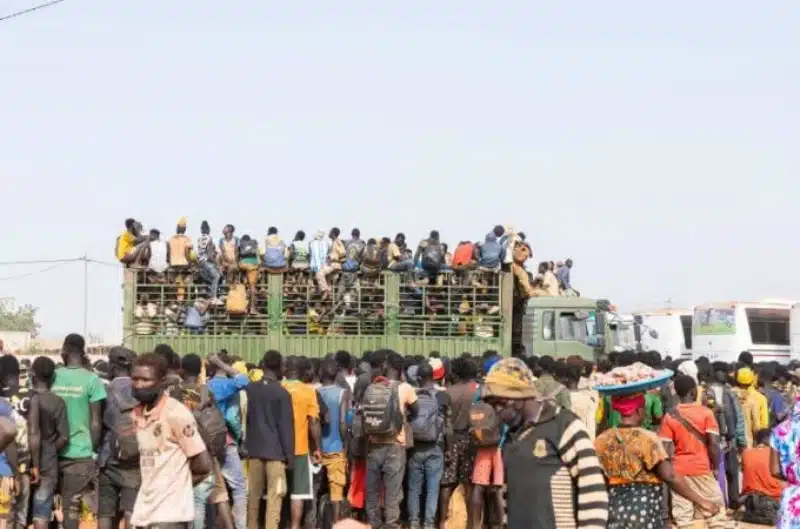

Noufa had been in Siguiri for about a month when the order came.
The young Burkinabè, in his early 20s, had reached Guinea’s gold country in early October to work in a small mine. Just as hope was building, he told Deutsche Welle (DW), ‘we were told to leave’.
His story sits inside a much bigger number. By Tuesday 17 November, the National Council for Emergency Relief and Rehabilitation (Conasur) had registered 70,126 mostly Burkinabè returnees, though the total includes 1,962 foreign nationals and 14,743 children.
The count is overwhelmingly male, with 68,779 men against 1,347 women. Subtract the foreigners and roughly 68,000 citizens remain.
So why did so many Burkinabè returnees leave so fast? And was this about rivers and rules, or about who controls Guinea’s gold?
The trigger came on 2 November, when Guinea banned unregulated artisanal gold mining in Siguiri, the heart of its north-eastern gold belt. Guinean authorities said, according to Reuters, that miners were polluting farmland, rivers and vegetation.
People left quickly. Mali’s authorities estimate that about 160,000 West Africans were forced out of Guinea and into Mali, with Burkinabè the largest group. Most of the Burkinabè returnees then travelled home through Mali, on buses and trucks sent from Bamako and Ouagadougou.
The two figures measure different movements: Mali’s estimate covers West Africans who crossed into its territory, while Conasur’s count covers people registered on their return to Burkina Faso.
The pace at which Burkinabè returnees arrived stands out. Conasur had registered 37,136 people by 11 November. A day later the figure was 45,406, after 8,270 arrivals in 24 hours. By Monday 16 November it had reached 68,381.
Burkina Faso has absorbed a mass return before. After the 2002 rebellion in Côte d’Ivoire, 158,144 Burkinabè came home in nearly six months. Social welfare minister Mariam Lamizana gave that figure at a news conference in March 2003.
The 70,126 people registered in November represent more than 40 per cent of the 158,144 Burkinabè who returned during the Ivorian crisis, despite the current arrivals taking place within roughly two weeks.
Violence sharpened the crisis on 11 November. Clashes broke out in Balato, in the Siguiri area, during a patrol enforcing the ban. Guinea’s Ministry of Territorial Administration said in a statement, reported by Reuters, that 10 people were killed. The ministry also put the wounded at 13.
The government says prosecutors have been asked to establish the facts.
Arrests followed. Army spokesman General Mamadou Aliou Sow said 1,263 people had been arrested and taken to Conakry. They included Guineans, Burkinabè, Malians, Togolese, Nigerians, Ivorians and Ghanaians.
On 14 November, a convoy of 44 vehicles carrying 1,557 West Africans, mostly Burkinabè and Malians, reached Kouremale on the Mali border. Judicial and security sources said they had been tried and convicted in Conakry. The figures come from different dates and do not add up neatly.
Guinea rejects the claim that the Burkinabè returnees and other foreigners were singled out. Mohamed Nabe, who chairs the Committee on Mining and Industry, told DW that millions of Guineans are affected, against a few thousand foreigners. The aim, he said, is to organise and regulate the sector. Foreign Minister Morissanda Kouyaté has argued that Guinea is not the only country to ban illegal gold mining.
President Mamadi Doumbouya took a harder line at the Simandou Mining Summit on 11 November. He said Guinea had been indulgent in the name of pan-Africanism, but would now insist on respect for its rules. On that, he said in French, ‘we have neither friends nor relatives’.
The numbers sit awkwardly beside that. Burkinabè returnees alone number about 68,000, and Mali puts the wider exodus near 160,000. The figures may not measure the same thing, since many people left as soon as the ban was announced. Even so, the gap is large.
Others suspect a second motive. DW noted that the ban came as the Nimba Gold Refinery began operating in Conakry. Its target is to refine 30 per cent of the 70 tonnes of gold mined in Guinea. Mining expert Ibrahim Diallo suggested the state may want Siguiri’s output under its control to supply the plant. That is one expert’s reading. Officials point to environmental reasons.
Ouagadougou reacted angrily to the treatment of Burkinabè returnees. Security minister Mahamadou Sana alleged brutality and said the operation caused deaths and injuries. Ministers of the Confederation of Sahel States, meeting in Ouagadougou on 11 and 12 November, criticised what they called mass and uncoordinated expulsions.
Mali’s tone shifted. Bamako first called the expulsions a sovereign decision. Prime minister Abdoulaye Maiga has since spoken of a humanitarian catastrophe and regretted the lack of coordination.
In Guinea, former president Alpha Condé, ousted in 2021, called the crackdown unacceptably brutal and demanded an independent inquiry.
The returns land in a country where insecurity has already upended livelihoods. The Timbuktu Institute notes that some Burkinabè returnees went to Guinea for income, while others were supporting families displaced by conflict.
Authorities have discussed training and a move into farming, livestock and technical trades. The institute says delivery remains to be shown. It warns that some Burkinabè returnees may drift back to mining in unsafe areas.
Independent checks are also limited. The institute notes that Burkina Faso’s new penal code, adopted on 20 October, restores prison terms for press offences. That makes it harder to document what returnees face.
Gold took them to Siguiri and a ban brought them home. Whether home can give the Burkinabè returnees a living is the part nobody has answered yet.


