



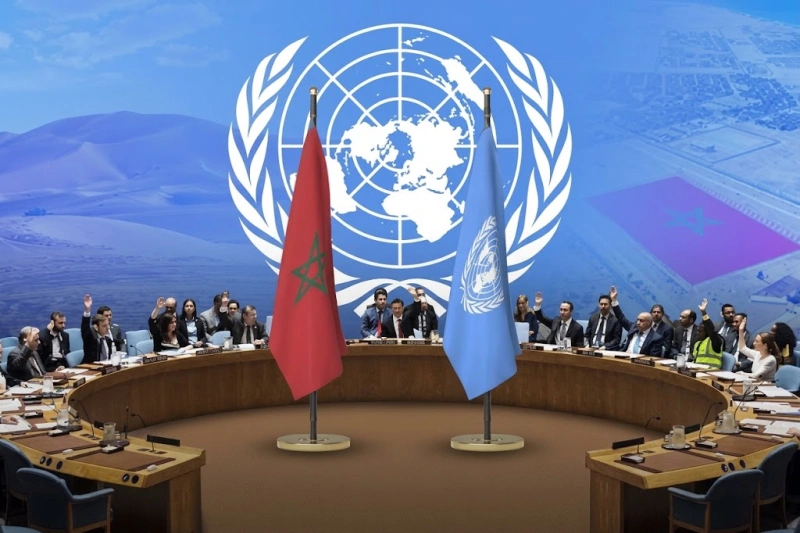

Take one letter out of MINURSO and the promise changes.
The R stands for referendum. Washington wants it gone.
That is the most visible change in the Western Sahara resolution the UN Security Council is expected to vote on this Friday, 30 October. The mission’s mandate expires a day later.
Under the draft Western Sahara resolution, the mission would be renamed MINUSO. Yabiladi, which obtained a copy of the revised text, reports that the mission “will no longer have a role in organizing a referendum”.
But the real fight over the new Western Sahara resolution is not a name. It is over who decides how this ends.
The first text, circulated to Council members on 22 October and quoted by PassBlue, called autonomy under Moroccan sovereignty the only feasible solution. It also made Morocco’s autonomy proposal the only basis for negotiation.
Four days later, a revised version appeared. Western Sahara Resource Watch, a Brussels-based campaign group, says the new text calls autonomy the most feasible solution instead. That is closer to the wording of last year’s Resolution 2797.
One thing stayed. Morocco’s plan is still the only basis for talks. The group warns that the trouble starts when autonomy is “made the only accepted option in advance”.
The draft Western Sahara resolution keeps the words self-determination and mutually acceptable. What it narrows is the menu.
Washington’s case for the Western Sahara resolution is simple. Talking without direction has gone nowhere.
In closed consultations in early October, UN envoy Staffan de Mistura told Council members that talks had hit a wall. Autonomy, he said in remarks seen by PassBlue, should anchor the next round.
US ambassador Mike Waltz met Polisario representatives in late September. He then said on X that refugees in the Tindouf camps should be offered genuine choices, not another ten years of waiting.
The roots go back a long way. Spain withdrew from the territory in 1975 and Morocco moved in. A 1991 ceasefire between Moroccan forces and the Polisario created MINURSO, with a referendum at its core.
Rabat tabled its autonomy plan at the UN in April 2007. The United States recognised Moroccan sovereignty in December 2020.
Then came Resolution 2797 last October. The Council adopted it, the UN’s own record shows, with 11 votes in favour and three abstentions.
Even some supporters drew a line. Sierra Leone’s representative said her country’s vote “does not constitute a recognition of Moroccan sovereignty over Western Sahara”.
This year brought three rounds of US-led talks in January and February. PassBlue’s reporting puts Morocco, the Polisario, Algeria and Mauritania in the room. The talks ended without a deal.
On 5 May, three projectiles hit near Es-Smara. The Polisario claimed the strike, and a UN report on the territory found two impact craters and one injured civilian.
Then, in a report dated 1 October, Secretary-General António Guterres told the Council that Sahrawis hold an inalienable right to self-determination. Any proposal, he added, must be put to them through meaningful consultation so they can freely accept or reject it.
That is the gap the Western Sahara resolution must now close. A UN chief who says Sahrawis must be free to say no. A draft that names one plan as the basis for talks.
The Polisario Front has already answered. Sidi Mohamed Omar, its UN representative, wrote to Council president Aglaia Balta. In the letter, quoted by PassBlue, he warned the Front would have “no choice but to disengage from the peace process as a whole” if the Western Sahara resolution passed without substantive changes.
Three days later, the tone shifted. After an extraordinary meeting of its general secretariat on 25 October, the Front issued a statement that, as Yabiladi noted, made no mention of quitting. It still rejected any approach not built on self-determination and independence.
The timing matters. The revised draft, Yabiladi reports, asks the UN envoy to consult a broad range of Sahrawi voices. That includes people outside the negotiating parties, in the territory, the camps and the diaspora.
The Polisario insists it is the legitimate representative of the Sahrawi people.
Yabiladi also reported that Waltz met the Sahrawi Movement for Peace, a group that split from the Polisario, in New York on 30 June. The movement has welcomed the consultation clause.
Now the arithmetic. A Western Sahara resolution needs nine votes and no veto from the five permanent members.
Russia abstained last year. Algeria, then a Council member, did not take part.
This week, Moscow was courted from both sides. Yabiladi reported that Foreign Minister Sergey Lavrov met Algeria’s Ahmed Attaf on Tuesday and Morocco’s Nasser Bourita on Wednesday. A source told the outlet that China and Russia pushed for amendments restoring the UN’s central role in the process.
Whatever Moscow decides will shape the Western Sahara resolution that finally emerges.
Africa has its own stake. The Sahrawi Arab Democratic Republic, which the Polisario administers in exile, is an African Union member.
South Africa and SADC have backed the referendum route for years. Somalia, DR Congo and Liberia hold the three African seats on the Council. They will vote on a Western Sahara resolution that cuts against that position.
The practical risk is a thinner UN presence. Yabiladi says the revised text orders a review of the mission that includes a gradual reduction of its military component. The first draft had proposed cutting it by half.
Critics say the Western Sahara resolution would leave fewer independent witnesses if fighting returns. Fighting has flared on and off since the ceasefire collapsed in November 2020. Hannah Rae Armstrong, a North Africa policy adviser, told PassBlue the first draft sharply raised the risk of escalation.
Then there are the people in the Tindouf camps. PassBlue puts the refugee population at 170,000 and cites UNICEF figures showing nearly 11 per cent of young children there are malnourished. Yabiladi says the draft backs UN registration of camp residents and voluntary return in safety and dignity.
Algeria, Yabiladi notes, has tied any census to a final settlement.
In a paper filed through South Africa’s delegation, the Polisario argued that returns before the root causes of displacement are removed would reward Moroccan occupation.
Campaigners go further. Erik Hagen of Western Sahara Resource Watch told PassBlue the Western Sahara resolution, in his view, breaches the UN Charter. He also warned of a precedent for other occupations.
Rabat’s reply is that self-determination does not have to mean a referendum, a point Foreign Minister Nasser Bourita has made publicly.
On Friday, the Western Sahara resolution goes to a vote. For 35 years, the word referendum has sat in the mission’s name, unfulfilled. By next week, it may be gone.


