




It began with a video feed that went quiet at the wrong moment.
On Tuesday, it reached the head of South Africa’s foreign affairs department, who invoked a treaty signed 65 years ago to remind Nigeria’s new envoy of the rules governing diplomatic engagement.
The Fani-Kayode diplomatic row looks small on paper. A ceremony livestream. A complaint. A handful of sharp posts. Underneath, it is a fight over who may complain, to whom, and on which platform.
On 17 November 2026, Zane Dangor, Director-General of the Department of International Relations and Cooperation (DIRCO), met Nigeria’s High Commissioner, Olufemi Adewumi Fani-Kayode, in Pretoria.
DIRCO said Dangor raised concern over events that followed the presentation of the envoy’s credentials to President Cyril Ramaphosa, and over his later remarks on social media.
Mark the wording. The statement says Dangor “met” the envoy. It does not use the words summons or démarche, though several headlines did. The department chose the quieter verb.
Then it reached for the rulebook.
Dangor recalled Article 41 of the Vienna Convention on Diplomatic Relations (1961), which requires official business entrusted to a diplomatic mission by its sending state to be conducted with or through the receiving state’s foreign ministry.
The treaty’s own text speaks of business “conducted with or through the Ministry for Foreign Affairs”. DIRCO added that official communication should run through “established diplomatic channels, including DIRCO”.
That moved the Fani-Kayode diplomatic row from social media into the formal diplomatic channel.
To see why, rewind to Friday 13 November.
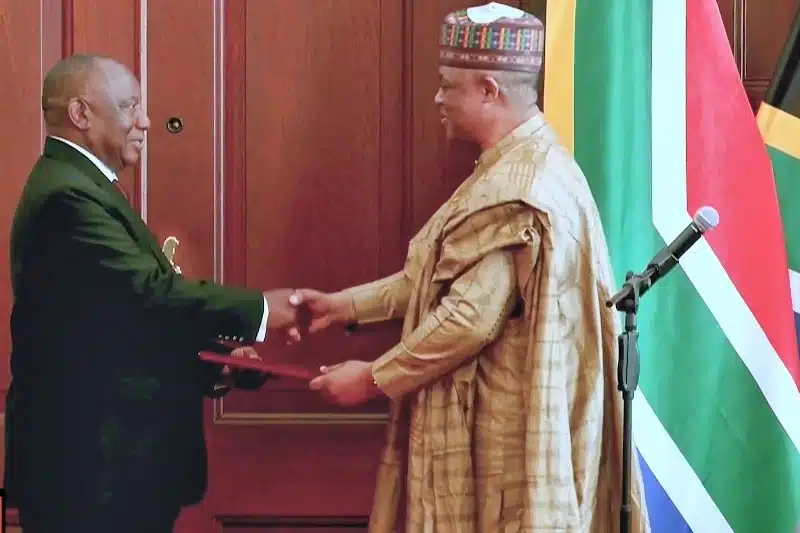
Fani-Kayode, a former aviation minister, presented his letters of credence in Pretoria alongside 14 other envoys. He is, according to Business Day, Nigeria’s first substantive envoy to South Africa in four years, and he formally began his duties on 30 October.
Then he went to X.
Of 15 introductions and speeches, he wrote, “only Nigeria’s was cut out.” He said he raised it with Ramaphosa during the photo session and that the president took him to the relevant officials.
He also turned down an interview with the South African Broadcasting Corporation (SABC).
Pretoria answered quickly. Presidency spokesperson Vincent Magwenya called the envoy’s approach “grossly inappropriate”. He said Ramaphosa had not intervened in the broadcaster’s editorial decisions, and had only pointed the envoy to an SABC editor.
Clayson Monyela, DIRCO’s head of public diplomacy, told Fani-Kayode on X, as The Citizen reported, that “this should not be the platform for engagement”.
Within days, the Fani-Kayode diplomatic row had turned personal.
Magwenya told the envoy to stop “disgracing yourself and your country”. The Nigerian High Commission replied on its official X account: “You are the disgrace and no one else.”
The mission had earlier declared the matter closed. It was not.
The timing is awkward for both capitals.
In July, Business Day reported, International Relations Minister Ronald Lamola travelled to Abuja as Ramaphosa’s special envoy, and both governments agreed to lower inflammatory rhetoric after weeks of anti-migrant protests.
Less than four months later, the sharpest public exchange involved Nigeria’s own envoy and Ramaphosa’s spokesperson.
The Fani-Kayode diplomatic row is unfolding against a relationship that was already under considerable strain.
The Citizen also recalled that Nigeria’s National Assembly suspended official visits by lawmakers and parliamentary officials to South Africa in September, alongside a boycott of South African-hosted legislative activities.
The decision was a parliamentary response to recurring anti-migrant violence and did not amount to a blanket suspension of visits by the Nigerian government.
The goodwill was already thin.
Read closely, DIRCO’s response to the Fani-Kayode diplomatic row was narrow.
It did not accuse the envoy of breaching the treaty. It “recalled” a provision. It never mentioned the livestream.
And it closed by reaffirming a “strategic partnership” with Nigeria in “the spirit of African solidarity and mutual respect”.
After days of public insults, Pretoria’s formal move was quiet: a meeting, a treaty reference and a courteous close.
What happened to the broadcast is still contested.
Fani-Kayode says only Nigeria was cut. The Presidency calls it a minor operational matter and published a separate video of his speech.
The SABC has said the Presidency’s livestream arrangements and its own editorial coverage are separate. It also maintained that it covered the ceremony through its own channels, although its response did not explain why the Presidency’s livestream went off during the event.
The Nigerian mission says it holds a full recording. No Nigerian response to Tuesday’s meeting had been reported at the time of writing.
The missing speech was published within hours.
After the Fani-Kayode diplomatic row, the goodwill between two capitals will take far longer to retrieve.


