



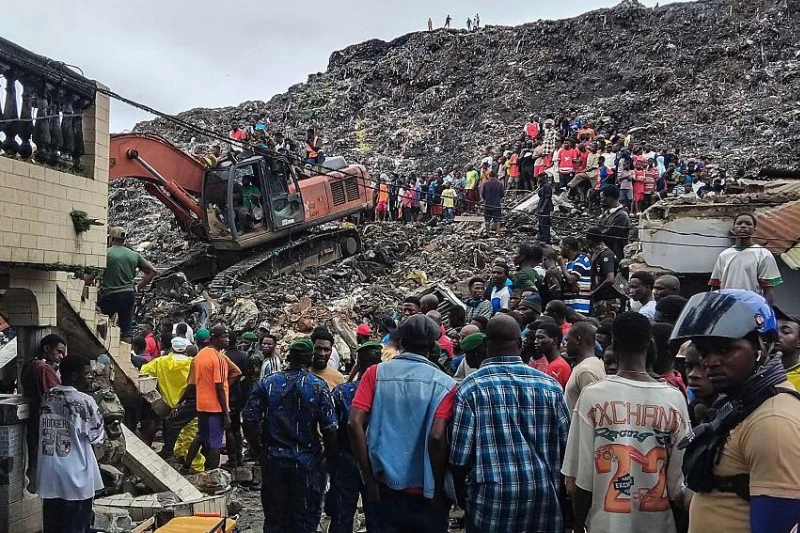

At least 30 people have died after a landfill collapse in Conakry buried informal homes on the edge of Guinea’s capital. A government statement confirmed the toll on Sunday.
Six others were seriously injured. Heavy rain triggered a landslide of refuse at the Dar-es-Salaam dumpsite in the Bbessia district shortly before dawn. Residents said the downpour began around 3am. A mountain of rubbish slid onto nearby shacks while families slept.
The site is the largest landfill serving Conakry. Its sheer scale has complicated recovery efforts. Excavators have been working through the debris since the early hours. Search and rescue teams are still combing the wreckage for anyone who might be trapped.
Lancine Sylla, head of the Dar-es-Salaam suburb, told the AFP news agency that eighteen bodies had already been pulled out and taken to the morgue by midday. He said he feared the final toll would climb higher.
Guinea’s Prime Minister, Amadou Oury Bah, travelled to the scene shortly after the disaster. He oversaw the response alongside emergency services. Significant material and human resources have been deployed to recover victims still buried under the waste, the government said. Medical care has also been arranged for the injured.
What makes this landfill collapse especially painful for residents is its timing. The dumpsite had been scheduled for closure on the very day the disaster struck. That detail came from Lieutenant Colonel Balde Mamadou Bailo, a sanitation officer with the Military Engineering Battalion. Authorities had recently ordered families living close to the site to move away, citing fears the towering refuse heap could give way.
Cellou Dalein Diallo, a former prime minister and prominent opposition figure now living in exile, called the incident a tragedy that has plunged the nation into dismay. He argued the closure announcement, coming so close to the collapse in Conakry, raises questions the authorities must now answer with full transparency.
Conakry’s low-lying, densely built neighbourhoods have long struggled with poor drainage. Unregulated construction leaves informal settlements exposed once the rainy season brings sustained downpours. Families in Dar-es-Salaam had built homes right against the base of the dump. It is a pattern common across West African cities, where land scarcity pushes the poorest residents onto hazardous ground close to landfill sites.
The landfill collapse has renewed concerns about waste management and the safety of communities living near major dumpsites in Guinea.
President Mamadi Doumbouya seized power in a 2021 coup. He later won election as president in December 2025. He has yet to make a personal statement on the landfill collapse beyond the government’s official communication.
For now, the priority on the ground remains recovery. Rescue workers are continuing to dig through what is left of the dump. Crowds of onlookers have gathered at the edges of the site. Families wait for word on relatives still unaccounted for.
For more click


