



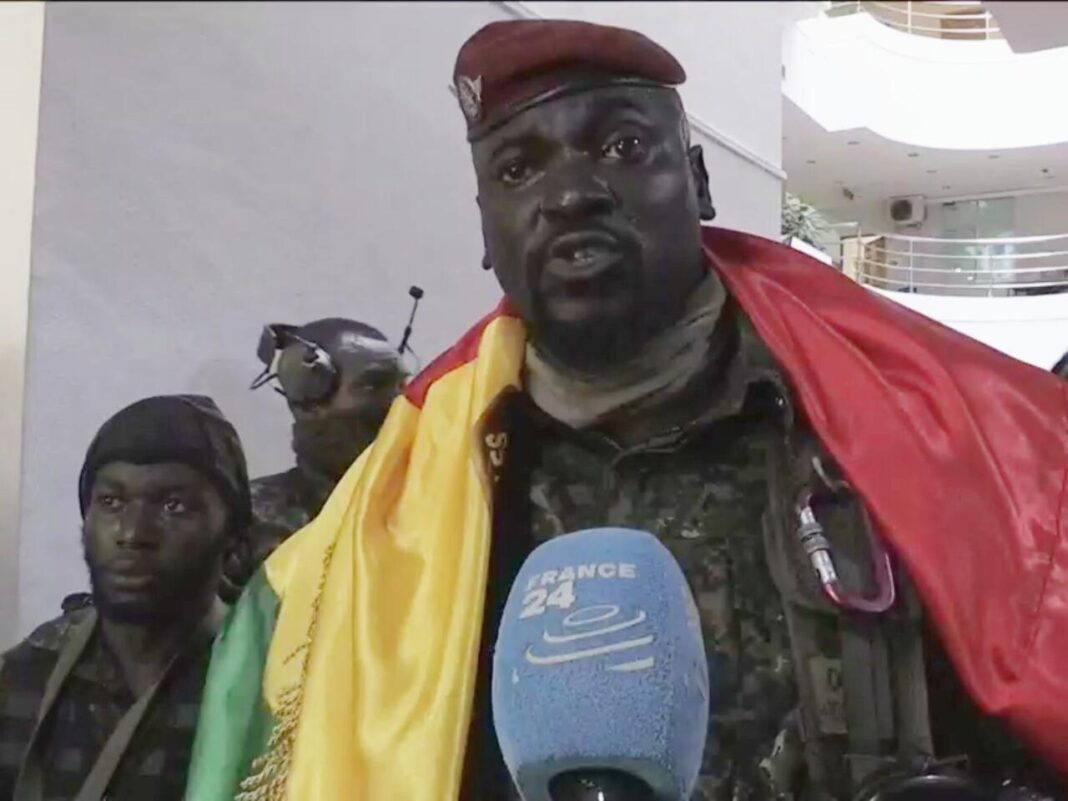

Screens went dark on Thursday. Across Guinea, viewers reaching for France 24 found nothing but static as the France 24 ban took effect nationwide, the latest sign that Conakry’s patience with foreign broadcasters has run out.
The country’s media regulator, the Haute Autorité de la Communication (HAC), ordered the France 24 ban with immediate effect, pulling the French news channel off air across Guinea. The decision followed a row that had been building for three days over how the channel described President Mamadi Doumbouya during a television broadcast.
It started with five words.
During a bulletin on 14 September, a France 24 presenter referred to Doumbouya as a “président putschiste”, a term that translates roughly as a president who came to power through a coup. Guinea’s government did not let the comment pass.
By Wednesday, the HAC had issued a formal protest, accusing the channel of deliberately using an inappropriate term for the head of state. The regulator ordered France 24 to correct the record across every digital platform it operates, not just on air.
France 24 did respond.
The channel admitted the presenter had wrongly described Doumbouya and said it would apologise and correct the error on air, according to a statement its communications director gave to AFP. Yet the clip in question was still available on the channel’s website on Thursday morning and, according to the regulator, that was reason enough to escalate from a protest to the France 24 ban.
Context matters here.
Doumbouya seized power in a military coup in September 2021, toppling then-president Alpha Condé. He later won a presidential election in December 2025, a vote that regional and continental observers, including ECOWAS and the African Union, described as calm and orderly, although it lacked any serious opposition challenger.
For the HAC, that election victory is precisely why the disputed description cuts so deeply. Officials argue that referring to Doumbouya primarily through the lens of the coup ignores the legitimacy they say he subsequently obtained through the ballot box.
The France 24 ban did not arrive alone.
Hours before the regulator moved against the broadcaster, it stripped press accreditation from Mamadou Diawo Barry, the permanent correspondent for the pan-African weekly Jeune Afrique in Guinea.
The HAC cited serious breaches of professional ethics but declined to identify a specific article or report behind the decision, leaving Barry, and readers, without a clear explanation of the alleged violations.
Two journalists silenced within 48 hours is not an accident of timing.
It fits a broader pattern. Reporters Without Borders has documented years of similar actions by the same regulator, from the nine-month suspension of the news website Depecheguinee.com in 2023 to the withdrawal of licences from six private radio and television stations in 2024, several of which remain off air more than a year later.
What makes this week different is the target of the France 24 ban.
Guinea has censured domestic media outlets before, but taking an international broadcaster completely off the air is a more consequential step. It signals that the government now treats discussion of Doumbouya’s route to power as a political red line rather than a historical question open to debate.
There is a contradiction at the heart of the dispute.
A leader who fought to be recognised as democratically elected has now moved against a broadcaster over a five-word description of how he first entered office.
The France 24 ban does not erase the events of 2021. It does, however, underline how sensitive that chapter of Guinea’s recent history remains for the country’s leadership.
For more insight visit France Info


