



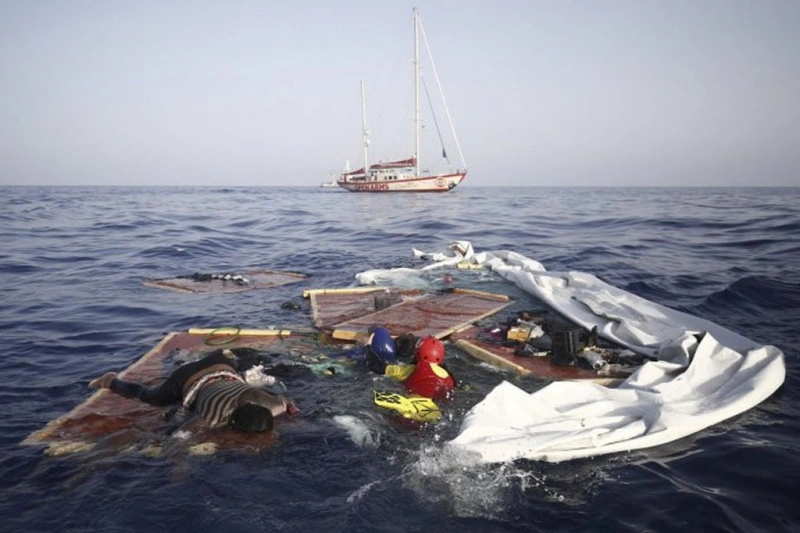

The Bouri migrant boat disaster unfolded within view of one of the Mediterranean’s most heavily monitored offshore zones, yet for those onboard, help came too late.
On the afternoon of Saturday, April 4, a wooden vessel carrying between 105 and 110 people capsized roughly 14 nautical miles northeast of the Bouri oil field, off the coast of Libya.
By Sunday morning, 32 survivors and two bodies had been brought ashore on Lampedusa. More than 70 others remain missing.
At that distance from shore, but still within reach of oil infrastructure and passing commercial traffic, the disaster sits in a space humanitarian responders often describe as a gap between visibility and action.
“We were in the water for hours”
The first rescue did not come from a coastguard vessel.
Instead, two merchant ships altered course after spotting people in distress. One crew managed to pull dozens from the water, along with two bodies.
While official survivor testimonies are still being recorded in Lampedusa, early accounts relayed through aid workers suggest a long period in open water before help arrived.
A volunteer linked to Mediterranea Saving Humans, speaking to Italian media, described the pattern seen in such incidents:
“These boats are often left alone for too long. By the time someone reaches them, the situation has already collapsed.”
That assessment aligns with what rescuers call “invisible shipwrecks”, cases where boats drift or struggle without coordinated intervention until they capsize or disappear.
Leaving Tajoura
The boat is believed to have departed from Tajoura, east of Tripoli, a coastline that remains active despite years of patrols and enforcement.
Departures from this stretch have not stopped. They have simply become less visible.
Those making the journey often board wooden vessels like this one, cheap to assemble, easy to launch, and dangerously unreliable once they reach open sea. Overcrowding is routine. Safety equipment is rare.
The oil platforms and the unanswered question
The Bouri migrant boat disaster is likely to draw scrutiny because of where it happened.
The oil field, operated by Mellitah Oil and Gas in partnership with Italy’s Eni, is not an isolated patch of sea. It is a functioning industrial hub with constant vessel movement and monitoring systems.
That raises a difficult, recurring question in the central Mediterranean.
When distress unfolds near such infrastructure, who is responsible for acting and when?
There is, so far, no indication of a coordinated rescue effort before the capsizing.
Lampedusa receives the survivors
On Lampedusa, the latest arrivals add to a steady flow that has once again stretched local systems.
Medical teams are treating dehydration, exhaustion, and shock. For many survivors, the psychological impact comes later, especially when fellow passengers remain missing.
Their testimonies will be critical in reconstructing the final hours of the journey, including how long the boat drifted, whether it took on water gradually, and if any distress signals were sent.
A deadly start to 2026
The Bouri migrant boat disaster is not an isolated incident.
On April 1, at least 19 bodies were recovered near Lampedusa in a separate shipwreck. According to data tracked by migration monitors, deaths along the central Mediterranean route this year are already approaching 700 to 800.
That places 2026 among the deadliest starts to a year in nearly a decade.
Beyond the numbers
For now, most of those missing remain unnamed.
The boat likely carried people from multiple African countries, each with families waiting for news that may not come. In past shipwrecks, identification can take weeks, or may never happen at all.
Search efforts continue northeast of Bouri, but as hours turn into days, the chances of finding survivors grow smaller.
What remains is the same question that follows many such incidents.
How can a boat carrying over 100 people reach crisis in one of the Mediterranean’s busiest and most observed corridors and still go largely unseen until it is too late?


