



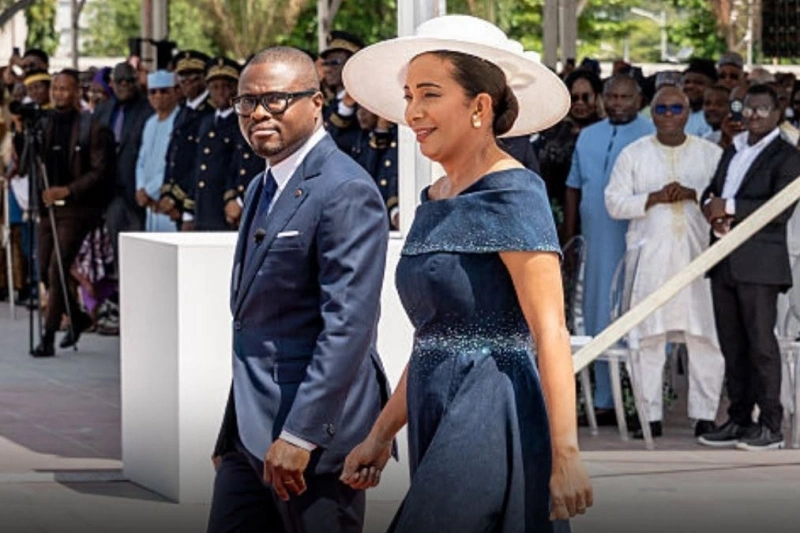

Romuald Wadagni marked his first 100 days as president of Benin this week. The milestone has drawn as much scrutiny as celebration. The former finance minister took over from Patrice Talon on 24 May. He inherited a country with strong growth figures but a reputation for shrinking civic space.
Three months on, Wadagni’s first 100 days tell a story of a leader trying to soften his predecessor’s edges, without breaking from his economic playbook.
Where Talon cultivated distance, Wadagni has leaned into approachability. During Wadagni’s first 100 days, he swapped the formal suit for open necked shirts at public events, according to reporting by KPC News. He has also kept up the note free, conversational speaking style that carried him through the campaign.
Analysts at the Timbuktu Institute noted that his inauguration drew regional leaders rarely seen together. Niger’s prime minister attended, alongside foreign ministers from Burkina Faso and Mali, an early signal of the diplomacy to come.
Regional outreach became one of the clearest markers of Wadagni’s first 100 days. Barely a week into office, he travelled to Cote d’Ivoire, Niger and Burkina Faso. He met juntas that Talon had largely kept at arm’s length.
In Niamey, Niger’s military leader Abdourahamane Tiani and Wadagni issued a joint statement. It committed both sides to remove obstacles to cooperation, chiefly the reopening of the closed Benin-Niger border, Africanews reported.
The border had been shut since the 2023 coup in Niger. That closure cut off a vital transit corridor and pushed Niger’s trade towards Togo’s port instead. Ecofin Agency reported that technical committees have since been set up to manage a phased reopening. Full restoration of transit flows remains some way off, however.
In Ouagadougou, Wadagni met Burkina Faso’s Ibrahim Traore to discuss security, infrastructure and vocational training. It was part of a wider effort to keep Benin relevant to a Sahel bloc that has formally distanced itself from ECOWAS.
That diplomatic thaw sits alongside a domestic push on welfare. Within Wadagni’s first 100 days, the government pushed through a revised budget. It lifted state spending to more than 4,148 billion CFA francs, an 8 per cent rise, according to Financial Afrik. The extra fiscal room has funded two changes that households can feel directly.
Public hospitals must now treat life threatening emergencies immediately. Payment can be deferred, removing the old requirement for an upfront deposit before treatment begins. Free secondary schooling for girls, already in place at junior level under Talon, has been extended through to the end of senior secondary.
Officials frame both moves as proof that growth is finally reaching ordinary households. The IMF and World Bank still project expansion above six per cent this year, rather than growth sitting only on a balance sheet.
Yet Wadagni’s first 100 days have also revived old questions about press freedom. The Committee to Protect Journalists this week wrote to Wadagni. Its letter urged reform of Benin’s Digital Code, which it says has been repeatedly used against journalists. It also called for the release of Olofofo Info’s publishing director Comlan Hugues Sossoukpe, who remains detained without trial after being extradited from Cote d’Ivoire.
Talon has not disappeared from public life either. He is expected to take a seat in the Senate, a body created under his own constitutional reforms. Analysts quoted by The Conversation have questioned whether his continued presence will limit how far Wadagni can manoeuvre. Parliament, elected under rules Talon shaped, remains largely loyal to the outgoing leader’s coalition.
For now, Wadagni’s first 100 days point to a presidency of managed continuity rather than rupture. He has kept several Talon era ministers in place. He has preserved the technocratic economic model that earned him recognition as Africa’s best finance minister in 2024. He has avoided any dramatic break with the industrial strategy that has drawn foreign investment into Benin.
What has changed is tone. The casual manner, the regional charm offensive and the emergency healthcare pledge suggest a president keen to seem accessible. That is a deliberate contrast with his predecessor.
Whether the shift becomes genuine political opening, particularly on press freedom, is a separate question. It is likely to define the phase that follows Wadagni’s first 100 days in office. For a country still measuring itself against Talon’s decade, that question about Wadagni’s first 100 days and what comes next will not go away quietly.


