



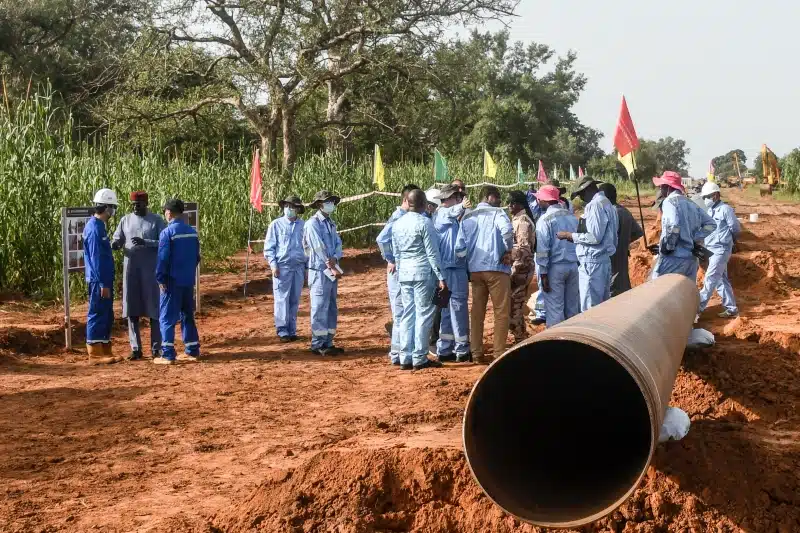

The Niger oil ultimatum comes with a number that is hard to ignore. Niamey says more than 3,000 billion CFA francs, about $5 billion, in crude export earnings has never been brought home.
Niger says more than 3,000 billion CFA francs, about $5 billion, in crude export earnings has not been repatriated. The government has given three Chinese oil companies 45 days to account for the money and comply with outstanding commitments.
The government has given three Chinese companies 45 days to put that right. They are China National Petroleum Corporation (CNPC), the West African Oil Pipeline Company (WAPCO) and SORAZ, the operator of the Zinder refinery.
Foreign Affairs Minister Bakary Yaou Sangaré, who chairs the state’s oil negotiating committee, read out the demands this week. The deadline falls in late November.
What happens after that is the unanswered question. Sangaré said only that the state would “draw all the consequences” of whether the demands are met.
He also kept the door open. The partnership with China is old, he said, and Niger wants to keep it, but on the basis of “uncompromising defence of Niger’s interests”.
This is not the first clash. In March 2025, the military government ordered the Niger-based directors of all three companies to leave within 48 hours, Reuters reported. Its sources pointed to disputes over pay for local staff and the pace of work.
A negotiating committee followed by presidential decree in July 2025. After almost a year of talks, a protocol was signed in Niamey on 18 May 2026.
State daily Le Sahel reported that the deal cut the pipeline tariff from $27 to $15 a barrel. The government values that at $106 million a year. Niger also won agreement in principle to a 45 per cent stake in WAPCO, with commercial terms to be settled later.
That was the headline. The audit is the small print. The protocol carried 45 commitments, and five months on the committee says it has found failings on the Chinese side. The Niger oil ultimatum is its formal answer.
Money comes first. Niamey says regional exchange rules oblige exporters to bring their earnings home. Sangaré puts Niger’s repatriation rate at 6 per cent, against an average above 70 per cent elsewhere in the West African Economic and Monetary Union.
The committee says that in two years “only 105 billion CFA francs have been repatriated”. That is what remained for the state after it earmarked 80 per cent of its revenue to repay a $400 million loan taken in 2024.
The shortfall costs the Treasury 17.4 billion CFA francs, Sangaré says, and leaves Nigerien banks short of deposits to lend.
Niamey rejects any idea that older agreements from 2008 and 2019 shield the firms from those rules. Under the Niger oil ultimatum, they must apply a permanent mechanism agreed with the regional central bank, the BCEAO.
On local employment, the committee’s assessment is equally direct. The protocol required a four-year plan to replace foreign workers with Nigeriens, the committee says. No plan has been filed and no hiring has started. About 558 expatriates work on CNPC-run sites.
Then there are the reserves. The committee says Agadem’s oil has not been certified by an independent firm since 2008. The volumes rest on the operator’s own declarations. In plain terms, the state has had no outside check on what lies beneath the block.
At home, fuel supply is tight. The committee links part of that to the Zinder refinery, which is running at 15,000 barrels a day against a design capacity of 20,000. It says the problem has several causes.
To meet the Niger oil ultimatum, the three firms must file corrected repatriation statements and hand over staffing plans. They must also start hiring, allow staffing audits and help certify Agadem’s reserves.
The Niger oil ultimatum carries risk for both sides. Niger owns 40 per cent of SORAZ, and the CNPC-built pipeline to Benin carries the crude it sells abroad. But CNPC runs the field, the pipeline and the refinery, so Niamey is pressing the very firms it relies on.
The Niger oil ultimatum is precise about the failings and silent about the penalty. Without one, 45 days is a deadline, not a threat.
Another dispute is running alongside. Crude and gas have escaped from the Goumeri W8 well in the Agadem block, operated by CNPC’s local unit, since 25 September. The oil ministry disclosed it only on 12 October, calling it an incident of “exceptional gravity” and saying it was only partly contained.
An independent inquiry is meant to establish responsibility. The two matters are formally separate, but together they put CNPC’s Niger operations under heavy scrutiny.
At the time of writing, no public response to the Niger oil ultimatum from the three companies had been reported.
The government’s list of failings is precise, but it says nothing about the penalty for non-compliance


