



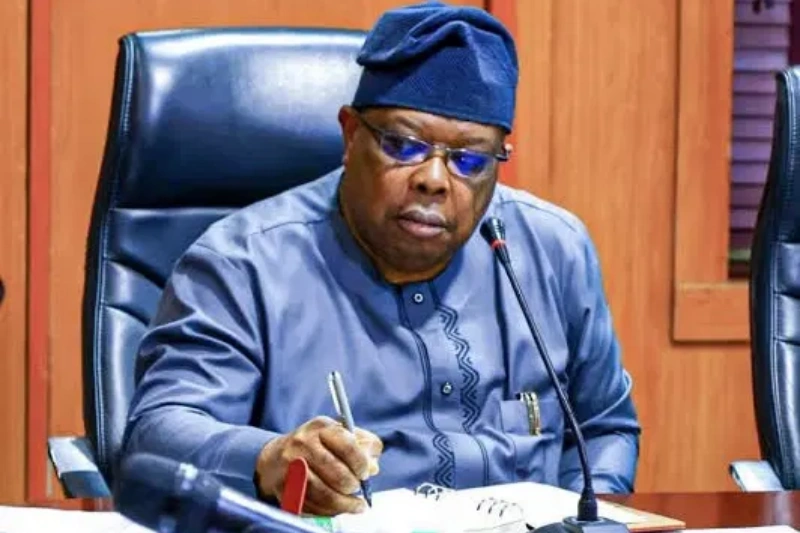

The Federal Government has set 2027 as the year electricity subsidy removal begins in earnest, with Minister of Power Joseph Tegbe telling reporters in Lagos on Friday that the phase out will be gradual and will not trigger an immediate tariff increase.
Tegbe made the announcement during a media interactive session where he laid out the administration’s plan for electricity subsidy removal to restore the finances of a power sector buckling under debt. He insisted that vulnerable consumers would be shielded as the process proceeds, and that Nigerians would not be denied the benefits of a functioning grid.
It is a familiar script, and Nigerians have heard versions of it before every major subsidy withdrawal. In May 2023, petrol subsidy was withdrawn overnight and the price of a litre of Premium Motor Spirit jumped from roughly N184 to about N600, a rise of more than 200 per cent within weeks. Inflation, which stood at 22.79 per cent the previous month, climbed to 24.08 per cent by July 2023 as transport and food costs absorbed the shock.
That history matters because it shows how a subsidy withdrawal, announced as a technical fix for a broken sector, quickly becomes a household affordability crisis. The government’s language around electricity subsidy removal echoes 2023 almost word for word: gradual implementation, protection for the poor, no immediate pain. Whether that promise holds will depend on figures the public still cannot independently verify.
Consider the numbers underpinning electricity subsidy removal. The government has previously put the electricity subsidy burden at about N3 trillion as of February 2024, while the Association of Power Generation Companies puts what its members are owed closer to N6.5 trillion.
The Nigerian Electricity Regulatory Commission, meanwhile, reported a gross subsidy obligation of N1.949 trillion for 2024 alone, equivalent to over 62 per cent of the total invoice issued by the Nigerian Bulk Electricity Trading company that year. By the fourth quarter of 2025, NERC recorded a further N418.79 billion in subsidy payments, followed by N358.32 billion in the first quarter of 2026.
None of these figures reconcile neatly with one another, and the gap has not gone unnoticed within the industry itself. Power generation companies have publicly disputed the government’s characterisation of a settled, audited liability, demanding clarity on how the underlying sums were computed. When the people owed the money cannot agree on how much they are owed, ordinary electricity consumers have little basis to judge whether the subsidy they are told they enjoy is real, inflated, or simply a bookkeeping figure moved between government accounts.
There is precedent for the scepticism trailing electricity subsidy removal that reaches beyond the power sector. Auditors flagged roughly N210 trillion in queries over National Petroleum Company transactions between 2017 and 2023, much of it tied to spending described as energy security expenses rather than subsidy, a pattern critics say was used to obscure the true cost of fuel support from public scrutiny. If billions can be reclassified on paper in the oil sector, the question of whether electricity subsidy figures reflect genuine market gaps or administrative convenience is not an unreasonable one to ask.
President Bola Tinubu has approved a N4 trillion bond programme to help clear the sector’s legacy debts, with a N501 billion first tranche issued in January and a second tranche of roughly N729 billion following on 20 July to settle verified obligations to generation companies. The word verified is doing a lot of work in that sentence, given how little independent audit detail has accompanied the bond programme meant to fund electricity subsidy removal.
Meanwhile, the official data on everyday life tells a more comfortable story than most households would recognise. The National Bureau of Statistics reported headline inflation easing to 15.91 per cent in June 2026, down sharply from 25.29 per cent a year earlier, a trend the Central Bank has cited in holding its benchmark rate steady at 26.50 per cent. Yet food inflation quickened to 17.52 per cent year on year in June, with month on month food prices rising 3.75 per cent, the fastest pace in months. Nineteen states and the Federal Capital Territory recorded annual inflation above 30 per cent, with Niger State topping the list at 42.23 per cent.
That disconnect between official figures and lived reality is the same one shadowing electricity subsidy removal, and it has not escaped the government’s own officials. Chief of Staff Femi Gbajabiamila told a labour summit in Abuja in June that the N70,000 minimum wage introduced in 2024 no longer reflects the economic reality Nigerians face, an admission that undercuts the reassurance embedded in every subsidy announcement that citizens will be cushioned.
This is the backdrop against which the 2027 timeline for electricity subsidy removal should be read. A cost reflective tariff system may well be necessary to attract the investment Nigeria’s power sector needs, with estimates putting the required spending at between nine and twelve billion dollars annually through 2045. But necessity is not the same as transparency, and Nigerians are being asked to accept the withdrawal of a subsidy whose size, distribution and beneficiaries have never been independently and publicly audited in a form ordinary citizens can check for themselves.
BusinessDay’s editorial board put it plainly in a recent piece on the subsidy regime: Nigerians deserve to know who benefits, how much is spent, and whether that spending translates into measurable improvements in supply. Until that accounting exists in a form the public can scrutinise, the electricity subsidy removal due in 2027 will arrive carrying the same unresolved question that has trailed every subsidy debate since 2023, whether the numbers driving the policy are the real numbers at all.
For many households, electricity subsidy removal will ultimately be judged not by government projections but by whether power supply improves without pushing electricity beyond their reach.


