



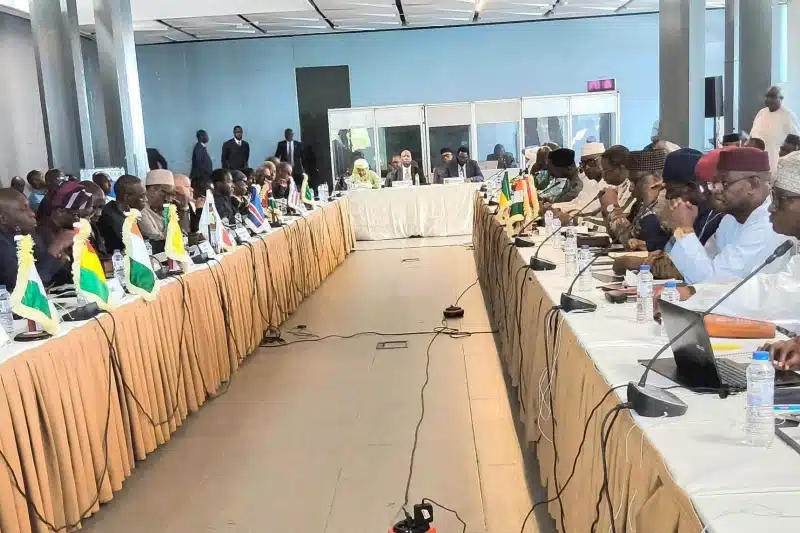

Nearly 21 months after their withdrawal from ECOWAS took effect, the ECOWAS-AES talks have formally begun, opening a new phase in relations between the West African bloc and the Alliance of Sahel States (AES). On Saturday in Dakar, the two sides held their first formal ministerial session on cooperation.
They did not leave with a deal. The ECOWAS-AES talks produced a joint communiqué and a plan to set up thematic working groups. Those groups are meant to prepare a framework cooperation agreement.
Cheikh Niang, Senegal’s foreign minister and chair of the ECOWAS Council of Ministers, led the bloc’s delegation. Karamoko Jean-Marie Traoré, Burkina Faso’s foreign minister and chair of the AES ministerial steering committee, led the Sahel side.
Traoré read out the communiqué himself. The text says the working groups will hold technical exchanges on shared interests and report to ministers before the next session. It sets no date or venue for that meeting. Those will be fixed later through diplomatic channels.
Both sides say the ECOWAS-AES talks should deliver a framework that is “balanced, realistic” and protects the interests of their peoples. The joint statement, as AFP reported it, also welcomed the “spirit of fraternity, mutual respect and openness” of the session.
The communiqué does not list the working groups’ specific mandates. RFI reported that free movement, trade and counterterrorism were among the issues under discussion. These are not abstract diplomatic concerns. They affect how people cross borders, how businesses move goods and how neighbouring states respond to insecurity.
That is the real story. The talks are not really about flags. They are about border posts, trade rules and passports. Traders, drivers and families who live across these frontiers do not care which bloc holds a seat. They care whether the rules that let them move will survive.
The road to the ECOWAS-AES talks has been rough. The three states formed the AES in September 2023. That followed military takeovers and a bitter row with ECOWAS over sanctions and the threat of force in Niger. They announced their exit in January 2024. It took effect on 29 January 2025.
ECOWAS then issued transitional guidelines to limit the damage, including duty-free trade, visa-free movement and residence for citizens of the three states. Talks followed in Niamey in February 2025 and in Bamako in May 2025. Traoré recalled on Friday that those rounds identified 14 areas of shared interest.
Until Saturday, however, those contacts were exploratory. AFP noted that Dakar was the first official ministerial meeting, even though contacts began in January 2025. That makes the ECOWAS-AES talks the first formal test of a relationship that has run on guidelines and goodwill.
Trade remains one of the practical tests for the two sides. In March 2025, the AES introduced a 0.5 per cent import levy, raising questions about how trade arrangements would work after the three countries left ECOWAS. Any future cooperation framework will need to address the rules governing cross-border commerce.
Before leaving for Dakar, the AES ministers named three priorities. These were the sovereignty of the three states, the consolidation of the Confederation and the defence of their peoples’ interests. Regional coverage called them red lines.
Traoré added a fourth message, aimed at the rumour mill. Before the ECOWAS-AES talks, he dismissed talk of a return to ECOWAS. The new page, he said, is about formalising relations between two distinct entities. The Confederation, he added, “is not built against anyone”.
Mali’s Abdoulaye Diop made the practical point. He said the two bodies need a legal instrument to frame their ties. For the AES, the ECOWAS-AES talks are about recognition, not readmission.
ECOWAS is also choosing its tone. Lansana Kouyaté, the bloc’s chief mediator with the AES, called the dialogue a “palaver tree”, a place where problems are talked through in the open. He urged both sides to keep the channel alive, even when it gets difficult.
Senegal’s President Bassirou Diomaye Faye has chaired ECOWAS since the Freetown summit on 19 July. He has urged the bloc to move from findings to action. Yet the communiqué sets no deadline for a framework agreement. Good intentions without a timetable tend to drift.
Nigeria has a direct stake in the outcome. Minister of State for Foreign Affairs Sola Enikanolaiye led the country’s delegation to the Dakar engagement, underscoring Abuja’s interest in preserving regional ties after the three Sahelian states left ECOWAS. Nigeria shares an extensive border with Niger, making the future of cross-border movement, trade and security cooperation a practical concern.
Gilles Yabi, founder of the Dakar-based think tank Wathi, said in December 2024 that the two camps were heading towards an “amicable separation”. Nearly two years later, that separation still lacks its paperwork.
The working groups are expected to prepare proposals for a framework cooperation agreement, but the next ministerial session has no confirmed date. Until those proposals emerge, the ECOWAS-AES talks remain a promise, not a policy.
Leaving was the easy part. Writing the rules for living next door is the work that began in Dakar on Saturday.


