




Power cuts in Tunisia are triggering severe water shortages, as a brutal heatwave pushes temperatures towards 50C across the country.
Kairouan, in central Tunisia, hit 49.8C on 27 August. That is according to the country’s Observatory for Weather and Climate.
The heat has forced households to run air conditioners day and night. Electricity demand has climbed to record levels as a result.
State utility STEG says demand reached roughly six gigawatts this week. That is up from 5.6 gigawatts just days earlier.
To protect the grid, STEG has been issuing daily notices. They list the neighbourhoods facing scheduled power cuts.
But these power cuts in Tunisia are not staying confined to lights and fridges. They are hitting the taps too.
On 24 August, an electricity interruption knocked out the main Kerker pumping station. Drinking water was cut to parts of Mahdia and Sfax.
That is according to SONEDE, Tunisia’s National Company for Water Exploitation and Distribution. It is the clearest example yet of how power cuts in Tunisia translate directly into empty taps.
Many pumping stations run on electricity alone.
So when the power goes, the water often follows soon after. The Kerker incident is one clear example of that chain reaction.
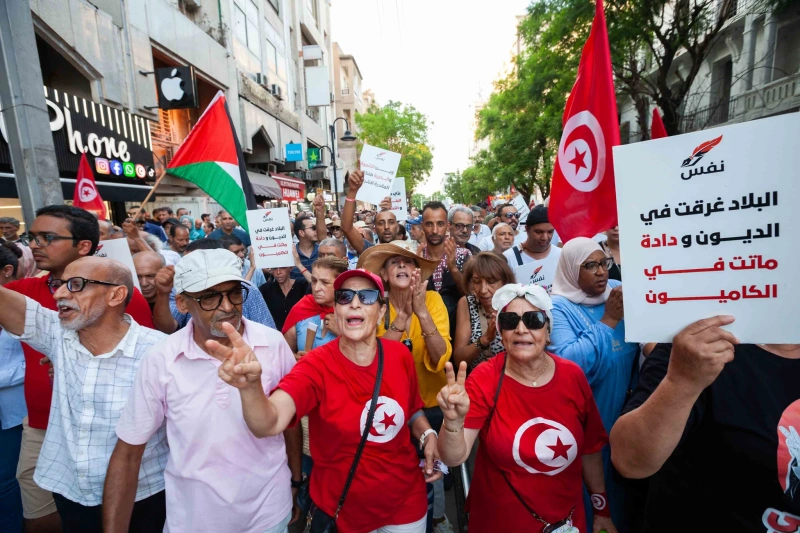
Frustration over the power cuts in Tunisia has spilled onto the streets. The Nafas movement organised a protest in Tunis on 20 August.
Demonstrators demanded reliable water and electricity. They also raised concerns about living costs and political freedoms.
President Kais Saied has rejected the idea that the outages are simple technical faults. He made his case after a cabinet meeting with Prime Minister Sarra Zaafrani, joined by STEG and SONEDE officials.
Saied described the disruptions as deliberate acts meant to sow confusion. He offered no evidence to support that claim.
He later visited the Ghedir El Golla water complex in Ariana, just north of Tunis. There, he pressed officials for accountability over the cuts.
This is not only about one bad summer, though. Tunisia has faced structural water scarcity and recurring drought for years.
The World Bank has been funding projects to make drinking water supplies more resilient to climate pressures. That work predates the current crisis by some time.
Power cuts in Tunisia have also been worsened by trouble next door. Tunisia leans on Algeria for gas and electricity imports.
A technical fault near Sidi Okba triggered Algeria’s worst blackout in roughly two decades, on 14 July. It cut supplies to about a quarter of Algeria’s provinces.
That outage had knock-on effects across the border. Tunisia’s own grid depends heavily on power flowing in from its larger neighbour.
Libya has suffered a similar squeeze from the same regional heatwave. A transmission line failure in the country’s west set off a nationwide blackout.
It shut down power stations, and with them, the pumps that keep water flowing to homes. Some Libyan areas went without power for up to fourteen hours at a stretch.
That triggered protests in Tripoli, Tajura, Janzur and Ain Zara. Residents there share the same frustrations as those in Tunis.
Officials across the region point to familiar causes behind the power cuts in Tunisia and its neighbours. Ageing infrastructure and years of underinvestment sit at the heart of it.
Heavy reliance on imported fuel makes things worse still. This is despite the region sitting on substantial oil and gas reserves of its own.
The World Meteorological Organization has named North Africa the fastest warming sub-region on the continent. Forecasters expect heatwaves here to keep lasting longer.
They also expect these heatwaves to overlap more often with drought. That combination puts even greater strain on water systems.
Tunisia has set a target of drawing 35 per cent of its electricity from renewable sources by 2030. Solar and wind still make up only a small share of the mix today.
STEG says it is coordinating with Algeria and Libya to strengthen cross-border power links. A planned 600 megawatt cable to Italy also remains in the pipeline.
None of these projects will ease pressure before the current heatwave passes, though. Relief from the power cuts in Tunisia is still years away.
For now, families across Tunisia are adapting to daily disruption as best they can. Officials expect electricity demand to keep climbing by 2.5 to 3.5 per cent a year through 2030.
That growth trajectory suggests power cuts in Tunisia could become a routine part of summer. It may no longer be treated as an exceptional event.


