




Three men walked into a house where people were enjoying an evening together and left eleven of them dead. That is the brutal shorthand for what happened in KwaMakhutha on Tuesday night, and it is the kind of sentence no editor wants to write twice in one year about the same stretch of South African coastline.
Ten people died where they sat or stood. Four others were rushed to hospital. One of them did not survive the night, bringing the final toll to eleven. Three more remain wounded. Police spokesperson Colonel Robert Netshiunda confirmed the sequence of events on Wednesday, saying investigators believe the attackers targeted the gathering deliberately rather than firing at random.
No one has been arrested in connection with the KwaMakhutha shooting. That is the uncomfortable truth sitting at the centre of this story almost a full day later. Detectives have launched a manhunt, but as of Wednesday afternoon the three men who carried out the KwaMakhutha shooting had vanished into a township that, like much of KwaZulu-Natal, has learned to live with sudden violence.
What makes the KwaMakhutha shooting harder to file away as routine is the ambiguity around motive. Police have not ruled out a feud between rival groups. They have also acknowledged, carefully and without elaborating, that some of the people inside that house were already known to investigators in connection with other criminal activity. That is police language for saying this was not a random act, even if the full picture is still forming.
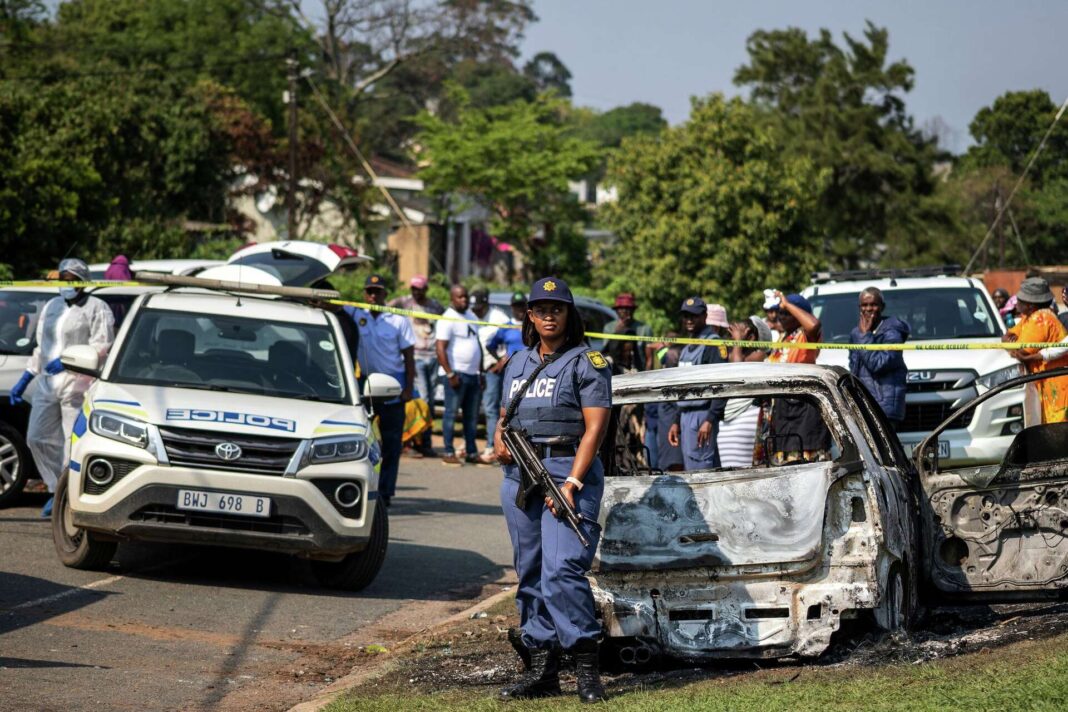
Officers are also examining whether a car torched near the property that same night is connected to the attack.
The scene told its own story by daylight. Bodies lay under white sheets outside the small house while forensic teams worked the property behind cordon tape, according to reporting carried by CBC News. It is the kind of image South Africans have seen too often, and one reason the KwaMakhutha shooting has drawn national political attention within hours rather than days.
KwaZulu-Natal Premier Thamsanqa Ntuli travelled to the scene of the KwaMakhutha shooting on Wednesday and did not soften his language. He told reporters the killings were “really disturbing,” and pointed to drug dealing and illegal firearms as entrenched problems in the community, a link his office says officials will now examine more closely as the investigation continues. His spokesperson, Lindelani Mbatha, said the province had extended condolences to grieving families and would engage community leaders and law enforcement over the coming days.
Context matters here, and the numbers are sobering rather than shocking to anyone who follows crime statistics in this province. Police figures for April to June this year recorded 1,179 murders across KwaZulu-Natal alone, a slight year-on-year decline that officials were careful not to celebrate. Acting Provincial Commissioner Phumelele Makoba put it plainly at the time: a falling number is not the same as safety.
The KwaMakhutha shooting also lands inside a wider, grimmer pattern. South Africa has recorded several mass shootings at social gatherings this year, including one in Johannesburg in June that killed twelve people. Each case tends to follow the same script: young people gathered for something ordinary, gunmen arriving without warning, and a community left to bury its dead before anyone is charged.
In the aftermath of the KwaMakhutha shooting, the people of Ziko are doing what has become a familiar, exhausting ritual. They are mourning, answering questions from investigators, and waiting to see whether this manhunt ends differently from the ones before it. Eleven families do not have that luxury of waiting. They already know how this particular night ended for them.


