



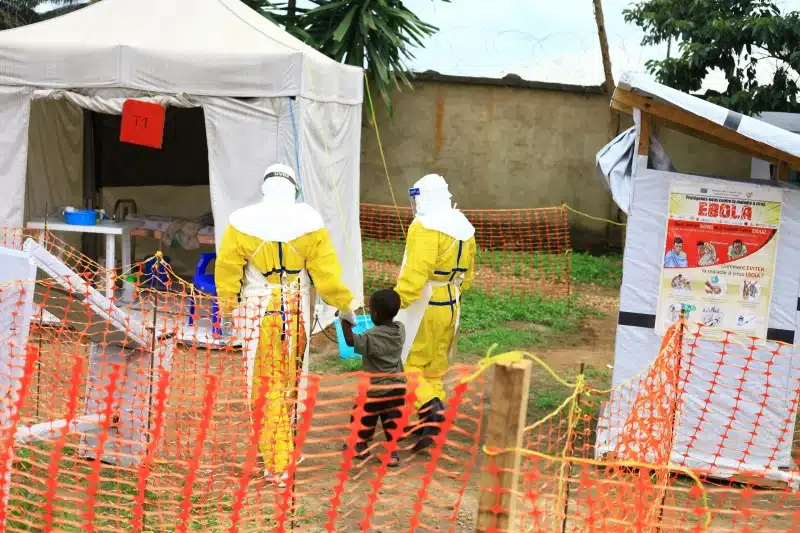

Africa CDC convenes emergency meeting as conflict, mining corridors and porous borders threaten to push Ituri beyond control
AfricanQuarters.co | 15 May 2026
The numbers arrived on Friday and they were grim. Africa’s top public health body, the Africa Centres for Disease Control and Prevention, confirmed a new Ebola outbreak in DRC’s war-ravaged Ituri province, recording 246 suspected cases and 65 deaths. Four of those deaths have been confirmed through laboratory testing.
It is the country’s 17th documented Ebola outbreak since the virus was first identified there in 1976.
But this Ebola outbreak in DRC is already different from those that came before it, and health officials are deeply unsettled by one specific reason. They said the current Ebola outbreak in DRC is evolving faster than many previous flare-ups recorded in eastern Congo.
The Strain Nobody Was Expecting
Preliminary laboratory results from the Institut National de Recherche Biomédicale, known as the INRB, detected the Ebola virus in 13 of 20 tested samples. The troubling part: the results suggest a non-Zaire ebolavirus strain is responsible.
That matters enormously.
According to the World Health Organisation, the only two vaccines currently licensed and stockpiled for outbreak response, Ervebo and the Zabdeno-Mvabea regimen, are specifically designed to protect against the Zaire species of the virus. Both Ervebo and Zabdeno-Mvabea are prequalified by WHO for Ebola virus disease caused by Ebola virus of the species Orthoebolavirus zairense. If the strain circulating in Ituri turns out to be something else entirely, the existing vaccine stockpile could be rendered medically useless against it.
Africa CDC said on Friday that genomic sequencing results are expected within 24 hours, with the agency providing direct laboratory support. Africa CDC said it will work with partners to assess the availability and appropriateness of medical countermeasures once sequencing results confirm the exact ebolavirus species.
Until then, response teams are operating without a confirmed therapeutic playbook.
Where the Outbreak Sits
The current Ebola outbreak in DRC is concentrated in Ituri province, a region sitting more than 1,000 kilometres from the capital, Kinshasa. Ituri is characterised by poor road networks, remote settlements and limited health infrastructure that slow contact tracing and delay treatment.
The two hardest-hit areas are the Mongwalu and Rwampara health zones. Suspected cases have also now appeared in Bunia, the provincial capital, though confirmation is still pending. However, public health analysts warn the Ebola outbreak in DRC could accelerate if confirmed infections establish sustained transmission inside Bunia.
That development in Bunia is what has health officials most worried.
Africa CDC said it is concerned about the risk of further spread due to the urban context of Bunia and Rwampara, intense population movement, mining-related mobility in Mongwalu, insecurity in affected areas, gaps in contact listing, and the proximity of affected areas to Uganda and South Sudan.
Mining Routes Are the Virus’s Best Friend
Mongwalu is not just a health zone. It is a major gold mining hub, and that creates a specific containment nightmare.
Miners move constantly, shuttling between remote bush camps, local trading centres, and larger towns. They carry goods, cash, and potentially the virus across dozens of kilometres of terrain that health workers struggle to access even in peacetime. That mobility is now considered one of the biggest structural risks driving the Ebola outbreak in DRC.
This is not a new problem for the region. Research published in the Proceedings of the National Academy of Sciences found that mining regions in the provinces of North Kivu and Ituri have been repeatedly destabilised, with conflict from more than 70 armed groups making it nearly impossible to maintain consistent public health operations. The interaction between commercial movement and active insecurity creates conditions where a single untraceable contact can seed multiple new clusters.
A Province Already at War
The Ebola outbreak in DRC is unfolding in a province that is simultaneously fighting a different kind of battle. Ituri is battling violence from the Allied Democratic Force, an ISIS-linked militant group which has killed dozens there and in other parts of eastern DRC.
The consequences for outbreak response are severe. Medical teams cannot safely establish isolation centres in areas under active threat. Safe and dignified burials, which are critical to breaking transmission, cannot be conducted in zones where armed actors operate freely. Contact tracing, which requires going door to door in affected communities, becomes impossible when those communities are in active conflict zones.
History has demonstrated exactly what happens when these two crises collide. During the 2018 to 2020 Ebola outbreak in North Kivu and Ituri, which remains the largest in the DRC’s history, the outbreak lasted approximately two years, peaking in mid-2019, with violence from armed groups and pockets of community mistrust making it extremely difficult to control despite rapid national and international responses. That outbreak claimed 2,287 lives.
The Border Threat
The Ebola outbreak in DRC is also raising urgent alarm in neighbouring countries. Ituri shares borders with Uganda and South Sudan, and population movement across those frontiers is constant and largely informal.
The concern is not hypothetical. During the 2018 outbreak, four confirmed cases were recorded in Uganda attributed to cross-border movement from DRC. The DRC government declared its 10th Ebola outbreak on 1 August 2018, with cases eventually reported in Ituri, South Kivu, and Uganda before the WHO declared it over on 25 June 2020.
This time, Africa CDC moved immediately to prevent a repeat.
An Emergency Meeting Like Few Before It
On Friday 15 May 2026, Africa CDC convened an urgent high-level coordination meeting bringing together health authorities from DRC, Uganda and South Sudan alongside an unusually broad coalition of global partners.
Partners at the meeting include the World Health Organisation, UNICEF, FAO, the United States CDC, the European CDC, China CDC, the Public Health Agency of Canada, pharmaceutical companies including Gilead Sciences, Merck and Co., Johnson and Johnson Innovative Medicine, Regeneron Pharmaceuticals, Roche, Abbott Laboratories, BioNTech and Moderna, as well as financing bodies including the World Bank, the African Development Bank, the Gates Foundation and the Wellcome Trust.
The meeting is focused on immediate response priorities: cross-border surveillance, laboratory support, infection prevention, risk communication, safe burials, and resource mobilisation.
Africa CDC Director General Dr Jean Kaseya addressed the gravity of the moment directly. Given the high population movement between affected areas and neighbouring countries, rapid regional coordination is essential. We are working with DRC, Uganda, South Sudan and partners to strengthen surveillance, preparedness and response, and to help contain the outbreak as quickly as possible,” Dr Kaseya said.
The Clock Is Now Running
The sequencing results expected within hours will define the entire trajectory of the response. If they confirm a Zaire strain, the existing stockpile of Ervebo vaccines can be deployed immediately. If they confirm something else, the international coalition assembled on Friday will face the far harder task of developing or sourcing countermeasures from scratch while the outbreak continues to spread.
This new Ebola outbreak in DRC arrives barely five months after the country declared its previous outbreak over. That earlier outbreak, which lasted three months, ended with 43 deaths, and the World Health Organisation had initially faced significant challenges delivering vaccines due to limited access and scarce funds.
Those funding constraints have not gone away. Neither has the conflict. Neither has the mining mobility. International responders say the Ebola outbreak in DRC may become significantly harder to contain if vaccine limitations are confirmed through sequencing.
The next 24 hours in Ituri will tell health authorities which weapon they have available to fight back. After that, the harder work begins.
This story is developing. AfricanQuarters will update as sequencing results and further case figures are released.


