



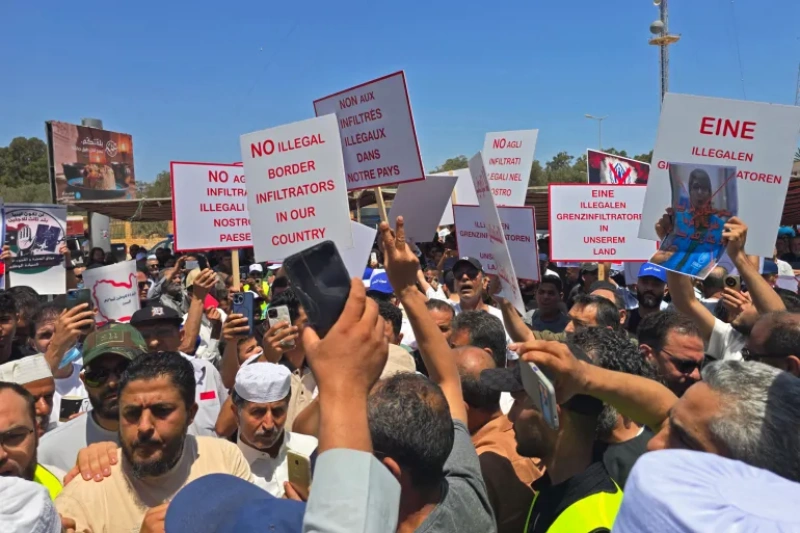

Hundreds of Libyans took to the streets of Tripoli on Thursday, 4 June, surrounding the headquarters of the United Nations High Commissioner for Refugees in what became one of the most visible Libya protest against migrants in recent years.
Demonstrators blocked off the UNHCR’s main office in Tripoli’s Sarraj neighbourhood, chanting slogans such as “No, No to settlement, Libya only for Libyans.” The Libya protest against migrants drew hundreds of demonstrators carrying signs reading “Our love for our country is not racism” and “Libya is not the world’s garbage bin.”
Some protesters stormed the compound itself, demanding the expulsion of the agency over allegations of migrant resettlement in Libya.
Videos circulating on social media showed demonstrators entering a United Nations mission office in the Janzour district west of the capital. Other protesters blocked access to a UNHCR office in the Sarraj area by piling sand and debris at its entrances.
No clashes or injuries were immediately reported.
A country stretched thin
Libya has a total population of roughly seven million people. The growing migrant population has become a major political issue, helping fuel the latest Libya protest against migrants in the capital. According to the UN, it now harbours well over 900,000 migrants.
Since a NATO-backed uprising in 2011, Libya has become a transit route for hundreds of thousands of migrants fleeing conflict and poverty, often from sub-Saharan Africa, with many risking dangerous journeys across the desert or the Mediterranean.
Sudanese nationals make up 35 per cent of the migrant population, an influx that surged after conflict erupted in Sudan in 2023, driving tens of thousands across Libya’s southern border.
More than 538,000 Sudanese have arrived since 2023, more than 80 per cent of them women and children, most entering through the remote desert crossing at Alkufra. Only around 70,000 have been formally registered.
The scale of that movement forms much of the backdrop to Thursday’s Libya protest against migrants. One demonstrator, Ahmad al-Ghasa, told Reuters he blamed migrants for break-ins and assaults in his neighbourhood. “These phenomena were not present in Libyan society before,” he said.
The UN pushes back
The UN mission in Libya issued a firm denial on Thursday. It said UN agencies “are not implementing any programmes to resettle migrants in Libya and all claims against that are completely unhealthy.”
The mission said UNHCR works to help people fleeing war find solutions outside Libya, including evacuation to third countries and voluntary return when conditions allow. UN officials stressed that misinformation surrounding migration policies has contributed to tensions behind the recent Libya protest against migrants.
Ahead of the protest, the UN mission had warned against a “renewed spread of misinformation, disinformation, and inflammatory rhetoric” targeting individuals or specific groups, and called on authorities to address acts of incitement that could threaten public order or the rights of individuals.
UNHCR did not respond to a separate request for comment from Reuters.
Officials add their voices
The Libya protest against migrants carried some official backing alongside it. Libya’s acting Foreign Minister Taher al-Baour earlier this week reiterated his government’s rejection of any proposal to permanently settle irregular migrants in the country, telling the Libya Alahrar channel that Libya was “not capable of handling these numbers.”
Senior Libyan officials including High Council of State President Mohamed Takala, Presidential Council member Abdullah Al-Lafi and Administrative Control Authority chief Abdullah Qaderbouh issued similar statements. The Al-Sarraj Social Council, a local civil society organisation, backed the demonstrations and called for the removal of UNHCR operations from Libya altogether.
Saddam Haftar, deputy commander of eastern Libyan forces, also ordered security agencies to end what he described as irregular migration activity in areas under his command.
A gateway with no exit
For the migrants at the centre of Thursday’s Libya protest against migrants, conditions remain grim. Without documentation, refugees cannot access services and risk arrest and deportation. More than 3,700 were deported in 2025 alone. For many, the calculation becomes whether to attempt the Mediterranean crossing.
In 2025, Sudanese nationals were among the top nationalities intercepted at sea and among those arriving in Italy and Greece.
UNHCR’s 2026 regional response plan has allocated $116 million for Libya as part of a broader $1.6 billion Sudan refugee response covering seven countries, with the agency and 123 partners seeking to prevent dangerous sea crossings from becoming the only option for those stranded inside the country.
The Libya protest against migrants on Thursday underlines how sharply public sentiment is hardening, even as the humanitarian needs driving migration into the country show no sign of easing.


