



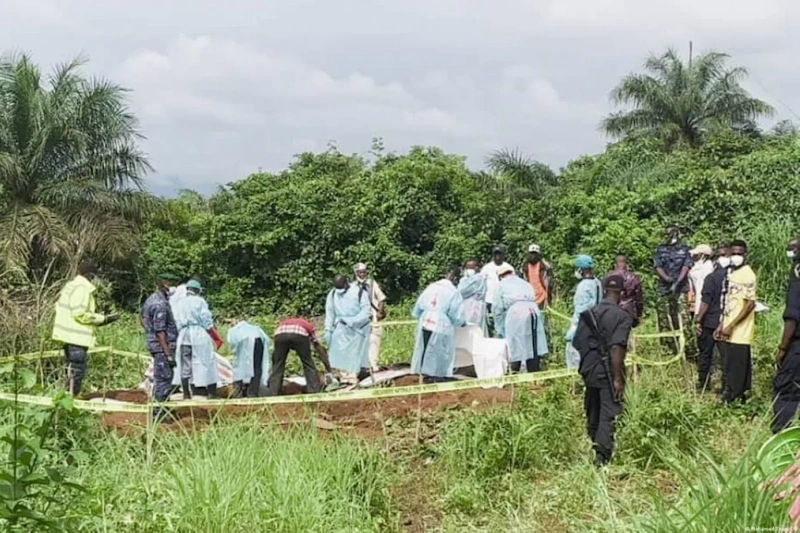

The Forecariah mass grave investigation is drawing growing attention across West Africa after the discovery of six bodies buried in a forest in south-western Guinea.
The bodies were found near Allassoyah in Forecariah prefecture after local residents searching for firewood alerted authorities to a suspicious site.
According to officials, all six victims were male. Their hands were reportedly bound and their eyes blindfolded when the bodies were recovered.
The discovery has turned the Forecariah mass grave investigation into a major test for Guinea’s military-led authorities, who have promised to establish how the men died and who was responsible.
The bodies were transferred to a local hospital as investigators began efforts to identify the victims and determine the circumstances surrounding their deaths.
So far, authorities have not released the names of the deceased or provided details about how long the bodies may have been buried.
That lack of information has fuelled concern among rights groups and families of missing persons.
A coalition of 20 African civil society organisations is now calling for an independent and transparent inquiry.
The organisations argue that the Forecariah mass grave investigation should involve national and international forensic experts to ensure the findings are credible and accepted by the public.
They say every possible explanation must be examined before conclusions are reached.
Rights advocates have also urged investigators to preserve evidence carefully and conduct DNA testing where possible.
The discovery has revived wider concerns about disappearances and accountability in Guinea.
Several civil society organisations have documented cases of people who allegedly disappeared after the military seized power in September 2021.
While there is no evidence linking those cases directly to the six bodies found in Forecariah, campaigners say the context makes a thorough investigation essential.
The Forecariah mass grave investigation is therefore being watched closely not only by local communities but also by regional rights groups.
Guinea’s armed forces have acknowledged the seriousness of the case and pledged to make the results of the inquiry public.
Officials have cautioned against speculation while forensic and judicial work continues.
Investigators are expected to focus first on identifying the victims.
Establishing who the men were could provide crucial clues about how they ended up in the remote forest location where they were discovered.
The Forecariah mass grave investigation may also seek to establish whether the victims were killed elsewhere before being buried at the site.
Questions remain about whether the men knew one another, where they came from and whether relatives had previously reported them missing.
Those answers could take weeks or even months to emerge.
The case has already attracted international attention.
France has publicly supported calls for a transparent judicial inquiry, while rights organisations have urged close monitoring of the process.
The pressure reflects growing concern that unresolved cases can undermine public trust in state institutions.
For residents of Forecariah, the discovery has been deeply unsettling.
The prefecture lies about 90 kilometres south-west of the capital, Conakry, and is known largely for farming, fishing and cross-border trade with neighbouring Sierra Leone.
The appearance of a burial site containing six bound and blindfolded men has shocked many local communities.
As investigators continue their work, the Forecariah mass grave investigation is becoming one of Guinea’s most sensitive human rights cases in recent years.
Much now depends on whether authorities can establish the identities of the victims and provide a clear account of what happened.
Civil society groups say transparency will be essential.
Without credible answers, questions surrounding the deaths are likely to persist.
For now, the Forecariah mass grave investigation remains focused on a simple objective: identifying six men whose deaths have raised concerns far beyond the forest where they were found.
Until that process is complete, pressure on investigators is expected to continue.
The outcome of the Forecariah mass grave investigation could shape public confidence in Guinea’s justice system and determine whether families searching for missing relatives finally receive answers.


