



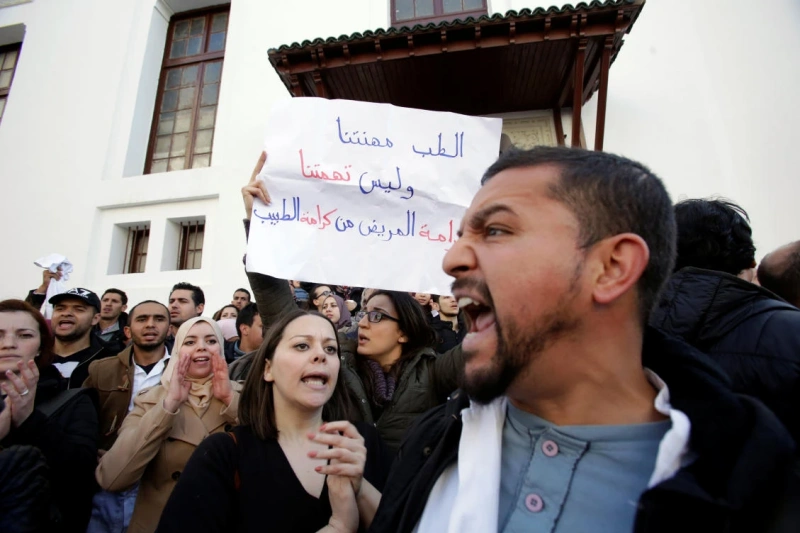

The Libya salary protests are no longer a teachers’ dispute. What began as classroom sit-ins has pulled in doctors, nurses and now university lecturers, and the government is running out of room to treat each grievance separately.
The spark is easy to trace.
Libya’s House of Representatives approved a new pay structure for the armed forces late last year, then finalised a detailed scale for the eastern army in April, lifting a field marshal’s monthly salary to 12,800 dinars and a soldier’s to 2,100 dinars.
Civil servants took note.
Teachers noticed first, and loudest, becoming the first organised force behind the Libya salary protests.
Wasim Kleish, who heads the steering committee of the Teachers’ Syndicate in Al-Arban, set out the grievance in a phone interview with Libya Al-Ahrar TV this month.
He said teachers want their pay moved onto the unified public sector scale already benefiting other groups, rather than staying under the older Law No. 4 that leaves education salaries at the bottom.
Class allowances promised for the 2025/2026 academic year, he added, still have not been disbursed, despite assurances from the education and finance ministries after a meeting with the prime minister.
The dispute has become central to the Libya salary protests.
Kleish was careful to frame the action as restrained.
Teachers, he said, “do not want to disrupt state functions or harm students in any way,” and any sit-ins would stay inside schools, organised and without absences logged against staff.
That restraint has not stopped the Libya salary protests from spreading.
Health workers joined within days.
Medical staff at Al-Khadra and Zuwara hospitals announced they were falling in behind a partial strike already under way elsewhere.
The General Syndicate for Allied Medical Professions issued a statement that read less like a complaint and more like a warning.
“IT IS INCONCEIVABLE THAT DOORS ARE OPENED FOR SALARY INCREASES AND SPECIAL PRIVILEGES FOR CERTAIN GROUPS, WHILE HEALTHCARE WORKERS, WHO BEAR THE RESPONSIBILITY OF SAVING THE LIVES OF THE SICK AND INJURED, ARE LEFT TO SUFFER WITH LOW WAGES.”
The syndicate went further, threatening escalation “up to and including a comprehensive, total sit-in across all health facilities and institutions at every level” if the government keeps stalling.
That line captures what is driving the Libya salary protests now.
Soldiers received a rise, backdated increases and hazard payments for the wounded.
Doctors, nurses and radiographers, the syndicate argues, get sympathy and delay instead.
The statement never named the military outright, but few in Tripoli misread who “certain groups” meant.
Political analyst Mohamed Al-Harari told local media that wage disputes have increasingly become a test of state credibility in Libya, where rival administrations continue to compete for public legitimacy through spending commitments and salary policies.
The widening Libya salary protests, he suggested, reflect broader frustrations over how public resources are distributed across sectors.
University lecturers have watched this pattern before.
Libya’s academic unions have a history of turning grievance into leverage fast, having previously halted teaching at public universities for weeks until pay disputes were resolved.
With classroom staff and hospital workers already mobilised, faculty representatives have signalled they could join the wider Libya salary protests if wages are not addressed.
Such a step would put entire semesters at risk just as the new academic year gets under way.
What sets this round of Libya salary protests apart is the timing.
Teachers, health workers and now university staff are converging within the same fortnight, rather than taking turns the way they have in past years.
A government used to negotiating with one aggrieved union at a time now faces several at once, each pointing to the military pay rise as proof that money exists when the political will is there.
None of the unions involved are asking for anything unusual by regional standards: a functioning pay scale, health insurance and allowances paid on schedule.
What sharpens their case is the comparison sitting right beside it, an army given a rise while the people staffing classrooms and operating theatres are told to wait their turn.
Libya has cycled through this before, teachers striking, professors sitting in, doctors threatening walkouts that get patched over with promises instead of budgets.
This time the sectors are not moving one after another.
They are moving together, and that is the part the government cannot afford to underestimate as the Libya salary protests enter a more coordinated phase.


