



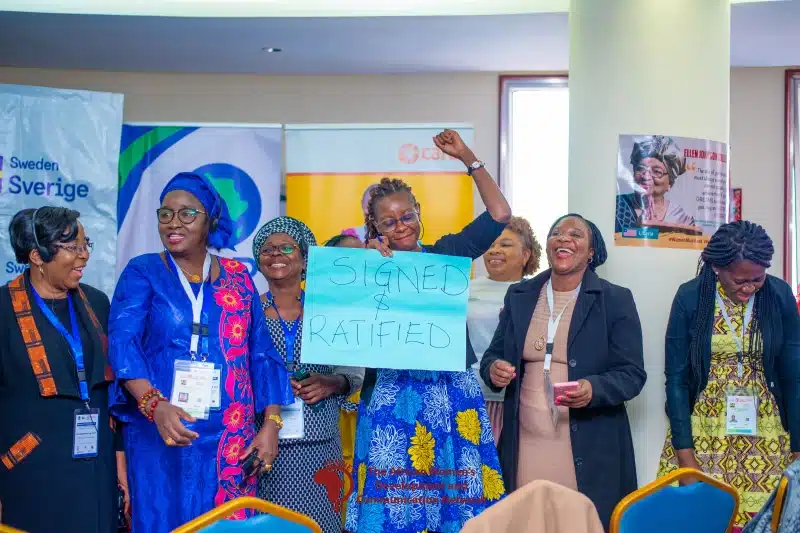

Feminist and women’s rights organisations in Senegal did not let the claim stand. Within days, a coalition of these groups issued a joint statement making clear that the Maputo Protocol, ratified by Senegal in December 2004 without reservation, deals exclusively with the rights of women and girls. Nothing in its text touches on sexual orientation, they said, and using it to fuel a moral panic distorts a document that took years of continental negotiation to produce.
The protocol, officially the Protocol to the African Charter on Human and Peoples‘ Rights on the Rights of Women in Africa, was adopted by the African Union in July 2003 in the Mozambican city that gives it its name. It commits ratifying states to a long list of guarantees, among them political participation, protection from harmful practices such as female genital mutilation, reproductive health decisions, and equal standing with men before the law.
According to the University of Pretoria’s Centre for Human Rights, which tracks ratification across the continent, Senegal signed the Maputo Protocol in December 2003 and ratified it a year later, becoming one of the treaty’s earliest and most vocal supporters.
Yet more than two decades after ratification, several of the Maputo Protocol’s key provisions remain absent from Senegalese law.
Article 14 of the Maputo Protocol asks states to guarantee women’s reproductive rights, including access to medically supervised abortion in cases of rape, incest or danger to the mother’s health. Senegalese law has not caught up.
Survivors of sexual violence who become pregnant are still, in most circumstances, required to carry the pregnancy to term, according to a 2024 report by Senegal’s national statistics agency, cited by rights groups pressing the government to align its penal code with its own treaty obligations.
Girls under 18 can still legally marry in Senegal too, one of eleven African countries where this remains possible more than two decades after the Maputo Protocol asked states to set 18 as the minimum age for marriage. Campaigners say this gap between what Senegal signed and what its laws actually permit is the real story here, not a manufactured link to homosexuality.
The February row erupted against a tense backdrop. Senegal’s parliament voted in March to toughen penalties under the penal code’s provisions on what it calls acts against nature, effectively increasing prison terms for consensual same sex conduct. The group that questioned the Maputo Protocol, led by Ababacar Mboup, had campaigned for years for that change. Mboup has framed his campaign as a defence of national identity, telling the Associated Press that homosexuality is contrary to our customs, our values, and our beliefs.
Women’s rights advocates worry that conflating the Maputo Protocol with an unrelated debate could weaken its standing in Senegal over time, even though the treaty has provided legal grounds for court rulings elsewhere on the continent.
A Tanzanian appeal court cited it in 2019 when it struck down a lower marriage age that had applied only to girls. Campaigners argue that every attempt to link the protocol to debates it was never written for chips away at public understanding of what it actually protects.
Senegal is not an outlier in the gap between ratification and results. By the Maputo Protocol’s own 20th anniversary review, forty four of Africa’s fifty five states had ratified it, yet more than half had failed to submit the periodic reports required to track progress. Eleven states, including neighbouring Mali, had not ratified it at all. The protocol’s drafters intended it as one of the world’s most progressive rights instruments. Two decades on, its biggest obstacle is not opposition to its text but indifference to enforcing it.
For the women and girls the Maputo Protocol was written to protect, the February controversy in Dakar changed nothing about daily reality. The law on abortion access has not moved. The minimum marriage age has not moved. What moved, briefly, was a news cycle, and a document written in 2003 to protect African women found itself, once again, being talked about by everyone except the women it was meant to serve.


