



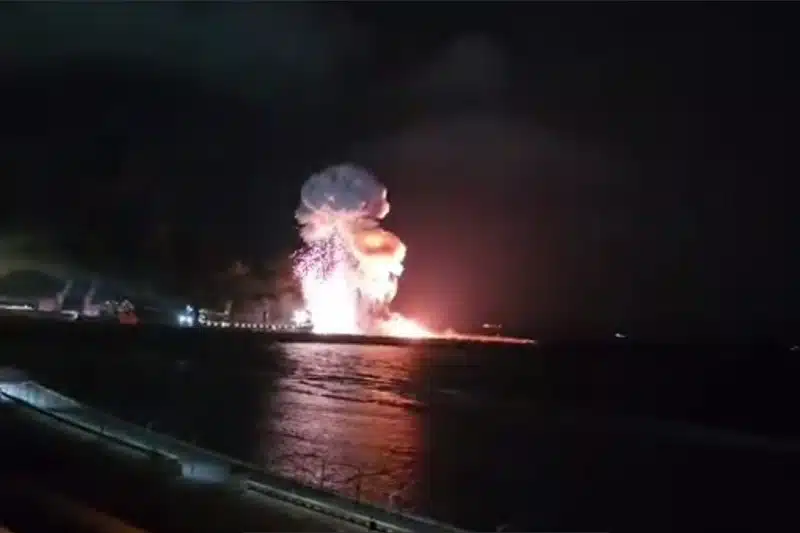

Hours later, Libya’s eastern-based government gave a different account. A preliminary investigation, it said, showed the explosion happened aboard a Russian ship docked in the port. It suspected a drone attack.
The vessel had stopped to refuel and resupply on its way home to Russia, the government said. That was allowed under maritime cooperation agreements between the two sides. Facilities at the Benghazi naval base were safe, it added, and the fire was under control.
That is where the official account stops. The rest is being pieced together from anonymous officials, naval analysts and rival governments.
Two Libyan military officials told the Associated Press that the strike on the Benghazi naval base hit the Merkury, a Russian navy corvette. They said Ukrainian sea drones were launched from a base run by Ukrainian forces in western Libya. Six drones targeted the vessel, they said. At least four were intercepted, while two struck the ship.
Both officials spoke on condition of anonymity. Reuters reported, citing two medical sources, that nobody had died but that people were injured. The number and nationalities of the injured were not known.
Naval analyst H I Sutton, who provisionally identified the ship, assessed that it was almost certainly destroyed or severely damaged. He also said it had been in port for several days, escorting a convoy linked to Russian arms exports.
That sits awkwardly beside the picture of a quick refuelling stop.
Ukraine has not claimed the strike, and Moscow had not commented at the time of writing. The journalist Barak Ravid reported, citing an unnamed source, that Ukraine’s SBU security service carried it out. No government has said so on the record.
AfricanQuarters could not independently verify the ship’s condition or where the drones were launched.
The suspected attack on the Benghazi naval base is not the first of its kind. In March, the Russian gas carrier Arctic Metagaz was badly damaged between Malta and Libya. Moscow blamed Ukrainian sea drones launched from the Libyan coast. President Vladimir Putin called it a terrorist attack.
A month later, Libyan officials told AP that Ukrainian forces, mostly drone experts, were working in the west. They described a covert deal with Prime Minister Abdulhamid Dbeibah’s government in Tripoli. They said the unit operates mainly from an air base in Misrata, with a presence in Tripoli and Zawiya.
As far as AfricanQuarters could find, Kyiv has not commented publicly on the arrangement. Analyst Jalel Harchaoui of the Royal United Services Institute suggested then that it fits years of NATO efforts. The aim, he said, was to keep western Libya “out of Russia’s reach.”
The east, for its part, has become a port of call for Moscow. The Washington Institute, a US think tank, points to reports of Russian plans to develop the deep-water port of Tobruk. It also cites a 2025 military cooperation agreement said to have been signed in Moscow by Khaled Haftar, son of the eastern commander.
So the east’s statement cuts both ways. Its government says it will not let Libyan ports become “an arena for settling scores”. It promises legal and diplomatic action against whoever is responsible.
Yet the same government hosts Russian warships under a cooperation deal. Its own military officials now point across the front line to a base in the west. For the authorities running the Benghazi naval base, that is an uncomfortable position.
Tripoli issued a warning of its own after the Benghazi naval base explosion. Its government said it was alarmed by the risks of drawing civilian ports into activities tied to external conflicts. Each government is warning against a war that its own territory appears to help host.
The east has ordered a joint investigation with Russia into the Benghazi naval base blast. It is an odd arrangement. Moscow owns the damaged ship and is also a partner in finding out who hit it.
And if the officials are right that the drones left from Misrata, the evidence sits in territory the east does not control.
The timing adds weight. On Saturday, a day before the Benghazi naval base blast, drones struck the Russian cargo ship Sparta II in the Baltic Sea. Finnish officials said Ukraine was likely behind the attack.
Libya has had two governments for more than a decade. It now has two sides of someone else’s war on its coastline. So far, neither government has shown it can keep that war out.


