



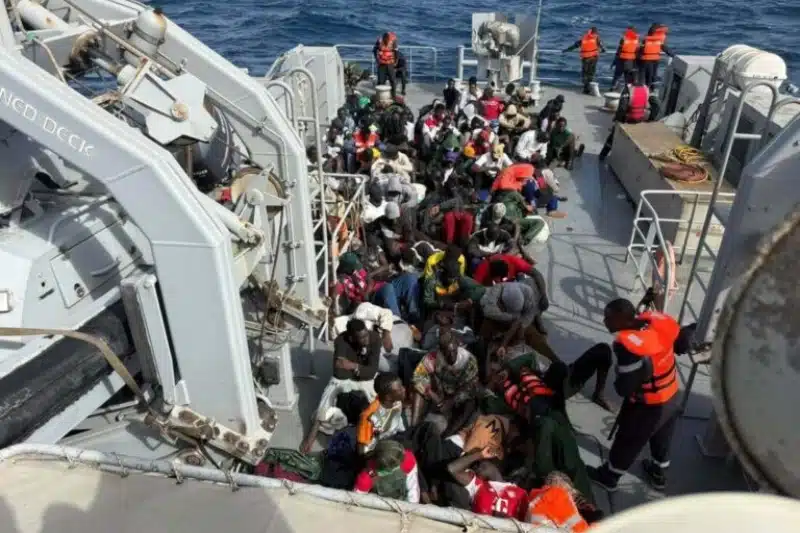

Seven pirogues. 946 people. Two days.
Everyone was brought ashore, the navy said, and handed to “the competent services”. The statement did not name them. It did not say what happens next either.
Look closely at the word “rescued”. The migrants rescued off Senegal this week were brought back to Senegalese shores. The navy did not say where they intended to go, although its statement frames the operations as part of efforts against irregular emigration by sea.
The African Press Agency, APA, puts the number at 3,903 people assisted or intercepted in the navy’s main operations since 1 November. The tally includes 104 people intercepted at Saint-Louis before departure.
Rewind three weeks. Senegal opened the Youth Olympic Games in Dakar on 31 October, the first Olympic event held in Africa.
Six days later, Spain’s interior ministry says, its minister Fernando Grande-Marlaska used a visit to Dakar to urge Senegal to strengthen its migration management.
On 7 November, the Interior Ministry confirmed that a pirogue carrying migrants was wrecked near Lompoul in north-western Senegal. By 11 November, the death toll had risen to 42, with one survivor, according to the national fire brigade. The migrants rescued off Senegal this week were luckier.
On 10 November, the Canary Islands government says, Senegal’s ambassador to Spain, Ibrahim Al Khalil Seck, told regional president Fernando Clavijo that departures had risen since October. He tied part of the rise to officers being pulled off coastal duty for the Games.
The Games closed on Friday 13 November. The next day, Spanish authorities counted 1,580 people reaching the Canary Islands in a single day, a record. Most arrived on El Hierro, an island of about 12,000 residents. The previous record, 1,461, dated from November 2020.
Spain’s Interior Ministry data show 11,037 arrivals in the Canaries in the first 15 days of November. October brought 6,194.
That is a reversal. The International Organization for Migration said in its review of 2025 that arrivals on this route had dropped after tighter border cooperation. It also warned that journeys were getting longer and riskier.
The navy did not say where the migrants rescued off Senegal were headed. But the Canary Islands, Spain’s Atlantic outpost, are where the pressure shows up.
Calm seas play a part. The IOM says El Niño may have eased winds and waves this autumn. The deeper pull is work, or the lack of it.
Helena Maleno, founder of the NGO Caminando Fronteras, told Público that boats once used for fishing now carry people to the islands. “Young people who no longer find a way out in fishing take those same boats,” she said.
President Bassirou Diomaye Faye reacted on 18 November. The communiqué from his council of ministers has him lamenting the “resurgence and intensification” of departures to Europe. The government’s response offered little immediate relief to those already planning to leave.
He wants tighter coastal controls, a detailed report from the interior minister and a special programme for young people’s employment and enterprise.
The patrols behind the migrants rescued off Senegal this week are the quick answer. Jobs are the slow one.
Even as the navy hauls in migrants rescued off Senegal, boats are still reaching El Hierro.
Senegal can count the boats it catches. Nobody can say how many slip past.


