



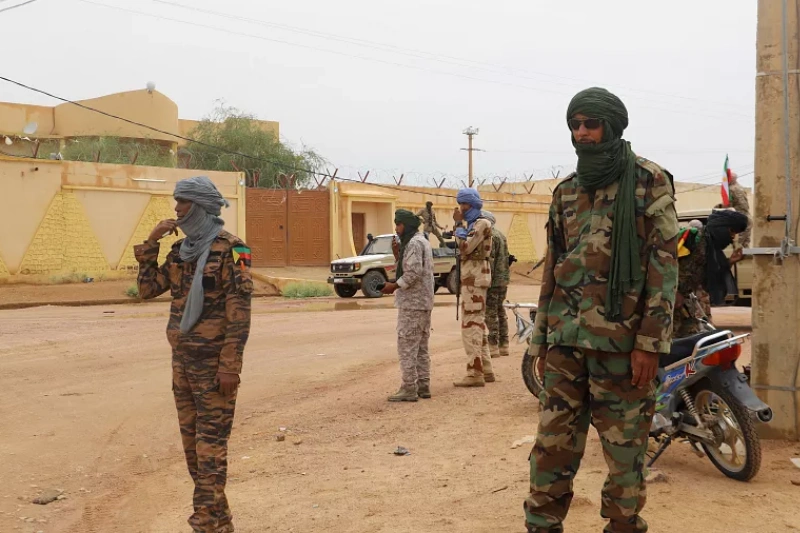

Mali’s military says an Abeïbara strike killed at least 50 fighters in the Kidal region. As at the time of reporting no independent source had verified the military’s casualty figure.
The army’s General Staff made the claim in a communiqué on Sunday 27 September. In its words, translated from French, the Abeïbara strike left at least 50 “terrorists neutralised”, a military term generally used to mean killed or rendered incapable of fighting. Among them were several leaders, the statement said. War equipment was destroyed too.
The Abeïbara strike hit a site about 45 kilometres north-east of the town, in the Kidal region. The army calls the toll provisional. It doesn’t say which group the dead belonged to, and it names no commander.
Independent verification is difficult because much of the Kidal region remains inaccessible to journalists and humanitarian organisations.
It also doesn’t say exactly how the Abeïbara strike was carried out. The release only says the positions were found through intelligence work and then hit.
According to the military, the operation formed part of Operation Dougoukoloko, an ongoing campaign targeting armed groups across northern Mali. The army also said the operation was conducted with support from unnamed partners, without providing further details.
That vagueness matters because this ground has a history. In June 2024, killings in and around Abeïbara left 70 or more people dead or missing, according to local groups. RFI reported that almost all of them were civilians. Local accounts blamed Malian soldiers and their Russian Wagner allies.
Then the map changed. The army had only retaken Kidal in November 2023, after about ten years of rebel control. On 25 April 2026, the Tuareg-led Azawad Liberation Front (FLA) and the al-Qaeda-linked Jama’at Nusrat al-Islam wal-Muslimin (JNIM) struck across Mali together. Defence Minister Sadio Camara was killed in Kati. Within days, Malian troops and Russia’s Africa Corps had pulled out of Kidal.
Since May, the army has hit Kidal from the air. Communiqués named Abeïbara on 24 and 25 August, and again on 7 September. Those notices promised a full assessment later. This Abeïbara strike is the first recent operation for which the army has publicly attached a specific casualty figure.
Numbers are easy to announce, though. On 6 July the army claimed about 200 fighters neutralised at Anefis. Twelve days later, a convoy leaving Anefis was ambushed. A local official close to the junta told AFP the toll was “extremely heavy”, with more than 50 soldiers killed and at least 24 taken prisoner, France 24 reported.
Disputed casualty claims have become a recurring feature of the conflict. In January, RFI reported that local sources and FLA members called an army toll near Ménaka heavily exaggerated. In March 2024, Amnesty International said two army drone strikes killed at least 13 civilians, seven of them children, in the Gao region. The army’s statement had spoken only of neutralised terrorists.
None of that proves the Abeïbara strike figure is wrong. Fifty fighters is plausible if they had gathered, as the army says. Neither the FLA nor JNIM had publicly commented by Monday, as far as we could see.
There’s a second story in the same news cycle. Malian media reported that a convoy of 493 fuel tankers had reached Bamako under army escort. JNIM began a fuel blockade of supply routes in September 2025, according to the Africa Center for Strategic Studies.
For now, the military’s account of the Abeïbara strike remains largely untested. The army says at least 50 fighters were killed, but independent confirmation had not emerged by Monday and no armed group had publicly commented on the claim.


