



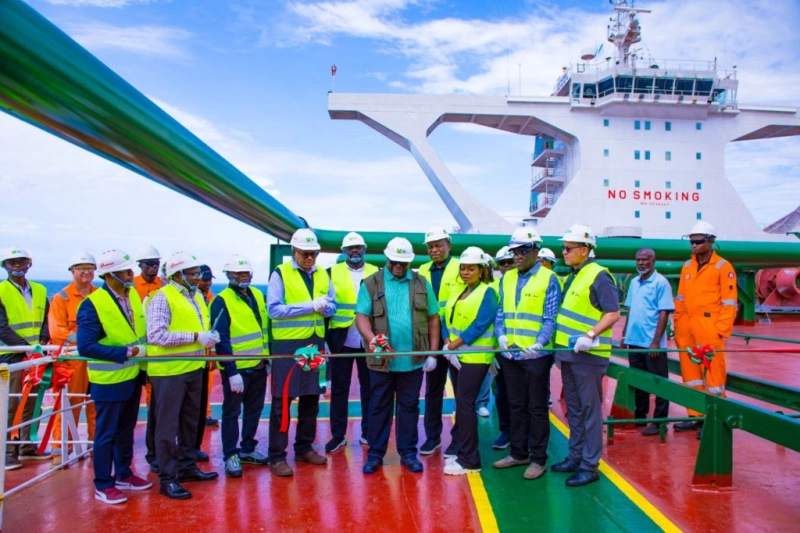

Nigeria’s push to raise oil output has received a boost after Sahara Group and its partners commissioned the country’s first wholly owned floating storage and offloading vessel to support OML 18 crude exports.
The 2.2 million barrel vessel, named Cawthorne, began operations in October 2025 offshore Bonny. It was inaugurated by the Nigerian National Petroleum Company Limited (NNPCL), Sahara Group, Eroton Exploration and Production Company, and Bilton Energy Limited, according to a statement by Sahara Group.
Cawthorne is designed to strengthen OML 18 crude exports by easing the logistical bottlenecks that have long slowed Nigeria’s crude evacuation. Sahara Group said in the statement that the double hull vessel would receive, store and offload crude oil to export tankers.
Udobong Ntia, Executive Vice President Upstream at NNPC, represented Group Chief Executive Officer Bashir Ojulari at the commissioning. Ntia described the vessel as another achievement from the partnership between NNPC and its joint venture partners, according to Sahara Group’s statement. He said it would help meet the production targets set by President Bola Ahmed Tinubu’s administration.
The Nigeria Upstream Petroleum Regulatory Commission also welcomed the vessel. Engineer Enorense Amadasu, who represented NUPRC Chief Executive Gbenga Komolafe, said Cawthorne aligns with the commission’s plan to accelerate OML 18 crude exports reliably and sustainably, per the statement carried by Sahara Group.
Amadasu added that Cawthorne would enhance Nigeria’s export reliability and support a more stable global energy supply chain, boosting confidence in OML 18 crude exports going forward.
Ibiyemi Asaolu, Managing Director of Niger Delta Exploration and Production Offshore Limited, said the vessel secures production continuity from OML 18 while contributing to the country’s long term energy infrastructure, according to the Sahara Group release.
Dr Tosin Etomi, Head of Commercial and Planning at Asharami Energy, the upstream arm of Sahara Group, called the vessel a symbol of innovation meeting necessity, per the same statement. She said Cawthorne was fitted with digital capabilities that reduce carbon exposure from barge movements and improve evacuation safety.
Before Cawthorne, OML 18 crude exports faced persistent constraints. These included limited barging capacity, delays in ship to ship transfers and siltation at berthing slots, Sahara Group said in its statement. The vessel is described as Nigeria’s first wholly owned crude oil terminal commissioned in five decades.
The commissioning arrives as Nigeria works to lift output closer to its OPEC quota. The country averaged around 1.5 million barrels per day in 2025, about 500,000 barrels per day below the government’s target, according to a Kpler note cited by Reuters and reported by OilPrice.com.
NNPC has since moved to launch a new crude grade tied to the Cawthorne project, following the pattern of Obodo in 2025 and Utapate in 2024, OilPrice.com reported, citing Reuters. The new grade could lift Nigeria’s crude and condensate supply to about 1.7 million barrels per day for the rest of 2026, up from roughly 1.65 million barrels per day, based on the Kpler estimate.
Stronger OML 18 crude exports would support NNPC’s broader plan to intensify collaboration with joint venture partners through the rest of 2026, maximise infrastructure uptime and improve facility maintenance across its assets, the company said, as reported by OilPrice.com.
For Nigeria, Africa’s largest crude producer, the addition of dedicated export infrastructure like Cawthorne is central to closing the gap between actual and targeted output. Continued investment in vessels and terminals of this kind could determine how quickly the country recovers lost production and strengthens OML 18 crude exports over the coming years.


