



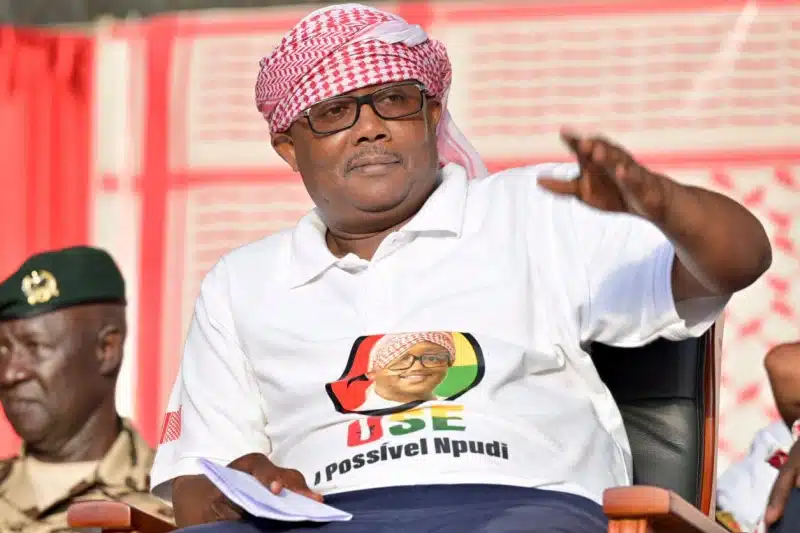

The man who announced that he had been overthrown is now being kept out of his own country by the military leadership that replaced him.
Nearly a year after Umaro Sissoco Embalo’s removal from power, the generals have blocked his return, dismissed officials associated with him and postponed the election he wants to contest. The sequence has revived an uncomfortable question: was the November 2025 coup really a break with Embalo, or did something more complicated happen?
The question is not new. In November, former Nigerian president Goodluck Jonathan, who led the West African Elders Forum’s election observation mission in Guinea-Bissau, openly challenged the official account of the takeover. He called it a “ceremonial coup”, questioning why Embalo himself announced that he had been overthrown while continuing to communicate with international media.
Jonathan said the election had been peaceful in the areas observed and called for the results to be announced. Both Embalo and opposition candidate Fernando Dias had claimed victory, but the electoral commission never published the final result. The military takeover halted the process.
Jonathan’s remarks gave international prominence to suspicions already circulating among Embalo’s opponents. The opposition and the civil society coalition known as the Popular Front alleged that the takeover was staged to prevent the publication of results that could have cost Embalo the presidency. They argued that the crisis offered him a way to escape an unfavourable outcome and preserve a route back to power.
Those allegations have never been conclusively established. But they have not disappeared, and the events unfolding now have given them a new dimension.
Embalo left the country after the takeover and has lived abroad, with AFP reporting that he was in Morocco. General Horta N’Tam, also known as Horta Inta-A, emerged as the leader of the transitional military government. He had previously held a senior security position at the presidency and was described by AFP as a close associate, part of Embalo military allies.
If Embalo expected the military leadership to remain a dependable route back into government, the events of October suggest that relationship has changed, although there is no confirmed evidence that such an arrangement ever existed.
The latest confrontation began on 1 October, when the military High Command said security conditions were not in place for Embalo to return on 4 October. He had announced plans to come home and contest the presidential election scheduled for 6 December.
The following day, tax director Malam Sissé was dismissed. He leads a small political party considered close to the former president and had held the position since March.
On 6 October, Decree 22/2026 ended the appointments of Interior Minister Mamasaliu Embalo and Fisheries Minister Virgínia Correia without giving a reason. António Suca Ntchama and Fidelis Forbs were named as replacements. Bissau Mayor Umaro Baldé was also removed, with Juviano Landin taking his place.
Mamasaliu Embalo, a brigadier general, is related to the former president, although published accounts differ on whether they are brothers or cousins. Both ministers had been appointed on 29 November 2025, three days after the coup.
The military then turned to the presidential guards. AFP reported that Horta N’Tam ordered guards loyal to Embalo to surrender their weapons or face consequences. Several had already been disarmed and placed under supervision at military headquarters.
The sequence is striking. Officials associated with the former president are losing their positions, his security allies are being disarmed and his own return has been blocked. These are documented developments. Whether they form part of a deliberate effort to eliminate Embalo’s political influence is a question the authorities have not answered publicly.
Then came the election announcement.
On 8 October, Prime Minister Ilídio Vieira Té said there were no conditions for holding the presidential and legislative elections scheduled for 6 December, Reuters reported. He cited missed candidate-registration deadlines and political parties that had yet to hold their congresses. He announced no replacement date.
The delay leaves Embalo facing a further obstacle. A constitution approved in an August referendum requires presidential candidates to have lived in Guinea-Bissau during the preceding five years. Reuters reported that it remained unclear how the requirement would apply to Embalo, who has been abroad since the takeover. No definitive ruling on his eligibility has been identified in the reporting cited here.
The suspicions surrounding the original takeover now intersect with a different question: whether the military authorities intend to allow the former president a genuine opportunity to return to politics.
Opposition figures and commentators have questioned the official account of the November events, while public discussion has included competing explanations of Embalo’s departure and the military’s subsequent actions. Such commentary is not proof of a secret arrangement. But Jonathan’s intervention and the opposition’s allegations mean the staged-coup theory cannot be dismissed as an invention of social media.
Nor does the current confrontation prove that Embalo deliberately surrendered power to military allies in the expectation that they would later restore him. What it does establish is that the military leadership that emerged from his removal is now taking decisions that weaken the position of people associated with him.
For Embalo, the immediate political consequences are clear. He remains outside the country, his return has been blocked, officials linked to him have lost their posts and the election has no new date.
The man who once occupied the presidency may yet attempt a political comeback. But the military leadership that took power after his removal is no longer giving him an obvious route back.
If the November takeover was a genuine rupture, the latest developments may represent the military consolidating its independence from the former president. If the allegations of a staged coup were correct, they raise a different possibility: that a political manoeuvre intended to preserve influence has instead produced a military leadership with its own interests.
Neither explanation has been conclusively proved. The dismissals, the blocked return and the postponed election, however, have made the question harder to ignore.


