



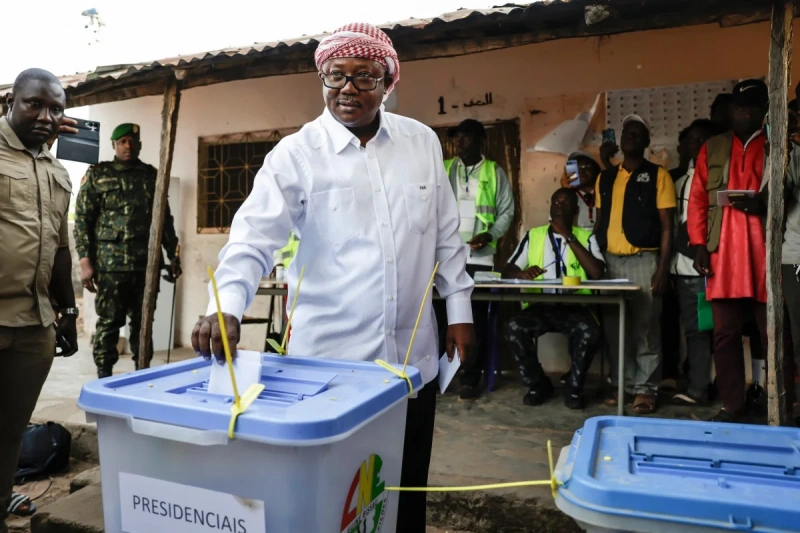

On Thursday, the Guinea-Bissau military government said the “necessary security conditions” were not in place to guarantee the former president’s return from exile.
Its military high command said the decision rested on national security, public order and social stability. The statement said it reflected current conditions, which leaves the door open, at least on paper.
The announcement came just three days after Embalo told AFP he intended to contest the presidential election scheduled for 6 December.
Reuters reported that a source close to him said the military-led government had assured him he was “welcome” to return. A source also told the agency that he planned to land on 4 October.
The head of the Guinea-Bissau military government had struck a similar note. General Horta N’Tam said last week that “every Guinean is free to return”, so long as they had nothing to be ashamed of.
So what changed in a few days? The Guinea-Bissau military government’s official answer is security. On Tuesday, authorities urged calm after reports of unrest in the presidential guard, AFP reported. Social media accounts claimed some troops had been moved to another army unit and were unhappy about it.
The deeper story sits in the history. AFP describes N’Tam as a close associate of Embalo. The army seized power on 26 November 2025, a day before provisional results from the 23 November vote were due. Embalo and his challenger, Fernando Dias, had both claimed victory by then.
Many observers suspect Embalo of orchestrating that coup to stop a count he appeared to be losing, AFP noted. That remains a suspicion, not a finding. The military said it acted after uncovering a plot involving drug lords.
The situation is unusual. Soldiers removed Embalo from office in November 2025, yet the authorities now deciding whether he can return are led by General Horta N’Tam, whom AFP describes as a close associate of the former president.
A second obstacle may be waiting even if he lands. In August, voters approved a new constitution in a referendum, with provisional results putting support at 70 percent. The main opposition party boycotted the vote.
The new text requires presidential candidates to have lived continuously in Guinea-Bissau for the five years before an election. Embalo has been abroad since the coup. Reuters said it was unclear how that rule might affect his candidacy.
Political analyst Malam Cisse told AFP that “nothing stands in the way” of his return legally, since Embalo never signed a document renouncing power. But coming home and qualifying to run are separate matters. Any prolonged restriction on his return could complicate efforts to register as a candidate for the December vote.
The stakes go beyond one man. Manuel Nobre de Barros, a professor at Lusofona University in Guinea-Bissau, warned before the referendum that the reforms give the president “absolute power. Whoever wins on 6 December inherits that office.
Even basic facts remain unclear. AFP places Embalo in Morocco. Reuters says he fled first to Senegal, then the Republic of Congo, and could not establish where he is now.
ECOWAS suspended Guinea-Bissau from its decision-making bodies after the coup, until constitutional order returns. The Guinea-Bissau military government has pressed ahead with its own timetable regardless.
On Thursday, the Guinea-Bissau military government also confirmed that curbs on demonstrations, gatherings and political meetings remain in force. Activists who had posted plans for a Sunday return will struggle to organise any gathering.
It is not yet clear whether the ban will affect the December timetable, AFP reported. Embalo had not responded publicly in the reports reviewed at the time of writing.
The Guinea-Bissau military government says it is steering the country back to civilian rule. Its first real test is a civilian who wants to come home. On Thursday, it said not yet.


