



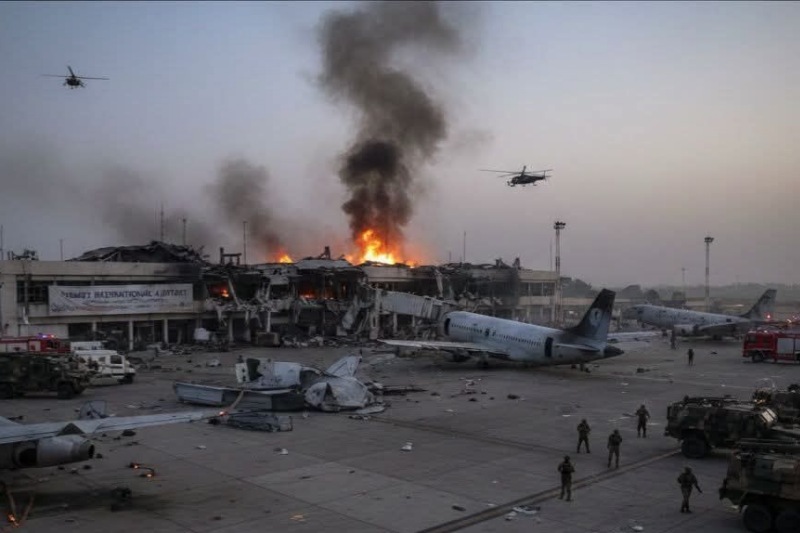

Sustained gunfire and explosions tore through Niger’s capital in the early hours of Saturday. The Niamey airport attack struck Diori Hamani International Airport, the adjoining Base 101 military installation, and the perimeter of the presidential palace.
Witnesses reported heavy exchanges of fire lasting well into the morning. The fiercest fighting was concentrated around the airport complex and the presidency.
A security source told Reuters that “terrorists” launched the Niamey airport attack. The attackers struck the airport first, then tried to breach the security cordon around the presidency. That account has not been independently verified. Reuters said it could not confirm the identity of the assailants at the time of reporting.
Base 101 again found itself at the centre of the violence. It is a major air force installation that shares its perimeter with the civilian airport. Bana Wagana Ibrahim is a member of Niger’s Consultative Council and a deputy in the Alliance of Sahel States parliament. He wrote on Facebook that the base had come under a “cowardly attack”. He said defence and security forces had restored control of the site.
Heavy gunfire persisted around the palace through the night, a witness said. Shooting resumed near the airport at roughly 2am local time. A second security source described some attackers as having been “neutralised. Others fled the scene. Search operations were launched across affected districts of the capital.
Saturday’s Niamey airport attack marks the third assault this year on the same complex. It underscores how the site has become a recurring target amid a wider jihadist insurgency across the Sahel. A January raid was claimed by the Islamic State’s Sahel affiliate. Twenty attackers were killed before troops backed by Russian forces at the base regained control. A second assault in June, claimed hours later by the al-Qaeda-linked JNIM, killed eleven soldiers and two civilians. Twenty-two attackers died in that raid.
No group had claimed responsibility for the latest Niamey airport attack at the time of publication. Nigerien authorities had yet to issue an official casualty toll. Niger’s military government, in power since the 2023 coup, has previously blamed French-backed mercenaries for similar strikes. Paris has consistently denied the accusation.
The Niamey airport attack comes as Niger battles armed groups linked to al-Qaeda and the Islamic State. Coup-era neighbours Mali and Burkina Faso face the same threat under the banner of the Alliance of Sahel States. All three governments pledged to restore order after severing security ties with France. They have pivoted towards Russian military cooperation instead. Yet insurgent attacks have persisted, and in some areas intensified.
The airport complex also carries economic weight. It sits close to stockpiles connected to Niger’s uranium sector. The junta has been restructuring that sector after stripping export permits from French and Canadian mining firms earlier this year. Those permits were reallocated to state-backed companies. Analysts say the site’s location makes it a symbolic target as well as a military one. It sits close to both the presidency and the uranium trade.
For residents of the capital, the Niamey airport attack revives memories of two earlier sieges this year. Both disrupted flights. Both rattled a city that had largely been spared the worst of the rural violence plaguing the Sahel’s tri-border region. Diori Hamani International Airport remains the country’s busiest. Repeated assaults on its perimeter, including Saturday’s Niamey airport attack, have raised fresh questions about security. Officials have long described the site as one of Niger’s most heavily guarded.
Search operations were continuing in parts of Niamey as of Saturday morning. Security forces were working to confirm whether all attackers involved in the latest Niamey airport attack had been accounted for. Details remained fluid. Neither the presidency nor the defence ministry had issued a formal statement by the time of writing.


