



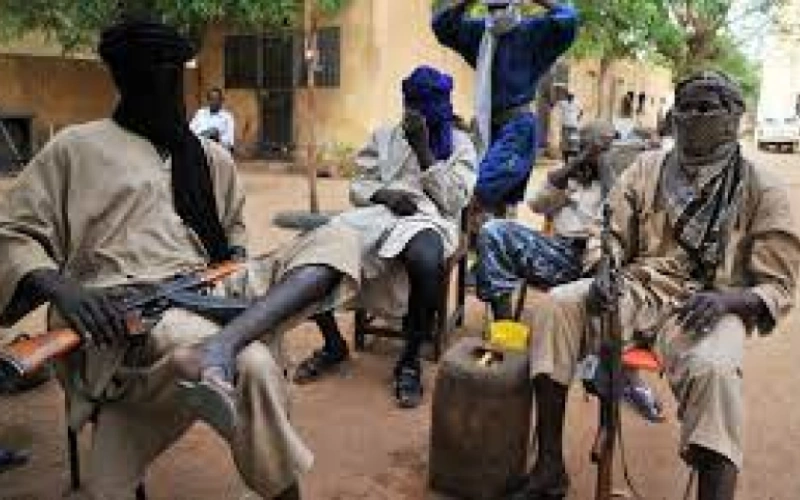

The United Nations has raised fresh alarm over Sahel jihadist expansion, warning that armed groups once known for hit and run raids are now administering captured territory and controlling trade routes across West Africa.
Leonardo Santos Simão, head of the UN Office for West Africa and the Sahel, briefed the Security Council on Tuesday on a report covering developments between 29 November 2025 and 30 June this year. He told council members that terrorist and non-state armed groups remain acute in the central Sahel and northern Nigeria, and are now pushing rapidly toward coastal states in the Gulf of Guinea.
According to Simão, the pattern behind the Sahel jihadist expansion has changed. Groups linked to Jama’at Nusrat al-Islam wal-Muslimin, commonly known as JNIM, are adapting quickly, deploying drones, encrypted communication tools and cryptocurrencies to fund and coordinate operations. Their attacks now span multiple countries at once, and their ties to transnational criminal networks are deepening.
The goal has shifted beyond battlefield gains. Simão said the armed groups driving the Sahel jihadist expansion want to consolidate territorial and economic control while chipping away at public trust in state authority, a strategy that mirrors how insurgencies elsewhere have entrenched themselves in ungoverned spaces.
Mali sits at the centre of this shift. On 25 April, JNIM fighters and Tuareg separatists from the Azawad Liberation Front launched coordinated attacks on Bamako, Kati, Gao, Kidal, Mopti and Sévaré. The assault killed senior military officials, including Defence Minister Sadio Camara, and fighting has continued in the north since then. Roads leading into the capital remain partially blockaded, and power lines have come under repeated attack, disrupting supplies to Bamako.
Russia’s deputy UN envoy, Anna Evstigneeva, told the council that fresh JNIM attacks near Aguelhok and Anefis in early July were repelled by Malian forces working alongside Russia’s Africa Corps, with the armed groups suffering significant losses. Moscow has continued to frame its military presence in Mali as support for the fight against the Sahel jihadist expansion, even as its own personnel have come under repeated attack.
Niger and Burkina Faso are also feeling the pressure. Niamey’s airport and a military base in Tahoua have been targeted in Niger, while Burkina Faso’s northern and eastern regions continue to suffer drone strikes and ambushes. In Nigeria, the north and the Middle Belt remain plagued by kidnappings and civilian casualties, underlining how the Sahel jihadist expansion now stretches well beyond the traditional tri-border zone of Mali, Niger and Burkina Faso.
The humanitarian toll is mounting alongside the security one. By the end of February, West Africa and the Sahel were hosting nearly 6.8 million internally displaced people and 1.3 million refugees and asylum seekers. Gulf of Guinea states, long spared the worst of the violence, now host roughly 220,000 refugees. In Liberia, the number of Burkinabe nationals has more than tripled since last year, climbing from 40,000 to 140,000 and straining land, services and host communities already stretched thin.
Drug trafficking has become another thread in the story of Sahel jihadist expansion. Simão told the council that production, trafficking and consumption of narcotics are rising fast, particularly in coastal states where seizures have increased. Some armed groups are reportedly supplying fighters with these substances, while criminal cartels are said to be gaining influence over public institutions, further blurring the line between insurgency and organised crime.
The briefing drew sharp exchanges among council members. United States representative Jeffrey Bartos condemned the April attack in Mali and a June 18 assault on Niamey’s airport, calling for accountability for JNIM, ISIS-Sahel, ISIS-West Africa and Boko Haram. He urged the Alliance of Sahel States and their coastal neighbours to set aside political differences and coordinate their response, arguing that current divisions only serve the interests of the groups behind the Sahel jihadist expansion.
Amid the grim security picture, UNOWAS pointed to modest signs of regional dialogue. The Kamba border crossing between Niger and Nigeria has reopened, Benin has restored contact with the Alliance of Sahel States, and Mali and Algeria have reopened their airspace to each other and reinstated ambassadors. Elections passed peacefully in Benin, Cape Verde, Côte d’Ivoire and Guinea in recent months, offering a rare counterpoint to the security concerns dominating the report.
Simão’s assessment leaves little doubt that military responses alone will not reverse the Sahel jihadist expansion. His report calls for continued investment in water, economic development and climate resilience alongside security operations, arguing that governance gaps and socio-economic vulnerability remain the conditions the armed groups exploit most effectively across the region.


