



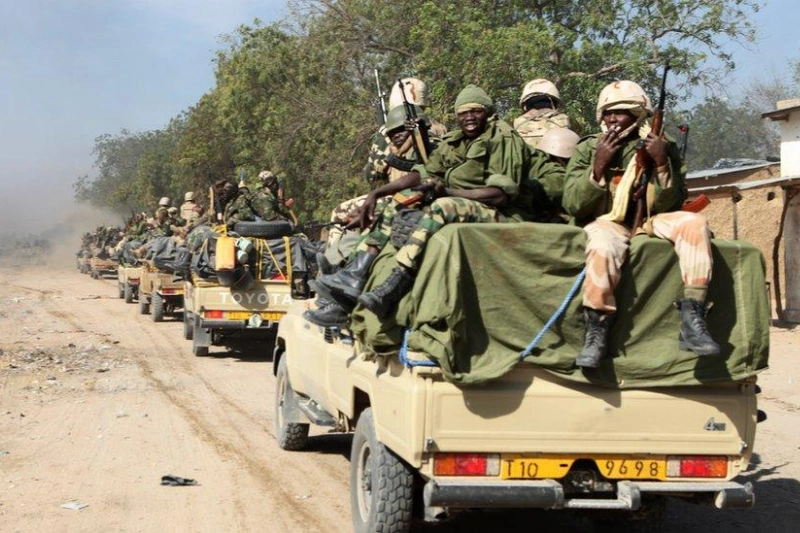

Chad is in three days of national mourning after a devastating Lake Chad Boko Haram attack. A second strike 48 hours later, exposed deep cracks in a military that once led the region’s fight against jihadist insurgency.
N’DJAMENA, 8 May 2026
Within 48 hours, Boko Haram had killed 24 soldiers on a remote island base, ambushed and killed two generals on patrol boats, and handed Chad one of its bloodiest weeks in recent memory.
The back-to-back strikes have shaken a country that, as recently as February 2025, declared the insurgent group had “no more sanctuary on Chadian territory.”
That claim now rings hollow.
Two Attacks in 48 Hours
The first Lake Chad Boko Haram attack came on the night of 4 May, when fighters stormed the military base at Barka Tolorom island on the Chadian shore of Lake Chad. Chadian army spokesman Brigadier General Chanane Issakha Acheikh confirmed that 23 soldiers were killed and 26 wounded, with the assault launched at around 10 p.m. local time.
The army said it repelled the attackers and killed a number of them, but the losses were severe.
Two days later, the situation grew worse.
On Wednesday afternoon, security and defence force boats patrolling the lake’s island area fell into a Boko Haram ambush, an officer from the General Staff told AFP, adding that two generals were among the dead.
Chad then declared three days of national mourning, with the government stating it was called “in memory of the martyrs who fell on the field of honour during the attacks by terrorist groups that occurred on May 4 and 6.”
Flags were lowered to half-mast across the country. All festive activities were banned.
What Barka Tolorom Reveals
The island of Barka Tolorom sits inside a vast network of waterways, marshes and remote islands where the borders of Nigeria, Cameroon, Niger and Chad converge. For years, this geography has made Lake Chad one of Africa’s most difficult battlefields for conventional armies.
Insurgents move by boat, disappear into swampland and re-emerge after offensives subside. Military outposts on isolated islands are exposed and difficult to reinforce quickly.
Al Jazeera reports that recent months have seen a surge in attacks by the group’s JAS faction, including kidnappings and assaults on advanced army positions, particularly on islands and along Niger’s portion of the lake’s shores.
JAS refers to Jama’atu Ahlis Sunna Lidda’awati wal-Jihad, the Boko Haram faction behind the current wave of violence.
A Pattern That Keeps Repeating
The Lake Chad Boko Haram attack this week is not without precedent. The same waters have swallowed Chadian soldiers before.
In October 2024, a Lake Chad Boko Haram attack on a military base in the basin left around 40 Chadian soldiers dead. President Mahamat Idriss Deby Itno responded by launching Operation Haskanite, aimed at destroying the group’s capacity to cause harm.
The Chadian army completed that counteroffensive in February 2025, asserting that the jihadist group no longer had any sanctuary on Chadian territory. But attacks on security forces continued.
The cycle is familiar. Militants regroup in island terrain, launch surprise raids on isolated bases, absorb the retaliatory offensive, then return. It has repeated for more than 15 years.
President Deby’s Vow and Its Limits
After the first attack, President Deby visited wounded soldiers in hospital and posted a response on social media. He said that Chad remained “united and unwavering” and vowed that the fight would continue “with renewed determination until this threat is completely eradicated.”
But the killing of two generals in a patrol boat ambush just 48 hours later raised harder questions about whether that determination is matched by the intelligence and resources needed on the ground.
According to AllAfrica, tens of thousands of people have been killed and millions displaced across the four countries around the Lake Chad region since the insurgency began, with civilians remaining exposed to abductions, forced recruitment and extortion even as military operations intensify.
The Wider Risk
The Lake Chad Boko Haram attack is not only Chad’s problem.
Lake Chad’s islands and marshes also serve as a haven for Boko Haram’s rival splinter group, the Islamic State West Africa Province, known as ISWAP, which continues to operate in the region.
The two factions are rivals. That rivalry, analysts note, tends to increase overall violence, as each faction seeks to demonstrate strength through attacks. The result is that soldiers and civilians around the basin face pressure from multiple armed groups simultaneously.
If violence escalates in Chad, it risks spreading further into northeastern Nigeria, Niger’s Diffa region and Cameroon’s Far North, all of which share borders that insurgents cross routinely.
What’s Next After Lake Chad Boko Haram Attack
Chad’s government has yet to announce what follows the national mourning period in operational terms. Whether Deby orders another large-scale lake offensive, and whether Nigeria coordinates closely with N’Djamena on cross-border insurgent routes, will shape what happens in the coming weeks.
For now, the Lake Chad Boko Haram attack has made one thing clear.
Despite years of military campaigns, declarations of victory, and personal presidential pledges, the insurgency in the Lake Chad Basin is very much alive, and it has just claimed two generals to prove it.
Reporting draws on statements from the Chadian General Staff, the office of President Mahamat Idriss Deby Itno, and accounts from Al Jazeera, AFP, Arab News, Africanews, AllAfrica and Xinhua.


