



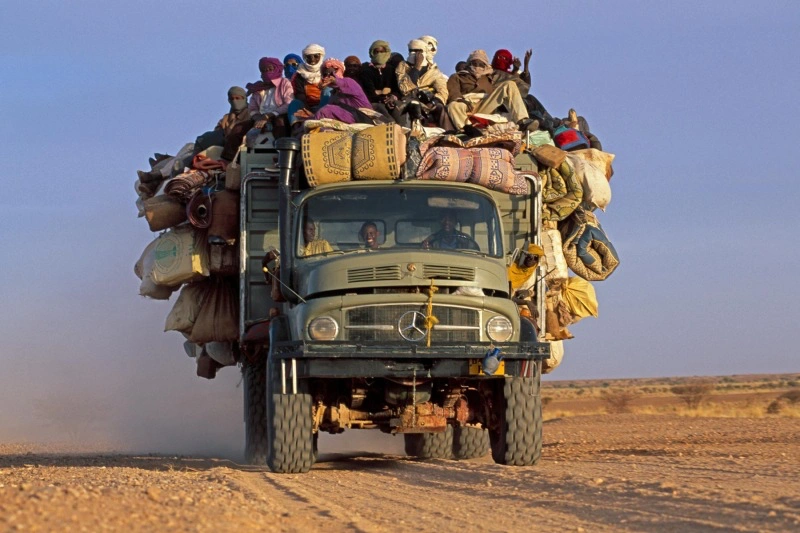

Every truck that leaves the edge of Sebha before dawn carries more than diesel and sacks of flour. It carries the working capital of a desert economy that has outlasted every government sent to police it. Across the belt of sand linking southern Algeria, Libya, Niger and Chad, trans-Saharan smuggling networks move fuel, gold, food and people. These corridors are older than the modern border itself.
Long before independence drew straight lines across the Sahara, Tuareg and Tebu caravanners carried salt, dates and cloth between the Mediterranean coast and the Sahel. Mobility was not treated as a crime. It was a survival strategy in a landscape where rain could fail for a decade at a stretch. That older economy never disappeared. It simply changed cargo, and today’s trans-Saharan smuggling networks are its direct descendants.
Fuel is the clearest example of how the trade works. Libya’s subsidised pumps sell petrol for a fraction of what neighbouring states charge. That price gap alone sustains entire convoys. According to the United Nations Office on Drugs and Crime, Libyan fuel can retail for as little as eleven cents a litre. Pump prices in parts of the Sahel run close to two dollars. A driver crossing that line with a loaded tank earns more in one trip than most formal jobs pay in a month.
Niger’s anti-corruption authority puts the annual cost of that lost tax revenue at close to eight million dollars. It is a figure the UNODC has cited in its own assessments of trans-Saharan smuggling networks across the region. Officials in Niamey have tried registered export quotas and tighter checkpoints. Drivers simply divert marked fuel back across the border once it clears customs.
Gold changed the arithmetic further. Artisanal mining took off around Djado and Kouri Bougoudi in the mid-2010s. That gave the smuggling networks a second, more durable pillar than migration alone. Field researchers with the Global Initiative Against Transnational Organized Crime have tracked the gold camps near the Chad-Niger-Libya triangle closely. They now pull labourers, generator dealers, fuel resellers and armed escorts into one supply chain feeding the trans-Saharan smuggling networks.
Generators, jackhammers, mercury and spare tyres move south along trans-Saharan smuggling networks to feed the mines. Raw gold ore moves north, often in the same vehicles that once ferried migrants towards Libya’s coast. Algerian military statements this year describe routine seizures along this axis. They include hundreds of generators, dozens of jackhammers and quantities of unrefined gold intercepted around Tamanrasset, In Guezzam and Bordj Badji Mokhtar.
Human movement has not stopped either. It simply went underground after Niger’s 2015 law criminalising the migrant transport business in Agadez. That decision pushed established travel agencies out of the open. It handed more leverage to smaller, less accountable operators feeding the same trans-Saharan smuggling networks. When Niger’s military government scrapped its European-backed anti-smuggling deal in late 2023, the trade resurfaced with fewer legal risks attached.
A passeur in Agadez interviewed by regional reporters described pocketing roughly 350 dollars for arranging one migrant’s onward journey towards the Libyan border. That fee has climbed as routes grow riskier and more circuitous. Vehicles now travel at night without headlights to avoid patrols. It adds hours and hazard to journeys that were already lethal.
Armed groups have layered themselves over trans-Saharan smuggling networks rather than replaced them. In northern Chad, Tebu and Tuareg factions historically managed border crossings and taxed transporters directly. Analysts tracking the region describe militia-run corridors, sometimes called traffic loops. Fuel, gold, weapons and fighters circulate together through them rather than as separate trades.
Libya’s Haftar-aligned forces have pushed to bring more of that traffic under their own control in the past two years. A 2025 crackdown on a militia commander near Gatrun scattered rival fighters across the Fezzan. Some fled back towards northern Niger and Chad, reshuffling alliances without ending the trans-Saharan smuggling networks that fund them. Clashes there briefly halted fuel deliveries into artisanal gold camps that depend entirely on contraband petrol.
Southern Algeria occupies a quieter but no less important place in this system. Tamanrasset has grown into a hub where Nigerien, Malian and Libyan nationals take part in gold trafficking, fuel diversion and irregular migration side by side. Organised crime researchers who study the wilaya describe it as a meeting point for several trans-Saharan smuggling networks at once. Algiers has responded with sand berms, expanded patrols and a newly created southern province structure. Enforcement data still points to a resilient trade rather than a defeated one.
Weekly military bulletins from Algeria’s southern commands routinely report the same mix of seizures. Tens of thousands of litres of diverted fuel. Sacks of tobacco destined for resale. Vehicles converted for desert crossings. The consistency of those figures across months suggests interdiction is managing the flow rather than closing it down.
None of this runs on criminal intent alone. Formal employment across much of the Sahel remains scarce. Informal work accounts for the overwhelming majority of jobs in Niger and Chad alike. Communities along these routes rely on trans-Saharan smuggling networks for consumer goods, medicine and cash that formal supply chains rarely reach. Cutting the trade without replacing the income it provides risks deeper instability than the smuggling itself.
Governments in the region face a genuine dilemma rather than a simple enforcement gap. Aggressive crackdowns tend to push prices higher. They drive routes into more dangerous terrain and hand more leverage to armed groups willing to guarantee safe passage. Softer approaches leave state revenue haemorrhaging and let militias entrench their hold on strategic crossings.
What is emerging instead is a patchwork of local accommodations. Some Chadian and Nigerien authorities have quietly tolerated small-scale fuel and food trade. They target weapons and larger gold shipments specifically. Trans-Saharan smuggling networks keep adapting faster than most policy can follow. Whether that distinction holds will shape security across four countries for years to come, long after any single crackdown makes headlines.


