



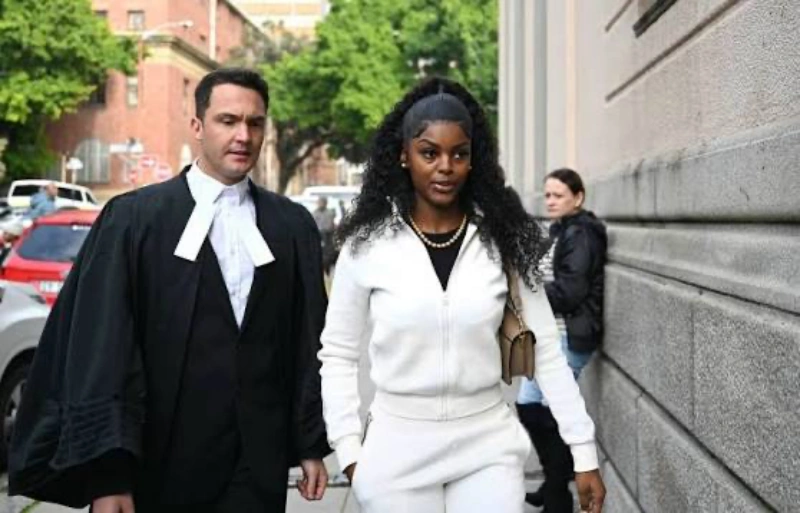

The Chidimma Adetshina citizenship case took a fresh turn this week after the Cape Town Regional Court adjourned judgement on her deportation and immigration status to 27 February 2027, extending a legal battle that has gripped South Africa since 2024.
The postponement means the Chidimma Adetshina citizenship case will remain unresolved for at least another six months as parallel legal proceedings continue. Proceedings on Wednesday were disrupted by members of the anti-immigration group Operation Dudula, who gathered outside the courthouse demanding that Adetshina be deported to Nigeria.
The former Miss South Africa finalist addressed reporters afterwards in a composed statement, saying she had been “treated unfairly and targeted” and that there had been an attempt to make her “an example”. She added that she remained committed to respecting South Africa’s legal process and thanked her family and legal team for their support throughout the case.
The Department of Home Affairs maintains that Adetshina has no valid legal basis to remain in South Africa following the revocation of her citizenship documents, which it alleges were obtained through identity fraud linked to her mother, Anabella Carlos Runga. Adetshina’s legal team is contesting that position through a separate High Court review, arguing that she has deep and lifelong ties to the country of her birth.
The court’s decision to postpone judgement on Chidimma Adetshina citizenship case was influenced by the pending High Court proceedings, which are expected to play a central role in determining the outcome of the dispute.
Court papers filed on her behalf state that Adetshina was born in Johannesburg on 8 January 2001 to a Mozambican-born mother who has lived in South Africa for more than three decades and a father who holds dual South African and Nigerian citizenship. Her three-year-old son is listed as the second applicant in the matter, meaning the outcome of the case will also determine his status.
The dispute traces back to Adetshina’s participation in Miss South Africa 2024, when questions over her family’s citizenship documentation triggered a wave of online hostility that eventually forced her withdrawal from the pageant. She went on to compete for Nigeria instead, winning Miss Universe Nigeria before finishing as first runner-up at the global Miss Universe pageant.
A Question Bigger Than One Court Case
Beyond the legal wrangling now scheduled to resume next year, the Chidimma Adetshina citizenship case has forced a harder conversation onto the continent, one that veteran Plateau State politician and legal practitioner Solomon Dalung argues Africa can no longer avoid.
In a submission shared with AfricanQuarters, Dalung notes that Adetshina was born in South Africa, schooled there and grew up regarding it as home, only to now be fighting in a South African court for the right to remain in the only country she has ever known. He is careful to draw a line between the law and the human being behind it. If fraud attended the acquisition of her mother’s citizenship or the registration of her birth, he argues, the law must deal with whoever committed it, since nobody should be shielded simply because a matter has become politically or emotionally charged.
But Dalung insists that another question deserves an honest answer alongside the legal one: what responsibility can a child reasonably bear for an alleged wrongdoing committed by an adult before, or around the time of, her birth? Adetshina herself raised this point directly in her affidavit, stating that she was not even alive when her mother allegedly acquired citizenship irregularly and describing herself and her son as “indisputably innocent”.
Dalung frames the 2024 pageant controversy as a symptom of a deeper unease in South Africa over who is considered sufficiently South African to represent the country, an unease that pushed a young woman born in Soweto into representing Nigeria instead. He finds an irony worth sitting with: a continent that speaks constantly of African unity, Ubuntu and borderless brotherhood still allows a child born and raised in one African country to be reminded that her belonging is conditional on the nationality of her parents.
For Dalung, the Chidimma Adetshina citizenship case raises a question that reaches far beyond Adetshina’s own circumstances, namely what justice looks like when citizenship law, bureaucracy, migration policy and the rights of a child born innocent of any wrongdoing collide. He argues that whatever consequences may eventually attach to her mother’s conduct, the South African state still owes a human answer to the child who inherited a dispute she did not create.
He concludes that the matter deserves more than the protests staged outside the courtroom each time it is heard. It deserves humanity, and it should compel Africans to confront a contradiction the continent has avoided for too long, that a united Africa is still, in practice, teaching Africans to fear one another.
Whatever the Cape Town court eventually decides when proceedings resume in February 2027, the Chidimma Adetshina citizenship case is likely to remain one of South Africa’s most closely watched legal and social controversies. Dalung’s submission leaves one question hanging over the case: whether belonging is something a human being can genuinely hold, or something a government can withdraw the moment the paperwork becomes inconvenient.


