



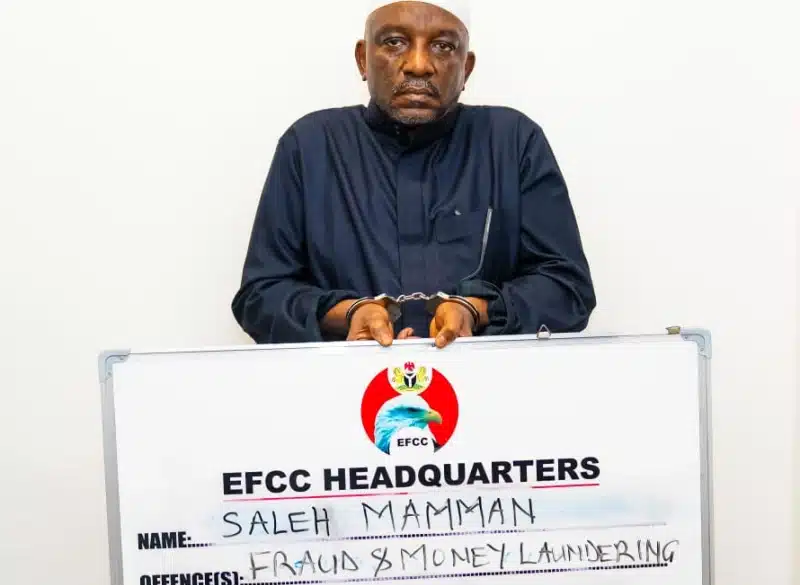

He stopped answering his phone, skipped court repeatedly, relied on two accomplices to shield him, and thought a crowded Kaduna suburb would be enough. It was not. Rather, the Saleh Mamman arrest became one of Nigeria’s most closely watched anti-corruption cases in 2026.
The Day He Vanished From Court
The moment Saleh Mamman’s legal options ran out, he stopped showing up.
The investigation that led to the Saleh Mamman arrest would later reveal how the former minister disappeared from public view for weeks.
The case before the Federal High Court in Abuja was adjourned to 23 February 2026 for the commencement of his defence. He never showed up.
His defence team had no explanation. His lawyer, Mohammed Ahmed, told the court he could not account for his client’s whereabouts, saying repeated calls to him had failed to connect.
Justice James Omotosho was not persuaded that this was coincidence. The judge noted that the absence of the former minister was a deliberate attempt to stop the wheel of justice.
The court pressed on regardless, convicting Mamman in absentia on all 12 counts on 7 May 2026.
A Sick Note That Could Not Save Him
Even as the conviction was announced, Mamman’s legal team tried one last manoeuvre. His lawyers claimed he was sick, but failed to provide medical evidence before the court. Justice Omotosho rejected the request for adjournment and proceeded with the judgment in Mamman’s absence.
Sentencing was fixed for 13 May. He did not appear for that either.
His legal representative replied that “he has nothing to say,” maintaining that he had previously informed the judge that he could not directly reach Mamman while requesting more time to produce him. The judge recalled the defence lawyer’s own admission that he did not know the whereabouts of his client.
Justice Omotosho agreed with the EFCC that the presence of an absconded defendant during sentencing does not matter, and held that the convict’s counsel had effectively left the issue of sentencing to the discretion of the court.
The total sentence came to 75 years, to run consecutively.
Two Courts, Two Warrants
The Saleh Mamman arrest was being sought on two separate fronts simultaneously. Beyond the Federal High Court conviction, a second case at the FCT High Court in Maitama was already in progress, where Mamman faces charges alongside seven co-defendants over an alleged ₦31 billion fraud also tied to the Mambilla Power Project.
The FCT High Court revoked the bail that had been granted to Mamman after it became clear that his whereabouts had remained largely unknown since his conviction by Justice Omotosho.
At those proceedings, prosecution counsel Rotimi Oyedepo told the court it was both noticeable and obvious that Mamman was absent, and that his counsel had given no reason for his non-attendance, just as no reason had been given before Justice Omotosho’s court.
On 11 May 2026, Justice Maryanne Anenih of the FCT High Court issued a bench warrant for his arrest after he failed to appear for proceedings in the matter.
Within a week of his conviction, two separate judges in Abuja had ordered his arrest.
Protected, Not Just Hiding
The EFCC did not treat this as a simple case of a man lying low. Intelligence within the commission pointed to active protection.
“We have discovered that he was actually being protected all this while,” EFCC Chairman Ola Olukoyede told journalists at the commission’s Abuja headquarters on Tuesday.
Olukoyede confirmed that Mamman was being harboured by two individuals in the Rigasa area of Kaduna State, and that those individuals had also been arrested. “It is a crime to protect or give shelter to a convicted person or fugitive,” he said.
The identities of the two arrested individuals have not been made public. Investigations into their role and relationship with the convicted former minister are continuing. Investigators said the Saleh Mamman arrest involved extensive surveillance and intelligence coordination across multiple states.
The Phone Signal That Gave Him Away
Following the sentencing ruling, the commission immediately activated intelligence, surveillance and recovery operations across various locations to track him down. “We have been searching for him all over the place since the judgment,” Olukoyede said.
The breakthrough came through signals intelligence. Sources within the EFCC disclosed that operatives spread their dragnet in search of Mamman immediately after sentencing. He was eventually tracked through his phone and found in an apartment in the Rigasa area of Kaduna State.
“Immediately the judgment was delivered, we spread our dragnet in search of him following weeks of intensive surveillance and intelligence gathering, but we eventually tracked him with his phone,” one EFCC source told Punch.
Rigasa, in Igabi Local Government Area, is among the most densely populated communities in northern Nigeria, with an estimated two million residents. It is also home to a major Nigerian Railway Service terminal. For a man trying not to be found, it offered considerable cover.
It was not enough.
The operation leading to Saleh Mamman arrest eventually narrowed down his location through electronic tracking and human intelligence.
3:30 a.m., Kaduna
“I’m happy to announce to Nigerians that at about 3:30 a.m. this morning, we arrested Mr Saleh Mamman somewhere in Rigasa, Kaduna State,” Olukoyede told journalists.
The Saleh Mamman arrest happened on Tuesday, 19 May 2026, six days after he had been sentenced to 75 years in prison by a court he chose to ignore. Operatives moved in before dawn, taking him alongside the two individuals who had been sheltering him.
The house where the arrest was made immediately became the subject of investigation.
The Transfer and the Wider Hunt
After the Saleh Mamman arrest was confirmed, questions arose about why he remained in EFCC custody rather than being moved directly to a correctional facility. EFCC Director of Public Prosecutions Rotimi Oyedepo said the process of transferring Mamman to the correctional centre was ongoing. “The Commission has not just arrested him; it has ensured the sentence is being executed,” he said.
The asset trail is also widening. Following Saleh Mamman arrest, investigators intensified efforts to identify additional assets connected to the former minister. Olukoyede disclosed that additional properties allegedly linked to Mamman had already been uncovered. “Just a few days ago, we discovered another one,” he told journalists.
Among the items already ordered forfeited to the Federal Government are four choice properties in Abuja, along with foreign currencies that were recovered from the former minister, including $13,890, 19,950 euros, 10,000 pounds, 42,390 dirhams and 35,000 South African rand.
Olukoyede also acknowledged that Nigerian authorities needed to strengthen surveillance measures for high-profile corruption suspects still undergoing trial, saying: “We are lucky to have found him here. If he had travelled to countries without Interpol agreements, it would have been difficult to bring him back.”
He added that the agency would review its internal procedures regarding the monitoring of high-profile suspects, saying future cases may require closer surveillance to prevent escape from jurisdiction before the conclusion of trials.
The rigour, strategy and assets deployed in Saleh Mamman arrest are now expected to shape how Nigerian authorities monitor politically exposed persons facing major corruption trials.
Reporting draws on official EFCC press briefings, Federal High Court proceedings in Abuja (case FHC/ABJ/CR/273/2024), FCT High Court proceedings, and sourced accounts from Punch, Channels Television, TheCable, Premium Times and Blueprint.


