



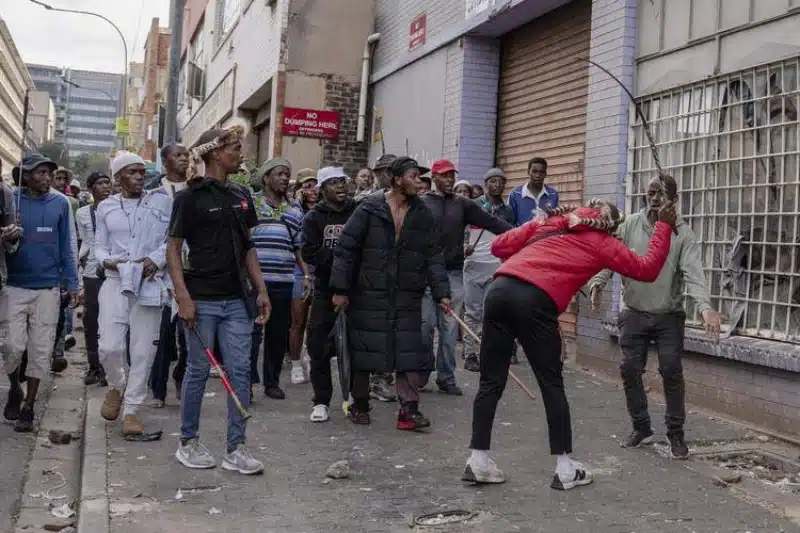

South Africa is bracing for one of its most volatile days in years as security forces move into full operational readiness, with nationwide anti-immigrant marches set for Tuesday, 30 June.
Tebello Mosikili, chairperson of the National Joint Operational and Intelligence Structure, confirmed on Monday that the country’s security cluster had entered the full implementation phase of its operational plan, adding that the country had remained relatively stable in the preceding 24 hours.
Acting Minister of Police Firoz Cachalia said on 22 June that deploying resources to potential flashpoints would cost around R600 million. South Africa’s largest private security company, Fidelity, has indicated it will support police by monitoring the situation. Defence Minister Angie Motshekga separately warned that the South African National Defence Force would be mobilised “if things get out of hand.”
Police confirmed that in Durban, marchers are expected to gather at King Dinuzulu Park at 10am before moving along Dr Pixley KaSeme Street towards the SAPS Point Police Station. Motorists have been warned to expect road closures and delays across the Durban CBD. Police and private security companies have identified Gauteng, KwaZulu-Natal, the Eastern Cape and the Western Cape as potential flashpoints, with officer leave cancelled and additional deployments authorised across all four provinces.
President Cyril Ramaphosa has repeatedly condemned the South Africa xenophobia crisis. He warned that the government “will not tolerate any attempts to destabilize the country by anyone, whether marching or otherwise,” accusing perpetrators of exploiting the legitimate grievances of the poor “under the false guise of community activism.” Ramaphosa also conceded that South Africa had experienced failures in border control, while insisting that illegal immigration was not the cause of the country’s social and economic difficulties.
The scale of displacement across the country tells a more urgent story. There concerns that the South Africa xenophobia crisis could deepen, if Tuesday’s demonstrations trigger wider unrest across major urban centres.
The South Africa xenophobia crisis has been starkest in KwaZulu-Natal, where tens of thousands of Malawian nationals sought refuge at a makeshift camp in Durban. At the old Durban Drive-In site, about one square kilometre from the beachfront, Islamic Relief South Africa estimated roughly 11,000 people were sheltering inside the camp with a further 2,700 waiting outside. Municipal workers erected portable toilets and makeshift showers, while a tented hospital with an emergency room and a Red Cross station provided basic care, according to Daily Maverick.
The eThekwini Mayor Cyril Xaba subsequently confirmed that more than 15,000 undocumented Malawian nationals had been processed at the site before it was closed and dismantled, with operations transferred to a new processing centre in Musina, Limpopo, near the Beitbridge border post. Humanitarian groups say the South Africa xenophobia crisis has already created one of the largest displacement emergencies seen in the country in recent years.
Hundreds of Zimbabweans spent nights on pavements outside their country’s consulate in Cape Town. Reuters quoted Amina Chiwoko, 30, saying outside the Zimbabwean consulate: “We are sleeping outside waiting for buses. Everyone just wants to go home.”
Not everyone displaced by the South Africa xenophobia crisis has a safe country to return to. Leanne Sefu, a 25-year-old asylum seeker from the Democratic Republic of Congo who arrived in South Africa at the age of three, told Reuters she could not go back. “The entire world knows that there’s a war in Congo, so me going back feels like going back to death,” she said, sitting on a mattress on the pavement outside a Home Affairs office alongside dozens of others.
Nigeria moved quickly to pull its nationals out. The Ministry of Foreign Affairs spokesperson Kimiebi Imomotimi Ebienfa confirmed that an Air Peace aircraft departed Nigeria on Monday 29 June at 3pm, expected to arrive in Johannesburg at approximately 9pm local time, with the return flight scheduled to depart at midnight carrying 271 Nigerians back to Lagos by Tuesday morning. Before this latest mission, 328 Nigerians had already been repatriated in two earlier operations.
The first flight, which landed on 11 June, carried 262 returnees, while another 66 arrived in Lagos on 25 June. Ebienfa advised Nigerians remaining in South Africa to stay calm and security-conscious, avoid routes and areas dominated by protesters, and remain in contact with the Nigerian High Commission for updates.
Uganda also moved to extract its nationals from the South Africa xenophobia crisis zone. Acting Minister of Foreign Affairs Haruna Kyeyune Kasolo announced on Sunday that President Yoweri Museveni had directed the government to organise the evacuation of Ugandan nationals, with Uganda Airlines set to operate special charter flights funded entirely by the Ugandan government.
As of 28 June, 746 Ugandan nationals had voluntarily registered for evacuation, according to the Ugandan government statement. The government confirmed that one Ugandan national had been killed in an attack in KwaZulu-Natal Province, with preparations under way to repatriate the body.
Nigeria and Ghana have between them repatriated nearly 2,000 people on government-sponsored flights, according to ABC News, with Zimbabwe and Mozambique also evacuating smaller numbers. The African Union has called on South Africa to guarantee the safety of all foreign nationals within its borders.
The violence that has fed the South Africa xenophobia crisis has been documented across several provinces. Five Mozambicans were killed in Mossel Bay, while a series of attacks on Ethiopian-owned businesses were reported in Gauteng province, according to reporting by HNGN citing multiple news agencies.
A Malawian man was also allegedly killed by a mob in Pietermaritzburg, prompting a police investigation. Three foreign nationals have been killed following anti-immigrant protests in total, and journalists covering the violence have been assaulted, the Institute for Security Studies reported.
The crisis has cast a shadow over South Africa’s international standing just weeks after the country hosted 2026 FIFA World Cup group matches as one of three co-hosts alongside the United States and Canada. World Health Organisation Director-General Tedros Adhanom Ghebreyesus condemned the violence, calling it a tragic betrayal of the African nations that had supported South Africa during the struggle against apartheid.
The underlying conditions feeding the South Africa xenophobia crisis remain severe. South Africa’s unemployment rate stood at 32% in the first quarter of 2026 after 350,000 jobs were lost, with young people hit hardest, according to South Africa’s national statistics agency. Human Rights Watch documented a pattern of escalating vigilante activity since 2024, warning that the current wave follows a well-established cycle of attacks in 2008, 2015, 2019 and 2021. The 2008 riots alone left more than 62 people dead.
March and March organisers pledged peaceful protests on 30 June but warned that action would continue if the government failed to meet demands for faster deportations, stronger border control, increased funding for the Border Management Authority and Home Affairs, and the prioritisation of South African citizens for township economic opportunities.
Security experts have warned that the South Africa xenophobia crisis remains highly unpredictable despite extensive police preparations.
South Africa’s Department of Justice confirmed that all courts would remain fully operational on Tuesday despite the planned demonstrations, with authorities assuring the public that essential government services would continue uninterrupted. Whether the South Africa xenophobia crisisescalates into the kind of mass violence seen in 2008 now depends on whether security forces can hold the line when the marches begin.


