




The money was paid. The hall was booked. Then the phone call that changed everything.
For Nigerian opposition parties, this is becoming a familiar problem: securing a campaign venue does not guarantee they will be allowed to use it.
That is how the Nigeria Democratic Congress (NDC) says it lost its fourth campaign venue. Its spokesman, Osa Director, said men claiming to own the land turned up and the party was told to collect its refund. “Nobody owns Nigeria,” he said on Monday.
The ruling All Progressives Congress (APC) dismissed the allegation as baseless through an official who declined to give his name.
Nigerian opposition parties say there are two ways to keep a candidate out of sight. Close the door, or raise the price. Both are now happening, and the pattern is hard to miss.
The fight over venues is not new. In April, the African Democratic Congress (ADC) said it was refused access to Eagle Square and the Velodrome at the Moshood Abiola National Stadium in Abuja for its national convention.
Peter Obi, then an ADC chieftain, said: “The government doesn’t want other parties to exist.”
At the federal level, the ADC points to Abuja. The party says its letter to Federal Capital Territory Minister Nyesom Wike was acknowledged but never answered. Wike’s response was procedural: he said the letter had been sent to the wrong office.
The party then booked the Rainbow Event Centre. According to the ADC, the owner told it after payment that he was under pressure from FCT authorities. The party called it creeping tyranny.
In June, ahead of the Ekiti governorship election, the ADC raised a similar complaint at state level, this time over the state pavilion. The state government said an application did not guarantee access. The ADC said the public hall sat empty, raising questions about why access had been denied.
For Nigerian opposition parties, the dispute over venues is only one part of the problem. The second barrier is financial. Across the states, campaign advertising comes with price tags that vary dramatically.
In late July, Abia’s signage agency announced that a presidential candidate must pay ₦200 million to display campaign materials in the state. Campaigns opened on 19 August. By then, other states had published rates of their own.
Vanguard’s review of those schedules shows how uneven the charges are. Enugu and Kogi, both governed by the APC, demand ₦150 million each from presidential candidates. Rivers charges ₦75 million and Anambra ₦50 million, up from ₦10 million in 2022. Kano charges about ₦1.15 million and treats political and commercial billboards alike. The difference between Abia and Kano is more than 170-fold.
Now consider the arithmetic. The Electoral Act 2026 caps a presidential candidate’s election spending at ₦10 billion. If every state and the Federal Capital Territory charged Abia’s ₦200 million rate, permits alone would cost ₦7.4 billion. That is 74 per cent of the spending ceiling before a single rally, jingle or other campaign expense.
For Nigerian opposition parties with limited resources, such charges could leave little room for the rest of the campaign. The Allied Peoples Movement and its presidential candidate, Oyo State Governor Seyi Makinde, say such fees could swallow more than 80 per cent of the spending ceiling. They have asked the Abia High Court to void the ₦200 million charge. No court has yet ruled on the fees.
The highest charge in this comparison comes from the Labour Party government of Governor Alex Otti in Abia. That deserves scrutiny too. But one government’s policy does not excuse another’s. The APC governs Enugu and Kogi, where the rates are also substantial, and controls the federal government whose handling of public venues the opposition has challenged.
State authorities describe the charges as administrative fees. In Enugu, party spokesman Uchenna Obute shrugged off the criticism: “If you want to do it, you have to pay.” The APC there says it is paying too.
Prof. Kamilu Sani Fage of Bayero University, Kano, expects ruling parties to pay from public funds while Nigerian opposition parties have to dig into their own pockets. “It is wrong to introduce such measures now,” he said.
The law raises serious questions about the use of state power to disadvantage political competitors. The Electoral Act bars the use of state apparatus to favour or disadvantage any political party or candidate. The Advertising Regulatory Council of Nigeria has said state agencies have no power to approve political adverts before they go up. Before the 2023 campaigns, the electoral commission’s then chairman, Mahmud Yakubu, warned that using incumbency to deny parties access to public facilities was illegal.
Those protections matter because Nigerian opposition parties must be able to compete without state apparatus being used against them. The question is whether the rules are being enforced effectively when parties report difficulties securing public venues or face advertising charges they say are prohibitive.
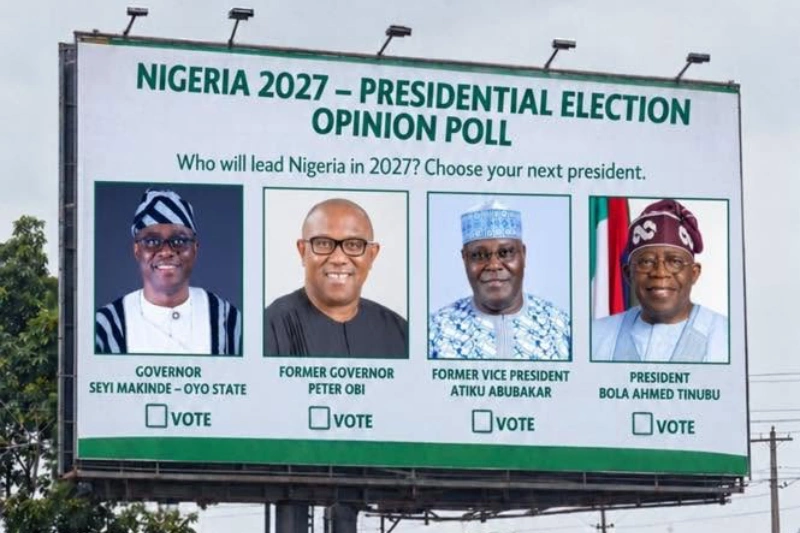
The consequences are immediate. Billboards can reach voters repeatedly over weeks or months. Without affordable billboard access, Nigerian opposition parties may have to rely more heavily on radio, social media and town halls. In Lagos, many candidates from opposition parties had placed no signboards after campaigns opened, according to the reporting cited in this article.
For a wealthy party, ₦200 million may be a line in the budget. For smaller Nigerian opposition parties, it can be a wall.
Stakeholders want the Independent National Electoral Commission (INEC) to separate administrative fees from campaign expenses. They want the National Assembly to cap state levies on political advertising. They also want states to publish who has paid and who has received a waiver.
Nobody needs proof of a rigged count to recognise the danger. An election can be formally contested and still offer unequal access to voters. When public venues become inaccessible and campaign advertising becomes prohibitively expensive, the field can be tilted before ballots are cast.
Those who control public institutions have a responsibility to ensure that those institutions do not become tools for disadvantaging political opponents. Where credible allegations arise, they deserve answers, scrutiny and, where necessary, legal challenge. Silence risks allowing barriers to political competition to become routine.
On 16 January 2027, voters will choose from the candidates on offer. But the opportunity to see and hear those candidates should not depend on who controls the gate or who can afford the price of entry. Nigerian opposition parties are losing space one hall and one billboard at a time.


