




African support for Mexico at the 2026 FIFA World Cup opener went far beyond football and the continent made no effort to hide it.
When Julián Quiñones drilled the first goal of the tournament through the legs of South African goalkeeper Ronwen Williams at Mexico City’s Estadio Azteca on Thursday, 11 June, the celebration on African social media was instant.
The explosion across West African platforms was ruthless and deeply personal. To anyone watching from outside the continent, it looked like standard football banter. It was not.
The campaign began on X and TikTok, started by Nigerians urging the rest of Africa to support the hosts, citing Mexico as more welcoming to African arrivals than South Africa has ever been. From there, it spread quickly. Ghanaians, Zimbabweans, Kenyans, Zambians and others joined in. African support for Mexico became the dominant mood online well before kick-off, and it carried a political charge that no amount of pre-tournament diplomacy had managed to defuse.
The match itself
Mexico won 2–0 in a contest that produced more red cards than goals. Quiñones opened the scoring in the ninth minute after intercepting a misplaced pass from South Africa’s defensive line. Roberto Alvarado then delivered a precise cross in the 67th minute for veteran striker Raúl Jiménez, who headed home his first-ever World Cup goal to double the lead.
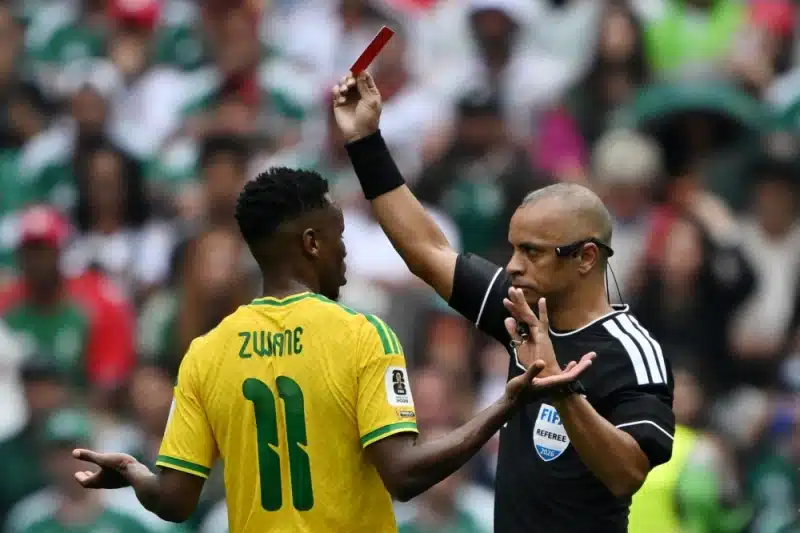
South Africa finished with nine men. Sphephelo Sithole received a straight red card in the 49th minute for a last-man challenge on Brian Gutiérrez. Substitute Themba Zwane was then dismissed in the 83rd minute for violent conduct following a VAR review.
Mexico’s captain César Montes also saw red in stoppage time for a professional foul, making it the first World Cup fixture to feature three straight red cards since 1998. Ironically, South Africa were involved in that 1998 incident too.
South African captain Williams was composed in defeat. Speaking to FIFA after the final whistle, he said: “If you make mistakes, they will punish you at this level. We went down, but we kept fighting. We’ll be better.”
For many viewers across the continent, the result appeared to validate the growing African support for Mexico that had dominated online conversations before the opening whistle.
What led to African support for Mexico
Bafana Bafana last appeared at the World Cup in 2010, when South Africa hosted the tournament as a continental celebration. Sixteen years later, the team returned to a global stage where many Africans wanted it to lose.
The reasons are documented and serious.
In April and May 2026, Human Rights Watch reported that vigilante groups in South Africa carried out violent xenophobic attacks targeting African and Asian foreign nationals, with little apparent response from police and other authorities.
The anti-foreigner group March and March organised marches in Tshwane and Johannesburg. It operates alongside Operation Dudula, a movement whose members have openly declared themselves xenophobic, calling for all foreigners, documented or not, to leave the country as a matter of urgency.
Six African governments responded. Reuters confirmed in May 2026 that Kenya, Malawi, Lesotho, Zimbabwe, Nigeria and Ghana all issued official warnings to their citizens living in South Africa. Ghana went furthest.
Foreign Affairs Minister Samuel Okudzeto Ablakwa stated publicly that his government would not rule out formal legal action in international courts, a statement made just five days before the World Cup opener. Ghana also began repatriating its citizens, with at least 1,000 nationals brought home following the violence. Nigeria’s Minister for Diaspora Affairs said retaliatory measures against South Africa were being considered.
Veteran Ghanaian journalist Kwesi Pratt Jnr, broadcasting on Ghana’s Metro TV in May 2026, provided the historical framing many fans had already reached independently: that South Africa’s xenophobia is a continuation of the apartheid system of governance.
That argument resonated widely. South Africa received solidarity from across the continent during its liberation struggle. Critics argue it has not returned that solidarity.
As those debates intensified, African support for Mexico increasingly became a vehicle for expressing frustration over South Africa’s treatment of fellow Africans.
Poetic justice, not football logic
The scale of African support for Mexico was visible the moment the red cards started flying. When Sithole and Zwane were sent off and a nine-man South Africa suffered a historic defeat, African social media did not see a football team struggling, it saw deserved punishment broadcast to the entire world.
Across social media platforms, hashtags linked to African support for Mexico continued trending throughout the match and long after the final whistle.
One widely shared post from Ghanaian influencer Eric Boateng captured the mood directly: “Mexico vs South Africa, if we support South Africa, they’ll say we are taking their jobs.” Another post, from a user identified as Kaleb Jireh, put it plainly: “You cannot kick us out of your country and expect us to cheer you on.”
Across the continent, fans wore Mexican colours, waved Mexican flags and celebrated with the energy usually reserved for their own national sides, a pan-African remix of borrowed identity and pointed protest.
Not everyone agreed with the sentiment. Vincent Okumagba, Chairman of the Unified Supporters Club of Nigeria, speaking to The Guardian Nigeria, argued firmly against withdrawing continental support from Bafana Bafana. X user Osagie Alonge also questioned the logic: “It’s quite revealing that Africans are opting to support a country on a completely different continent rather than an African one.
Those voices were largely outnumbered online. African support for Mexico was, as Kenyan digital outlet PlugTV Africa observed, the sound of a crack in pan-African solidarity, loud, public, and impossible to ignore.
Group A standings
Mexico top Group A with three points after one game. South Africa sit bottom with a goal difference of minus two. César Montes will serve a suspension for Mexico’s next fixture against South Korea, following his late red card.
Regardless of how the tournament unfolds, African support for Mexico has already emerged as one of the most unexpected political and cultural storylines of the 2026 World Cup.
The unintended headline – African support for Mexico has now moved from a social media trend to a documented continental statement. The question it leaves for South Africa goes well beyond the Group A table. It is about how the country is seen by the very people it once called brothers.


