



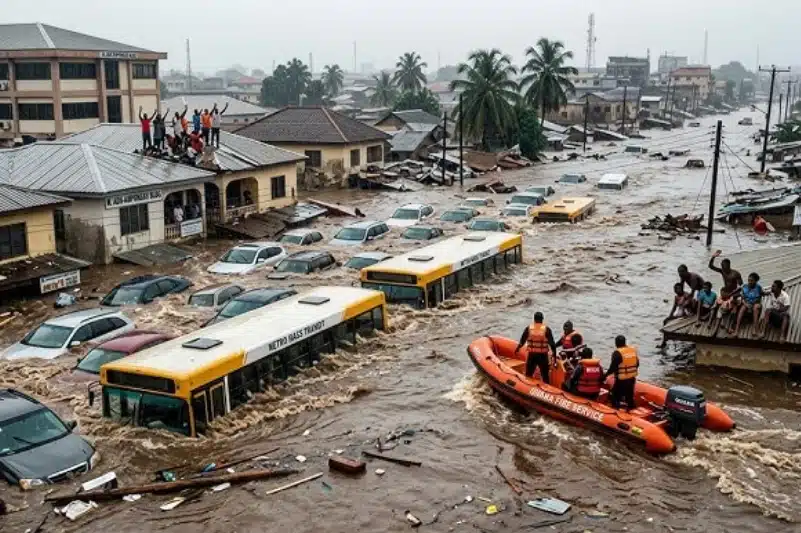

Heavy rain that began late on Sunday night turned Ghana’s capital into a city of waterways by Monday morning, with the Accra floods leaving roads submerged, homes inundated, and thousands of residents trapped or stranded across the Greater Accra Region.
Rain started falling around 10:00 p.m. on Sunday, 28 June, and was still coming down hard when Monday morning arrived. By the time commuters were on the road, much of the city was already underwater.
Residents in Tse Addo were among the hardest hit. Emergency teams deployed boats to evacuate 15 children and an infant after floodwaters sealed off the low-lying neighbourhood and trapped families inside their homes, YEN.com.gh reported.
Footage circulating online showed people swimming through neck-high water to pull neighbours from rooms that had been submerged almost to window level, according to the Ghana News Agency.
The National Disaster Management Organisation issued a flood alert at 7:30 a.m., confirming that flooding had been recorded across Accra, Tema and Kasoa, and urging residents to move to higher ground and keep children away from waterways and drains, Pulse Ghana reported. They warned that the Accra floods could worsen if heavy rainfall continued through the day.
Accra floods turned roads to rivers
The Accra floods choked the city’s main arteries during what would otherwise have been the morning rush hour. Sections of the N1 Highway, the Weija-Kasoa road, the Accra-Kasoa stretch, Achimota, Spintex, Kaneshie, Darkuman Junction, and the Kwame Nkrumah Interchange were all reported underwater, according to GhanaWeb.
Ghana News Agency monitoring confirmed that the Weija-Kasoa Road was completely blocked, while the area around Fiesta Royale Hotel was flooded and the Atomic Roundabout in Madina was impassable. The Legon-GIMPA By-Pass Road was also cut off near the new Law School building, with only one lane remaining accessible on parts of the route between the Ghana Standards Authority and Shiashie.
The flooding was not confined to Accra. Citinewsroom.com reported that sections of the Winneba-Cape Coast road were cut off, stranding commuters for hours, while similar disruptions hit the Accra-Kumasi highway. In neighbouring Togo, communities including Kodjoviakopé and Adétikopé were also affected.
Power shut down for safety
The Ghana Grid Company Limited and the Electricity Company of Ghana took the decision to shut down the Mallam and Achimota primary substations after floodwaters reached critical electricity infrastructure, The Ghanaian Chronicle reported.
In a joint statement, the two utilities said the precautionary shutdown was necessary because flooding had created serious risks to both equipment and operational staff, and warned that further outages could follow in other areas if conditions worsened.
Residents in Ofaakor, Ablekuma Omanjor, and Labadi Wireless were among those reporting power cuts, according to GhanaWeb. The widespread power cuts highlighted the growing impact of the Accra floods on critical infrastructure.
Separately, a fire broke out at the Odawna and Okaishie Rubber Market area at around 8:15 a.m., even as floodwaters continued to rise nearby, GhanaWeb reported. The cause remained unclear, and it was not immediately confirmed whether the Ghana National Fire Service had brought the blaze under control.
Military deployed across the city
The Ghana Armed Forces activated an emergency operation, codenamed Operation Boafo, deploying the 48 Engineer Regiment to flood-hit communities across the capital, according to MyJoyOnline.
Lieutenant Colonel Frank Osei Amponsah, the regiment’s commanding officer, said troops had been stationed at Klagon, Tse Addo, Dzowulu and surrounding communities and had already pulled several people from their homes. He said no fatalities had been recorded at the time of his report.
The emergency responders said that the Accra floods had stretched rescue resources across multiple districts. Yet residents in distress are directed to contact the operation on 0244 312 667.
The Ministry of the Interior ordered all citizens to remain where they were until conditions improved, warning that unnecessary movement posed deadly risks. The Ghanaian Chronicle reported that the Ghana Police Service, the Ghana National Fire Service and NADMO were also deployed across affected areas to manage traffic and support rescue efforts.
A crisis that keeps returning
For many Ghanaians, the Accra floods carry a weight beyond the immediate damage.
The United Nations Development Programme noted this month that Accra’s repeated flooding is no longer unexpected. “We are reliving the same story every rainy season,” one resident told the UNDP. “When it rains like this, we know trouble is coming.”
The UNDP pointed to decades of poor land use planning, blocked drains, and building on wetlands as the structural causes behind the recurring crisis. The President of the Ghana Institution of Engineers told the UNDP that the country has “done things the wrong way for over 30 to 40 years.
Markets such as Makola and Kaneshie, both of which were caught up in Monday’s Accra floods, suffer repeated losses that the UNDP described as financial shocks capable of erasing years of progress for low-income households.
Business leader Daniel McKorley was quoted by the UNDP as saying: “My heart weeps… we deserve better as a people.”
Ghana’s Ghana Meteorological Agency had warned before Monday’s downpour of thunderstorms and heavy rainfall across southern Ghana, with a storm system from the Togo-Benin coast expected to intensify conditions, YEN.com.gh reported.
The agency subsequently warned that rain would persist and spread to south-western Ghana, leaving little immediate relief in sight.


