



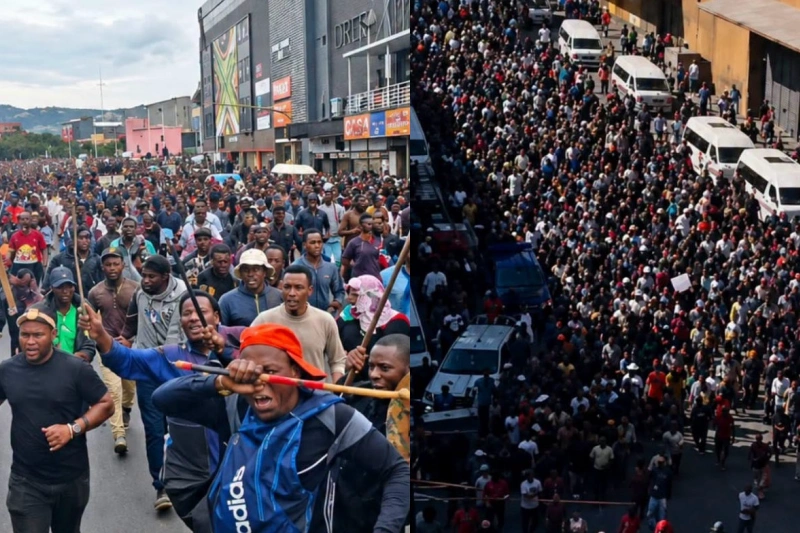

Tension gripped South African cities on Tuesday as anti-immigrant protests in South Africa reached their peak, marking the expiry of a disputed deadline set by citizen-led groups for undocumented foreign nationals to leave the country.
The deadline, popularly known as June 30, was never recognised by the South African government. Anti-immigrant groups, including the March and March movement founded by former Vuma FM presenter Jacinta Ngobese-Zuma, had warned undocumented migrants to leave or face arrest and deportation, a claim Al Jazeera reported the government rejected as false.
Officials have repeatedly stressed that anti-immigrant protests in South Africa do not have government backing despite widespread claims circulating online.
In Thembalethu, outside George in the Western Cape, Daily Maverick reported that police fired rubber bullets to disperse crowds attempting to confront foreign nationals in the township, one of several flashpoints security planners had flagged ahead of the deadline. The outlet’s running tally of the unrest also put the number of anti-foreigner protesters arrested over the past four months at 195.
Security analysts have pointed to social media and local community networks as the means used for the rapid spread of the anti-immigrant protests in South Africa.
Fear has driven thousands from their homes nationwide. France 24 reported that thousands of foreign nationals have been camping outside consulates and shelters for protection, with some saying they were evicted by landlords or fired by employers citing fears of fines or attacks.
The scale of the exodus is striking. IOL reported that more than 25,000 foreigners had already been bussed out of the country by Tuesday morning, while thousands more had fled their homes for repatriation centres, consulates and makeshift camps. In Cape Town alone, more than 2,000 Zimbabwean nationals were sheltering at the Cape Town Refugee Reception Centre, a facility built to hold roughly 300 people, IOL added.
President Cyril Ramaphosa addressed the nation on Monday, insisting, as Al Jazeera quoted him, that the right to protest does not allow people to threaten or intimidate others or to engage in vandalism or violence. He described vigilante action as unlawful, regardless of motivation.
The president’s remarks came as anti-immigrant protests in South Africa continued to draw national and international attention.
Policing of anti-immigrant protests in South Africa has been heavy and costly. IOL reported that the state deployed thousands of police officers and soldiers nationwide at a cost exceeding R600 million, determined to prevent a repeat of the deadly 2008 xenophobic violence that killed 62 people. By early Tuesday, the same outlet said police across the country had recorded no other major incidents linked to the planned demonstrations.
In Soweto, IOL reported that more than 10,000 people turned out for a final march on Monday before the deadline took effect, with some residents carrying traditional weapons such as shields and sticks as they marched from the Jabulani Amphitheatre to the Protea police station. Deputy provincial police commissioner Major General Fred Kekana told the outlet the march remained peaceful and under control.
Organisers have insisted that anti-immigrant protests in South Africa were intended to highlight concerns over illegal immigration rather than encourage violence.
Germiston also saw mobilisation overnight, with IOL reporting that a vigil march began in the area on Monday night, echoed by similar vigils held in other parts of the country.
The human cost of the unrest predates Tuesday’s deadline. France 24 reported that three people, including a Malawian man and two Mozambican nationals, were killed during earlier anti-immigration protests in KwaZulu-Natal and the Western Cape, prompting acting Police Minister Firoz Cachalia to say police would not tolerate violence or lawlessness as the new round of demonstrations unfolded.
Government enforcement has intensified alongside the protests. France 24 reported that deportations rose 46 percent over the past two financial years, climbing from just under 58,000 in 2024-2025 to 109,344 by March 2026, while more than 8,000 foreign nationals were processed for repatriation at the Beitbridge border post in under two weeks.
Human rights organisations argue that anti-immigrant protests in South Africa risk deepening divisions in communities already facing economic hardship.
Faith leaders in towns such as George have tried to calm tensions in the weeks leading up to the deadline. GroundUp reported that Pastor Boyce Saleni of the Thembalethu Baptist Church led an open letter from local clergy urging residents to reject violence, warning that unemployment and economic frustration were being misdirected at foreign nationals.
With November elections approaching, the political stakes around anti-immigrant protests in South Africa continue to rise. Al Jazeera reported that some politicians have increasingly leaned on anti-immigrant rhetoric even as other parties call for calm. Analysts warn that how the government manages the coming days could shape both its domestic standing and its broader image across the continent.


