The rebuke came from Burkina Faso’s Foreign Minister Karamoko Jean-Marie Traoré, who has repeatedly cast Sahel security crisis management as a matter for regional partners rather than outside pressure. He summoned Nigeria’s chargé d’affaires in Ouagadougou on the evening of 6 August 2026.
Diplomatic representatives of Mali and Niger attended alongside him. Their presence underlined that the response reflected the collective position of the Alliance of Sahel States, not Burkina Faso alone.
Traoré told the Nigerian envoy that the three countries would have preferred a more accurate account of the Sahel security crisis. He said Tinubu’s remarks amounted to an attempt to pin a complex regional problem on neighbouring states.
Such framing, he warned, risked stirring up misunderstandings and resentment between peoples bound together by history, geography and kinship. The minister added that the comments showed contempt for the sacrifices made by Nigerien forces during years of fighting against Boko Haram.
Speaking for the AES bloc, Traoré said Burkina Faso, Mali, Niger and Nigeria all face the same enemy. He expressed profound regret over statements he described as incompatible with the spirit of solidarity that should bind states confronting a shared threat. Nigeria’s chargé d’affaires reportedly acknowledged the AES countries’ contribution to counterterrorism efforts. He promised to relay the concerns to authorities in Abuja.
The friction traces back to remarks Tinubu made on 30 July 2026. He was receiving traditional rulers from Oyo State at the Presidential Villa, led by the Olubadan of Ibadan, Oba Rashidi Ladoja. Tinubu was discussing the abduction of schoolchildren and teachers from Oriire in Oyo State, an ordeal that stretched to 56 days before their rescue.
He told the visiting monarchs that some of the gunmen involved were not Nigerian. He then said the Sahel security crisis in Mali, Burkina Faso and Niger was adding more fuel to Nigeria’s own challenges. He cited the episode to justify expanding forest guard operations, creating state police and growing the Nigerian Army from eight to twelve divisions.
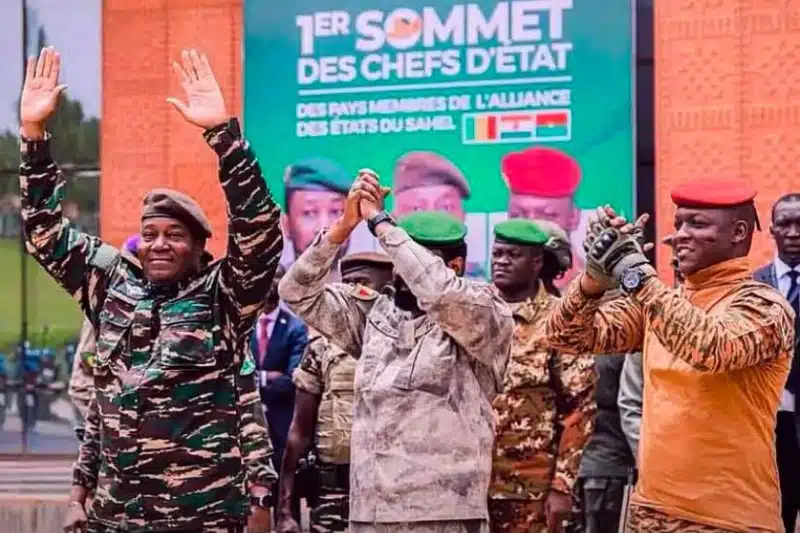
The AES was built for moments like this. It is a confederation formed by the military governments of Mali, Burkina Faso and Niger after a run of coups between 2020 and 2023. It has positioned itself as the bloc best placed to manage the Sahel security crisis on its own terms. All three withdrew from the Economic Community of West African States in January 2025.
The bloc has since built its own defence structures, including a joint Unified Force unveiled in Bamako in December 2025. Relations with Abuja have stayed delicate since Nigeria, under Tinubu’s ECOWAS chairmanship, backed sanctions and floated military intervention after the Niger coup of 2023.
The dispute also exposes a gap within Nigeria’s own government over how to handle the Sahel security crisis. Days before Traoré’s rebuke, Nigeria’s Minister of Defence, General Christopher Musa, was in Cotonou. He pressed for a unified security alliance between ECOWAS and the AES to jointly fight terrorism and cross-border crime.
Musa argued that insecurity does not respect national boundaries. He called for closer intelligence sharing and coordinated military action between the two blocs, a markedly more conciliatory tone than the one his president struck days earlier.
Analysts tracking the region caution that framing the Sahel security crisis purely as a foreign contagion risks obscuring the domestic drivers of Nigeria’s insecurity. Years of underinvestment in rural policing and economic neglect have let banditry take root in several states.
Farmers have continued to bear the brunt of the violence. At least 24 were killed in Zamfara State in late July, and 13 more died in Benue State days later. Those attacks predate and run parallel to the diplomatic quarrel between Abuja and the AES capitals.
For now, both sides have signalled a preference for dialogue over rupture. Traoré’s statement stopped short of any punitive measure against Nigeria. The AES has repeatedly stressed shared history and shared enemies even as it pushes back on Tinubu’s framing of the Sahel security crisis.
Whether that restraint holds may depend on how Abuja responds once the chargé d’affaires delivers Traoré’s message to the presidency. Much will also hinge on whether Tinubu’s team recalibrates its language on the Sahel security crisis in the weeks ahead.