



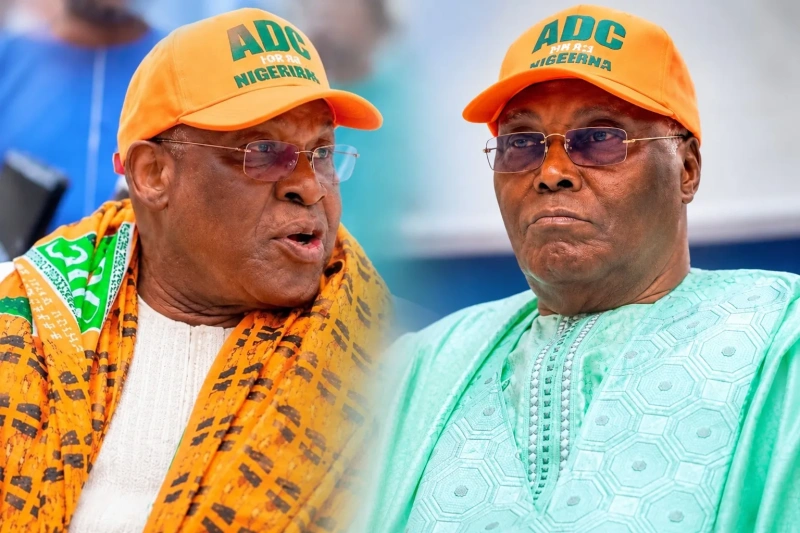

Atiku Abubakar launched his campaign on Wednesday. By Thursday, a judge had voided the primary that gave him his ticket.
The Federal High Court in Abuja ruled that the David Mark-led caretaker committee of the African Democratic Congress (ADC) was illegal. Justice Peter Lifu then cancelled every decision that committee took. The ruling has turned the ADC leadership crisis into a direct threat to Atiku’s 2027 presidential ambition.
The judgment also removed Mark as national chairman and Rauf Aregbesola as national secretary. Every ADC candidate nominated for the 2027 elections was struck out too.
The ADC says it will appeal. So does Atiku. Nothing here is final. But the calendar is not friendly. INEC’s timetable fixes the presidential election for 16 January 2027, which is 72 days after this ruling.
The bigger story is how long the ADC has fought over one question that no court would answer. Who leads the party? The ADC leadership crisis has now moved beyond a contest for party offices.
The Supreme Court did not settle it on 30 April. It set aside a Court of Appeal order to maintain the status quo and sent the case back to the Federal High Court for quick determination. That was a ruling about how the case was handled. It did not say who holds the chair. The ADC leadership crisis therefore remained unresolved.
Then came the presidential primary on Monday 25 May. The ADC announced that Atiku polled 1,846,370 votes. Rotimi Amaechi, the runner-up, got 504,117. Atiku later named him as his running mate. On 12 September, INEC published Atiku’s name among 18 presidential candidates. Everything about Atiku’s presidential ticket looked official by then.
Court rulings kept arriving all the same. On 2 July, Justice Musa Liman dismissed a separate suit by House of Representatives member Leke Abejide, who had challenged how Mark and Aregbesola took office. The ADC says that ruling backed its leadership. Eleven days later, the Court of Appeal ruled two to one that INEC could not recognise state congresses run through committees appointed by the Mark team.
So the party collected wins and losses in the same summer. None of them answered the claim that sat before Justice Lifu. The ADC leadership crisis was producing different outcomes across separate court proceedings.
That claim came from Nafiu Bala Gombe, the party’s former deputy national chairman for the North-East. His suit, FHC/ABJ/CS/1819/2025, argued that Ralph Nwosu’s exit as national chairman made him the rightful successor. He sued the ADC, INEC, Mark, Aregbesola and Nwosu. His challenge became the central legal test of the ADC leadership crisis.
Lifu reserved judgment on 5 October. It came a month later, one day after Atiku’s rally in Sokoto. He granted Gombe’s reliefs. Premium Times reported that he also told INEC not to recognise decisions from the party’s 99th National Executive Committee meeting of 27 July 2025. Thursday’s decision has given the ADC leadership crisis a direct electoral consequence.
The ADC reacted within hours. Its national publicity secretary, Bolaji Abdullahi, said the timing was no accident. “The Sokoto rally was simply a trigger that stampeded its delivery,” he said.
Atiku went further. In a statement from his campaign council, he said “The timing of this judgment is no coincidence.” He promised to challenge the ruling at the Court of Appeal and pointed to the Liman judgment, which he said upheld objections on jurisdiction and standing. The ADC leadership crisis is now heading towards another round of litigation.
Premium Times noted that the ADC offered no evidence for its claim, that the APC had not yet responded, and that INEC had not changed Atiku’s status on its list. It also noted that the two suits had different claimants.
The accusation points at the ruling APC. A week earlier, though, another judge of the same court removed Imo governor Hope Uzodimma as the APC candidate for Imo West senatorial district. The court told INEC to recognise Rochas Okorocha instead. The APC rejected that ruling and insists Uzodimma is still its man.
One ruling on each side proves nothing about motives. It does show that party primaries are now being settled in courtrooms. The ADC leadership crisis is another example of how disputes over party nominations can end up determining who appears on the ballot.
And the courts have until January to finish.
If the higher courts uphold Lifu’s judgment, Premium Times reported, the ADC would be barred from fielding candidates at all. That means every seat on its list, not only the presidency. The party has not said whether it has filed an appeal or asked for a stay of execution. Resolving the ADC leadership crisis is now inseparable from protecting its participation in the 2027 elections.
Atiku won the primary by more than a million votes. He drew a huge crowd in Sokoto. Neither moved the judge.
Atiku’s presidential ticket was won with votes in May. Now it will be saved or lost by judges, and the clock is already running.


