A coordinated offensive that targeted the heart of Bamako fell short of its ultimate objective and the reasons why reveal as much about the government’s resilience as they do about the insurgents’ ambition. The Mali Junta Attack marked one of the most coordinated attempts to destabilise the country’s military leadership in recent years.
AfricanQuarters | 29 April 2026
The Appearance That Answered the Silence
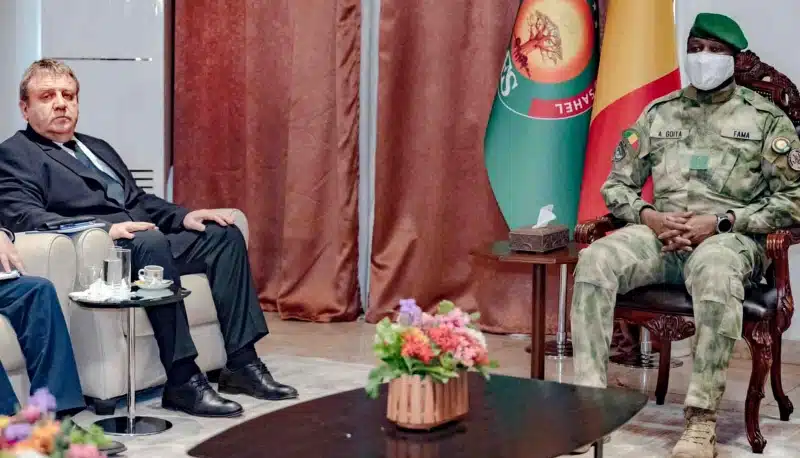
When Assimi Goïta stepped before cameras on Tuesday, 28 April 2026, he did so beside Igor Gromyko, Russia’s ambassador to Mali. After days of tense quiet following the most significant security challenge his administration has faced, the message was clear and deliberate: the government is intact, the leadership is functioning, and its key partnerships are holding.
The Mali Junta attack, which began on Saturday, 25 April, had been designed to prevent exactly that kind of appearance from ever happening again.
It failed, despite its scale and coordination, the Mali Junta Attack did not achieve regime change.
What the Insurgents Attempted
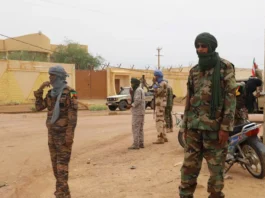
The offensive that security analysts are describing as the “Black Weekend” was unprecedented in its coordination. For the first time on record, two armed groups that have historically operated independently moved in concert.
The Al-Qaeda-affiliated Jama’at Nusrat al-Islam wal-Muslimin, known as JNIM, and the Tuareg-led Azawad Liberation Front struck simultaneously at the infrastructure of military authority. At its core, the Mali Junta Attack was designed to collapse central authority in a single, decisive push.
Insurgents targeted the Modibo Keïta International Airport and the Kati military base on the outskirts of Bamako. These were not peripheral or symbolic targets. They represented a deliberate attempt to decapitate the state’s security architecture and, in doing so, trigger the collapse of a government that has ruled Mali since 2021.
In the north, Russian-backed Malian forces were reportedly pushed out of Kidal, a city they had reclaimed from separatist groups as recently as 2023.
The scale of ambition was significant. The outcome was not what the attackers planned.
The Government Held and Here Is Why
The most important fact about the Mali junta attack is the one that has received the least analytical attention: the government was not overthrown. This is the defining outcome of the Mali Junta Attack.
That outcome did not happen by accident. Several factors combined to deny the insurgents the decisive result they sought.
Central command zones and key positions at the Kati military base were not fully overrun despite the intensity of the assault. Security forces responded rapidly enough to prevent any sustained occupation of Bamako. Africa Corps structures, the operational arm of Russia’s military presence in the Sahel, are understood to have helped reinforce critical positions and stabilise the government’s response during the most dangerous hours.
Most critically of all, the military did not fracture from within. In conflicts of this nature, internal defections are often the mechanism by which governments actually fall. Officers and soldiers who might, under different circumstances, have wavered held their positions. The command structure remained intact from the opening assault through to Goïta’s Tuesday address.
That cohesion, under fire, is not a minor achievement. It is the central reason Bamako did not fall.
The Death That Complicates the Picture
The killing of Defence Minister Sadio Camara in a car bomb attack on his residence in Kati is the event that most complicates any straightforward assessment. Camara was not simply a cabinet member. He was the principal architect of Mali’s security partnership with Russia and the government’s most trusted link to Moscow.
His loss is a serious blow. It narrows the personal conduit between Bamako and the Kremlin at a moment when that relationship is more operationally important than ever. The institutional structures Camara helped build will now need to function without the man who built them.
Why Goïta Chose Gromyko First
Against that backdrop, the decision to make his first public appearance alongside Russia’s ambassador was carefully considered. Russia had already characterised the weekend’s events as a thwarted coup attempt, with state-aligned sources suggesting that Russian forces played a direct defensive role at the presidential palace.
By standing with Gromyko on Tuesday, Goïta was signalling simultaneously to several audiences: to his own military, that external backing remains firm; to armed factions, that the pipeline for Russian hardware and air support has not been interrupted by Camara’s death; and to Moscow, that the partnership retains full government commitment.
With the Islamic State in the Greater Sahara reportedly entering the town of Ménaka, and JNIM’s spokesperson Bina Diarra having claimed publicly that Bamako is “closed off from all sides,” the strategic communication of that image mattered as much as any military manoeuvre.
What the Government’s Address Said and What the Ground Reflects
In a televised address on Tuesday evening, Goïta declared the situation “under control.” The military is currently pursuing a counter-offensive to retake Kidal while simultaneously defending the capital’s outskirts, a demanding two-front posture that reflects the scale of the challenge the government has contained rather than wished away.
The official casualty figures have not been comprehensively disclosed. The intensity of urban fighting and the destruction of civilian infrastructure suggest the humanitarian toll is considerable, though independent verification from within the affected zones remains difficult.
A Sober Accounting of Weaknesses
Recognising what the Mali military government held is not the same as pretending the weekend revealed no vulnerabilities. It revealed several. The Mali Junta Attack exposed these gaps not in theory, but in real time under coordinated pressure.
A coordinated offensive of this complexity, planned across multiple regions and executed simultaneously, went undetected. That points to gaps in the intelligence apparatus that will need urgent attention. The car bomb that killed Camara at his own residence indicates a degree of penetration into elite security layers that demands a thorough internal review. Northern and peripheral territories remain contested, and the recapture of Kidal is not yet assured.
These are real weaknesses. They sit alongside real institutional strengths and both need to be understood clearly.
The Insurgents’ Failure and Its Consequences
The failure to achieve regime change carries strategic consequences for the armed factions themselves. Having committed to an offensive of this scale and visibility without achieving the ultimate objective, JNIM and the Azawad Liberation Front now face a government that has demonstrated it can absorb a major blow. The psychological amplification that insurgent strategy depends upon is harder to sustain when the target is still standing.
Going forward, analysts expect a shift toward targeted assassinations, sustained urban disruption, and psychological pressure rather than another large-scale frontal assault in the near term.
For Russia, the stakes have deepened rather than changed direction. Moscow’s role in Mali is now more central than it was before the attack, not less, and the relationship that Camara built will need to be maintained through institutional channels rather than personal authority.
The Precise Reading
The Mali junta attack was not a government success in any clean or comfortable sense. Serious vulnerabilities were exposed. A key figure was lost. Territory in the north remains under pressure.
But framing it as an insurgent success would be an equal distortion of the facts. The government survived a complex, multi-front offensive that was explicitly designed to end it. The military held together when holding together was precisely what the attackers needed it not to do. The leadership is functioning. The capital is in government hands.
A more honest assessment sits between the dramatic headlines: a large-scale coordinated offensive that exposed genuine weaknesses in Mali’s security architecture, but that failed at the single objective that would have made it a historic turning point. The Mali Junta attack ultimately failed to deliver that turning point.
Goïta is still governing. That, for now, is the story.
AfricanQuarters is tracking developments in Mali. This report will be updated as further verified information becomes available.